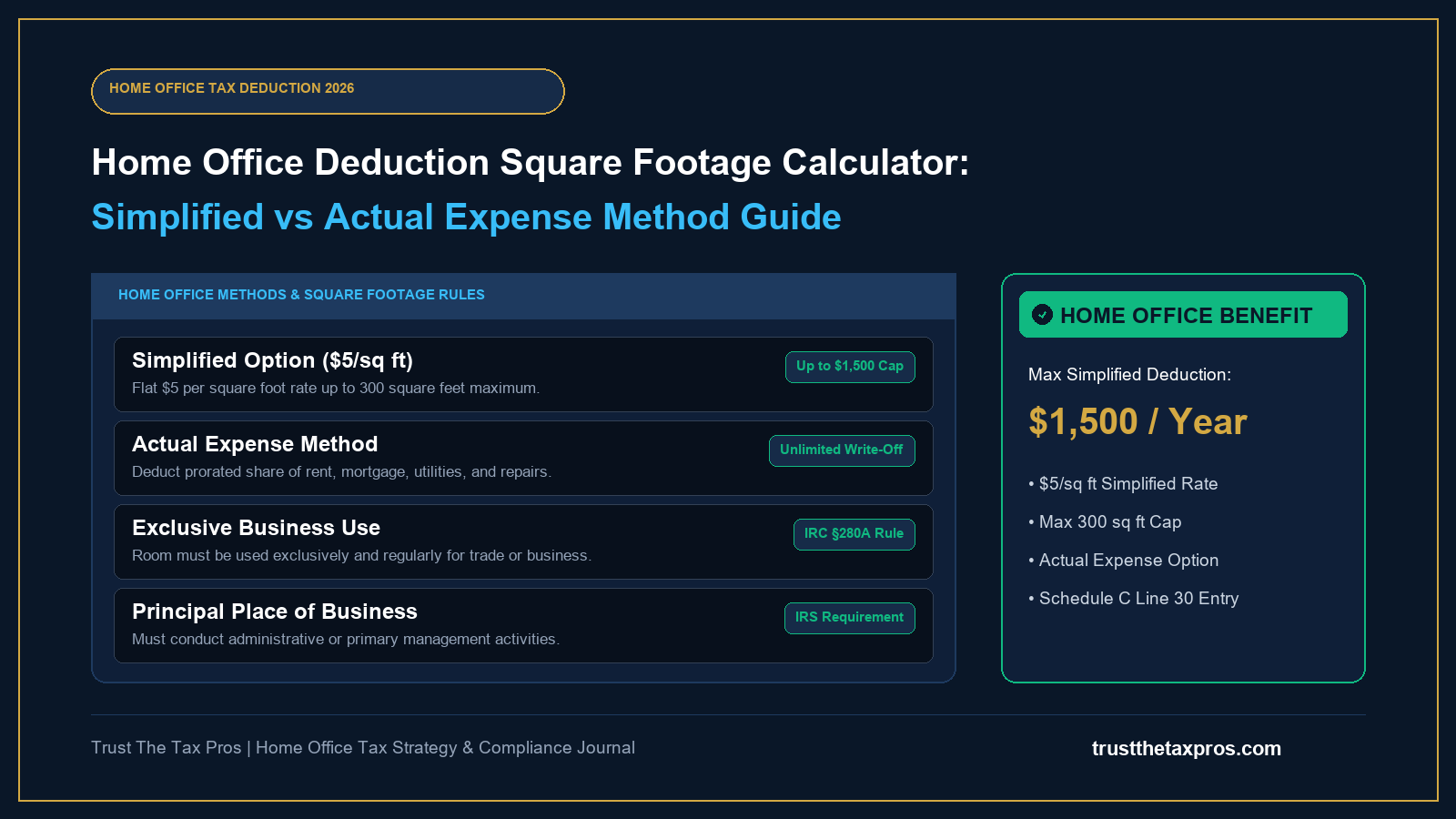
Working from home offers flexibility and reduces commuting costs, but it also creates one of the most valuable small business tax write-offs: the home office deduction. Whether you are an independent freelancer, sole proprietor, or single-member LLC owner, calculating your eligible workspace expenses can significantly reduce your net taxable business income.
To claim this tax write-off, you can choose between two IRS methods: the Simplified Square Footage Method ($5 per square foot up to 300 sq ft) or the Actual Expense Method via IRS Form 8829. This guide explains how to calculate your home office deduction square footage, meet strict IRS exclusive-use requirements, and select the optimal calculation strategy for your tax return.
1. Simplified Method vs Actual Expense Method (Form 8829)
The IRS provides two distinct calculation approaches for qualifying home workspaces:
- The Simplified Method: Multiply the square footage of your dedicated office workspace (up to a maximum of 300 square feet) by the standard IRS rate of $5 per square foot, resulting in a maximum annual deduction of $1,500. This method requires zero utility receipt tracking and does not trigger depreciation recapture taxes when you sell your home.
- The Actual Expense Method (Form 8829): Calculate the percentage of your home used for business (Office Square Footage ÷ Total Home Square Footage). That percentage is then applied to all actual housing expenses, including rent, mortgage interest, property taxes, home insurance, electric/gas utilities, internet, repairs, and annual home depreciation.
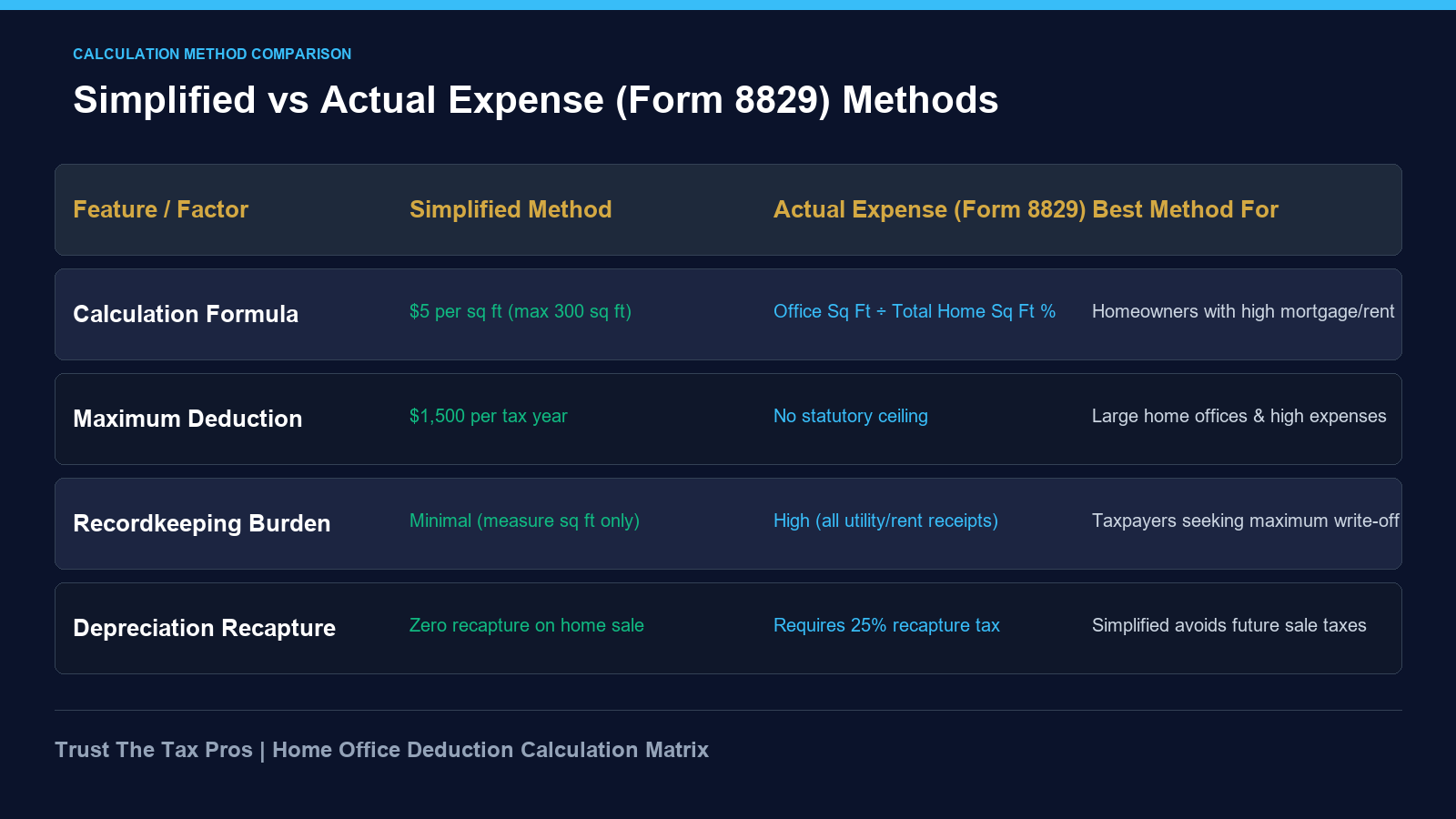
| Calculation Feature | Simplified Method | Actual Expense Method (Form 8829) | Best Taxpayer Fit |
|---|---|---|---|
| Formula | $5 x Sq Footage (Max 300 sq ft) | Office Sq Ft ÷ Total Sq Ft % | Renters with high monthly lease costs |
| Deduction Cap | $1,500 Maximum | No Statutory Ceiling | Large dedicated workspaces |
| Recordkeeping | None (Area measurement only) | High (Keep all utility & repair bills) | Organized bookkeeping workflows |
| Future Home Sale Tax | No Depreciation Recapture | 25% Depreciation Recapture Tax | Homeowners planning to sell soon |
2. The 2 Mandatory IRS Eligibility Requirements
To qualify for either calculation method, your home office space must meet two strict statutory tests under Internal Revenue Code Section 280A:
- Exclusive and Regular Use: You must use a specific area of your home exclusively and regularly for trade or business purposes. A corner of a dining room table or guest bedroom used for personal relaxation does not qualify.
- Principal Place of Business: Your home workspace must be your principal place of business, or a place where you regularly meet patients, clients, or customers in the normal course of business.
For independent contractor write-off strategies, explore our 1099 tax calculator guide.
3. Step-by-Step Square Footage Calculation Workflow
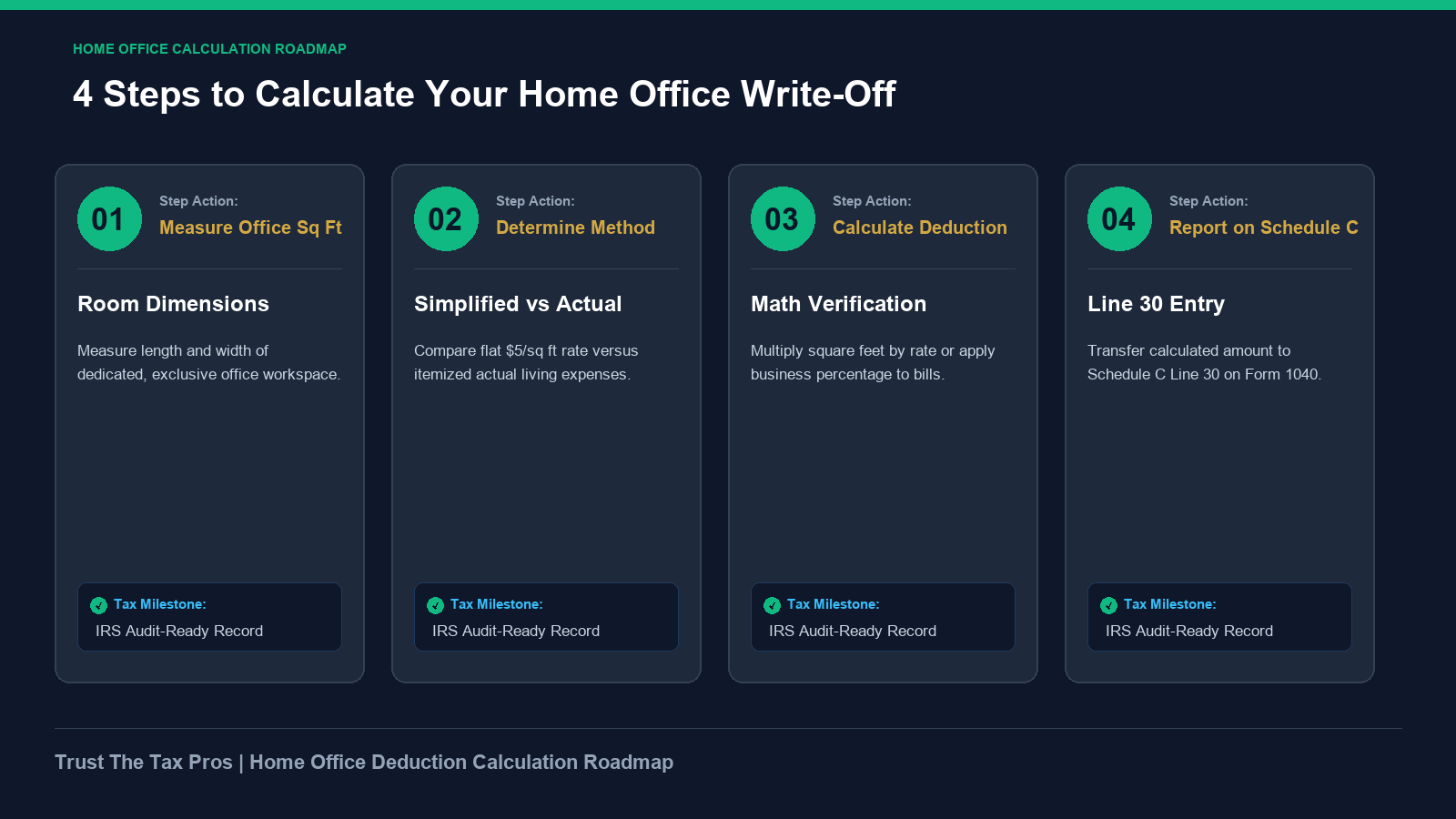
Calculating your deduction is straightforward once you have measured your dedicated workspace.
Square Footage Calculation Example
Suppose you rent a 2,000-square-foot apartment and use a dedicated 200-square-foot room exclusively as your consulting office:
- Square Footage Ratio: 200 sq ft ÷ 2,000 sq ft = 10% Business Use.
- Simplified Method Calculation: 200 sq ft × $5 = $1,000 Deduction.
- Actual Expense Method Calculation: If total annual apartment rent, utilities, and internet equal $30,000, your actual deduction is 10% × $30,000 = $3,000 Deduction.
- Result: In this scenario, the Actual Expense Method generates $2,000 more in tax deductions.
Review comprehensive audit defense tips in our IRS audit avoidance guide.
Access official tax publications directly on the Internal Revenue Service official portal.
If you operate a business in Northern California, review advice from a Sacramento tax accountant.
Frequently Asked Questions
Can W-2 remote employees claim the home office deduction?
No. Under the Tax Cuts and Jobs Act (TCJA), W-2 employees working remotely from home cannot claim the home office deduction. Only self-employed individuals, freelancers, and small business owners filing Schedule C are eligible.
What is the maximum deduction under the simplified home office method?
The simplified method allows $5 per square foot up to 300 square feet, providing a maximum annual deduction of $1,500.
Does taking the home office deduction trigger an IRS audit?
No. While claiming disproportionately large office space can attract IRS attention, legitimate home office deductions that meet exclusive-use rules and proper square footage ratios are standard business expenses.
Can I switch between the simplified and actual methods each year?
Yes. You can elect to use the simplified method in one tax year and switch to the actual expense method (Form 8829) in the next year based on which provides the highest tax savings.
Maximize Your Home Office Tax Savings
Using a home office deduction square footage calculator lets you compare the simplified $5/sq ft rate with actual home operating costs. Measure your workspace precisely, keep thorough utility records, and report your eligible deduction on Schedule C Line 30.
Consult a certified public accountant (CPA) to structure your home office deductions and ensure full compliance with federal tax guidelines.