Small business owners, sole proprietors, independent contractors, and corporate partners face a unique retirement planning challenge: without an employer-sponsored 401(k), building a substantial retirement fund while minimizing current tax liabilities requires proactive structuring. A Simplified Employee Pension (SEP) IRA represents one of the most effective, high-limit tax shelters available.
Governed by Internal Revenue Code Section 408(k), a SEP IRA allows employers and self-employed individuals to make significant tax-deductible contributions into individual retirement accounts. Understanding the statutory SEP IRA contribution limits for small business, the 25% compensation rule, and self-employed net profit calculation formulas allows you to shelter up to $69,000+ annually from federal and state income taxes.
1. Official SEP IRA Contribution Limits for 2026
Under IRS guidelines, SEP IRA contribution limits are adjusted annually for inflation. For the current tax season:
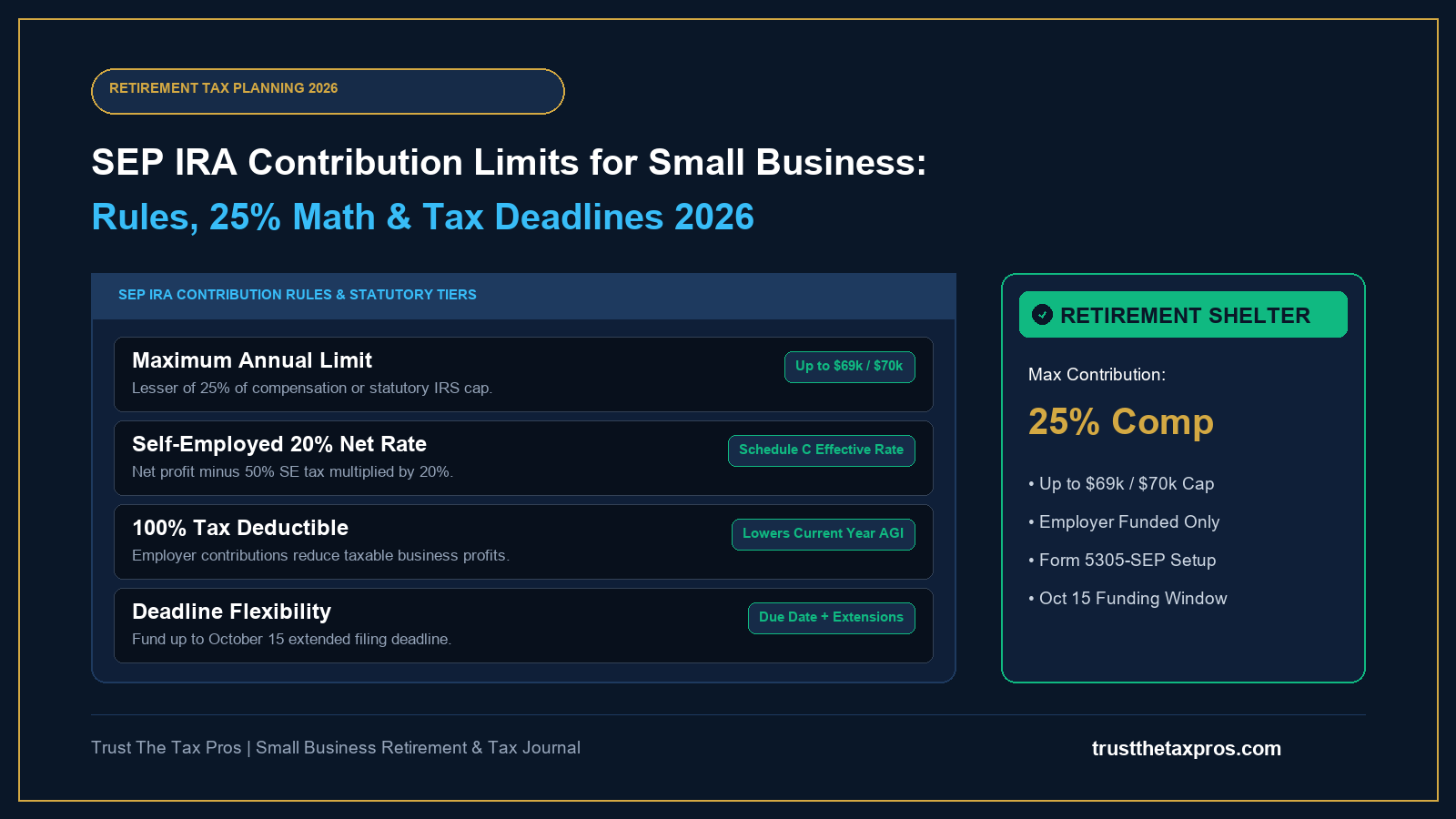
- Maximum Dollar Cap: Contributions cannot exceed the lesser of 25% of the employee’s compensation (or net self-employment earnings) or $69,000 (indexed to $70,000 in subsequent tax years).
- Maximum Compensation Cap: The maximum compensation that can be factored into contribution calculations is $345,000.
- Employer-Only Contributions: Unlike standard traditional or Roth IRAs, standard SEP IRAs are funded exclusively by the employer. Employees do not make salary deferrals.
- Equal Percentage Rule: If your business employs eligible staff (age 21+, worked in 3 of the last 5 years, earned at least $750), you must contribute the exact same percentage of compensation to all qualifying employees as you contribute for yourself.
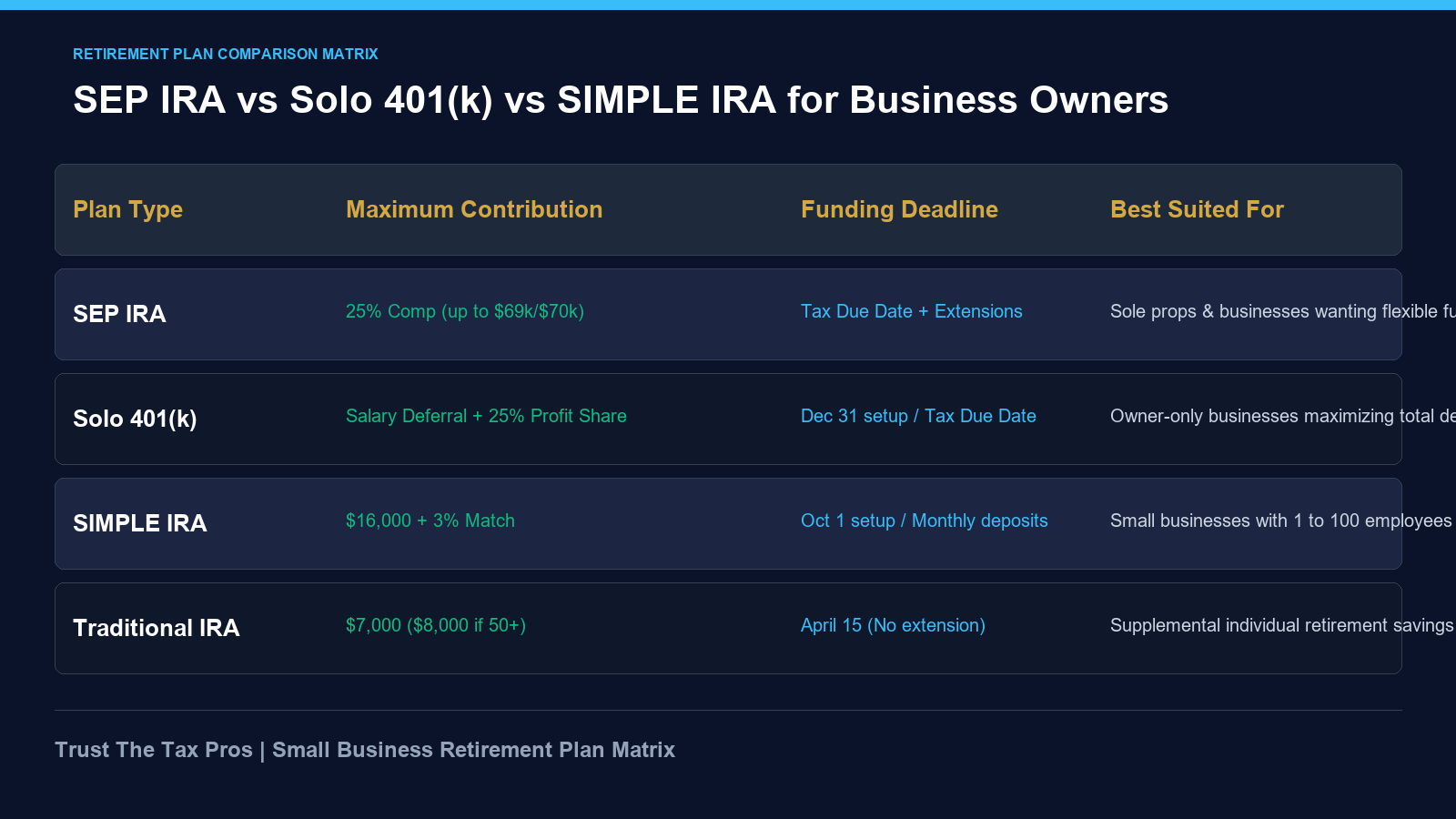
| Retirement Plan Type | Annual Contribution Ceiling | Funding Deadline | Best Taxpayer Fit |
|---|---|---|---|
| SEP IRA | 25% Comp (up to $69,000) | Tax Due Date + Extensions | Sole props & S-Corps wanting flexible funding |
| Solo 401(k) | $23,000 Deferral + 25% Profit Share | Dec 31 setup / Tax Due Date | Owner-only businesses maximizing total deferrals |
| SIMPLE IRA | $16,000 + 3% Employer Match | Oct 1 setup / Monthly deposits | Small businesses with 1 to 100 employees |
2. How Self-Employed Individuals Calculate Net Contributions
A frequent point of confusion for unincorporated sole proprietors and single-member LLCs filing Schedule C is the difference between the statutory 25% limit and the effective self-employed rate.
Because your SEP contribution reduces your net self-employment earnings, the IRS requires a circular adjustment detailed in IRS Publication 560. When contributing the maximum 25% of net adjusted earnings, the effective deduction rate applied to your net Schedule C profit (after deducting 50% of your self-employment tax) is exactly 20.0%.
For self-employed tax calculation formulas, explore our 1099 tax calculator guide.
3. Step-by-Step SEP IRA Calculation and Funding Workflow
Setting up and funding a SEP IRA offers tremendous tax flexibility compared to other retirement plans.
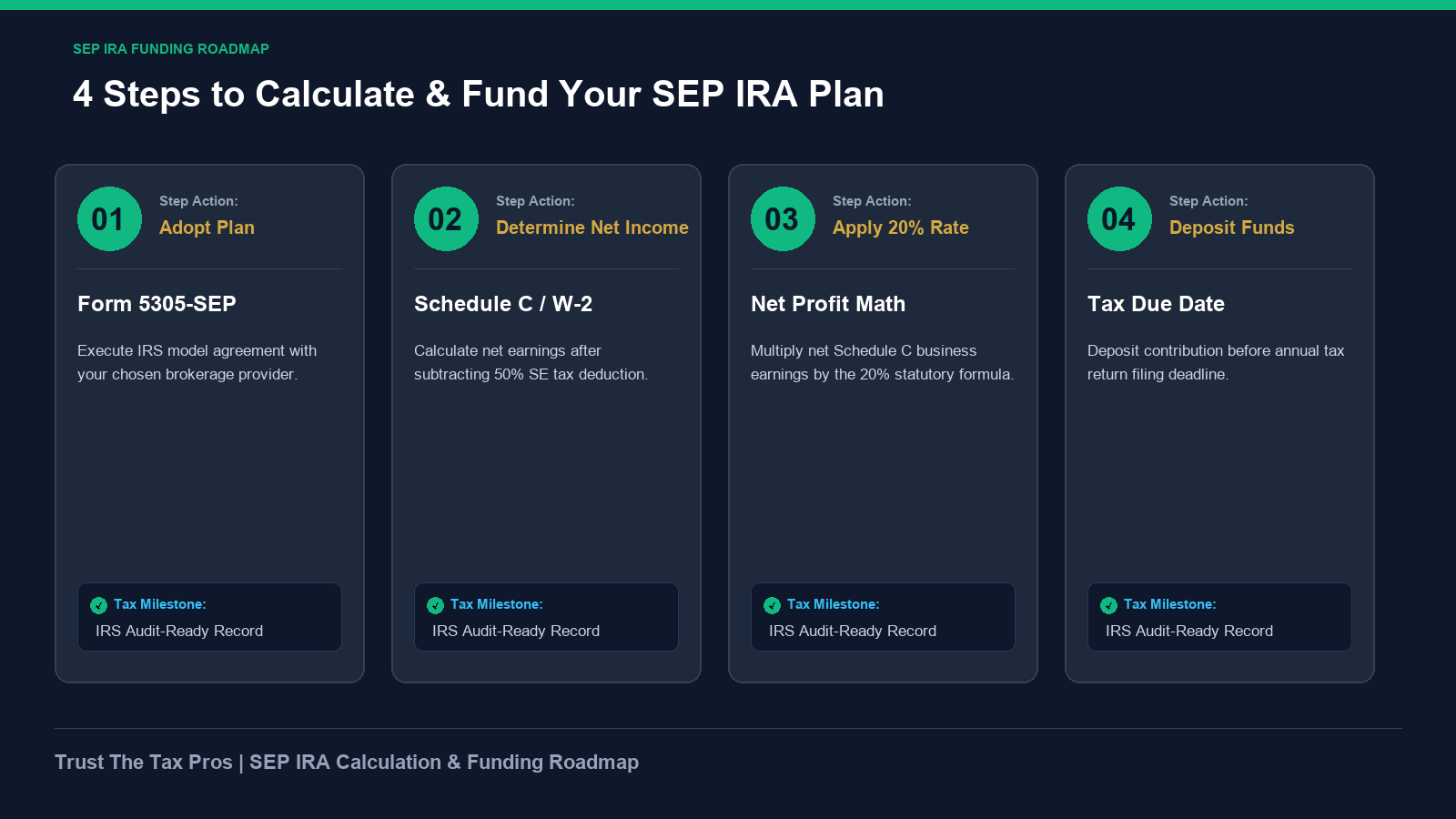
4 Key Execution Steps
- Execute IRS Form 5305-SEP: Complete the simple, one-page IRS model agreement (Form 5305-SEP) with a financial custodian (e.g. Fidelity, Vanguard, Charles Schwab). You do not need to submit this form to the IRS.
- Calculate Net Business Profit: Finalize your annual accounting ledgers and determine your Schedule C net profit or S-Corporation W-2 officer salary.
- Compute Deductible Contribution: Multiply your W-2 wage by up to 25% (or your net Schedule C earnings by 20%), up to the $69,000 ceiling.
- Fund Up to the Extended Tax Deadline: Deposit funds into your SEP IRA by your tax filing deadline (including valid 6-month extensions up to October 15) to claim the deduction for the preceding tax year.
Review LLC quarterly tax rules in our LLC quarterly estimated taxes guide.
Access official retirement guidance directly on the Internal Revenue Service official portal.
If you operate a business in Northern California, review advice from a Sacramento tax accountant.
Frequently Asked Questions
What is the deadline to open and fund a SEP IRA?
You can open and fund a SEP IRA up until your federal income tax filing due date, including automatic 6-month extensions (October 15). This allows you to calculate your exact tax bill before committing contribution dollars.
Can I have a SEP IRA and a Traditional or Roth IRA in the same year?
Yes. You can maximize your SEP IRA employer contributions and still contribute up to $7,000 ($8,000 if age 50+) to an individual Traditional or Roth IRA, subject to standard income phaseout rules.
How do S-Corporation owners calculate SEP IRA contributions?
For S-Corp owners, SEP contributions are calculated as 25% of their W-2 employee compensation (reasonable salary). Profit distributions (dividends) reported on Schedule K-1 cannot be included in the contribution base.
Are SEP IRA contributions mandatory every year?
No. SEP IRAs are completely discretionary. You can contribute the maximum 25% in high-profit years, reduce your percentage in lean years, or contribute $0 without penalty.
Maximize Your Small Business Retirement Shield
Leveraging SEP IRA contribution limits for your small business allows you to build substantial long-term wealth while immediately reducing your federal and state tax burdens. Calculate your net earnings accurately, establish your plan before filing, and fund your accounts prior to the tax deadline.
Consult a licensed CPA or fiduciary financial advisor to optimize your retirement plan mix and align your contributions with long-term wealth goals.