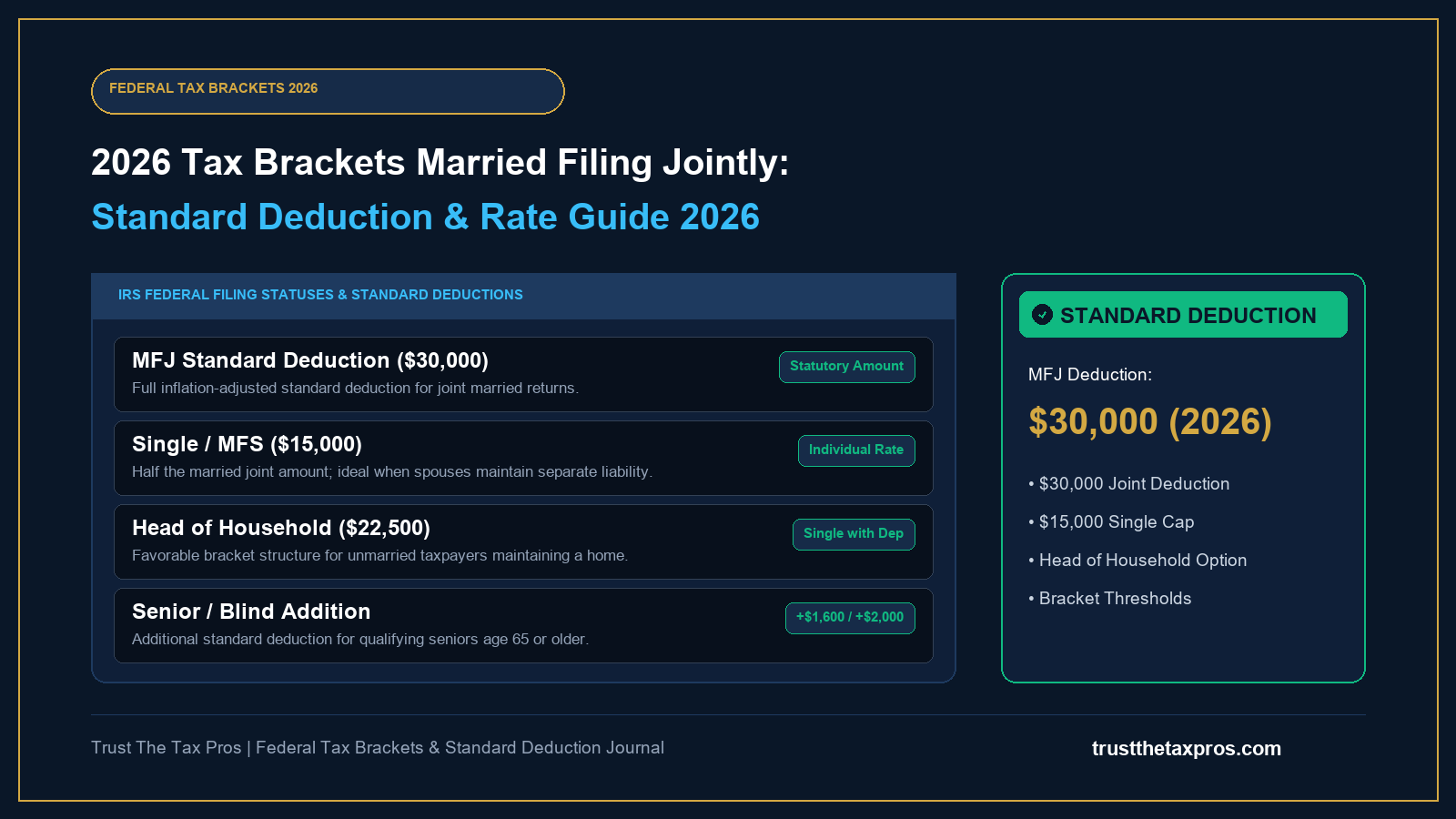
Navigating individual federal tax returns requires up-to-date knowledge of statutory income tax rates, marginal inflation adjustments, and statutory standard deductions. Understanding the 2026 tax brackets for married filing jointly is essential for dual-earner households and married couples planning their annual tax strategies.
For the 2026 tax year, the IRS increased the standard deduction for married couples filing jointly to $32,200 (up from $31,500 in 2025). Furthermore, federal income tax bracket thresholds expanded to prevent bracket creep caused by economic inflation, ensuring taxpayers retain more of their gross earned income.
1. Official 2026 Tax Brackets for Married Filing Jointly
Federal individual income taxes operate on a progressive marginal rate structure ranging from 10% to 37%. This means your income is taxed in incremental tiers rather than at a single flat percentage rate.
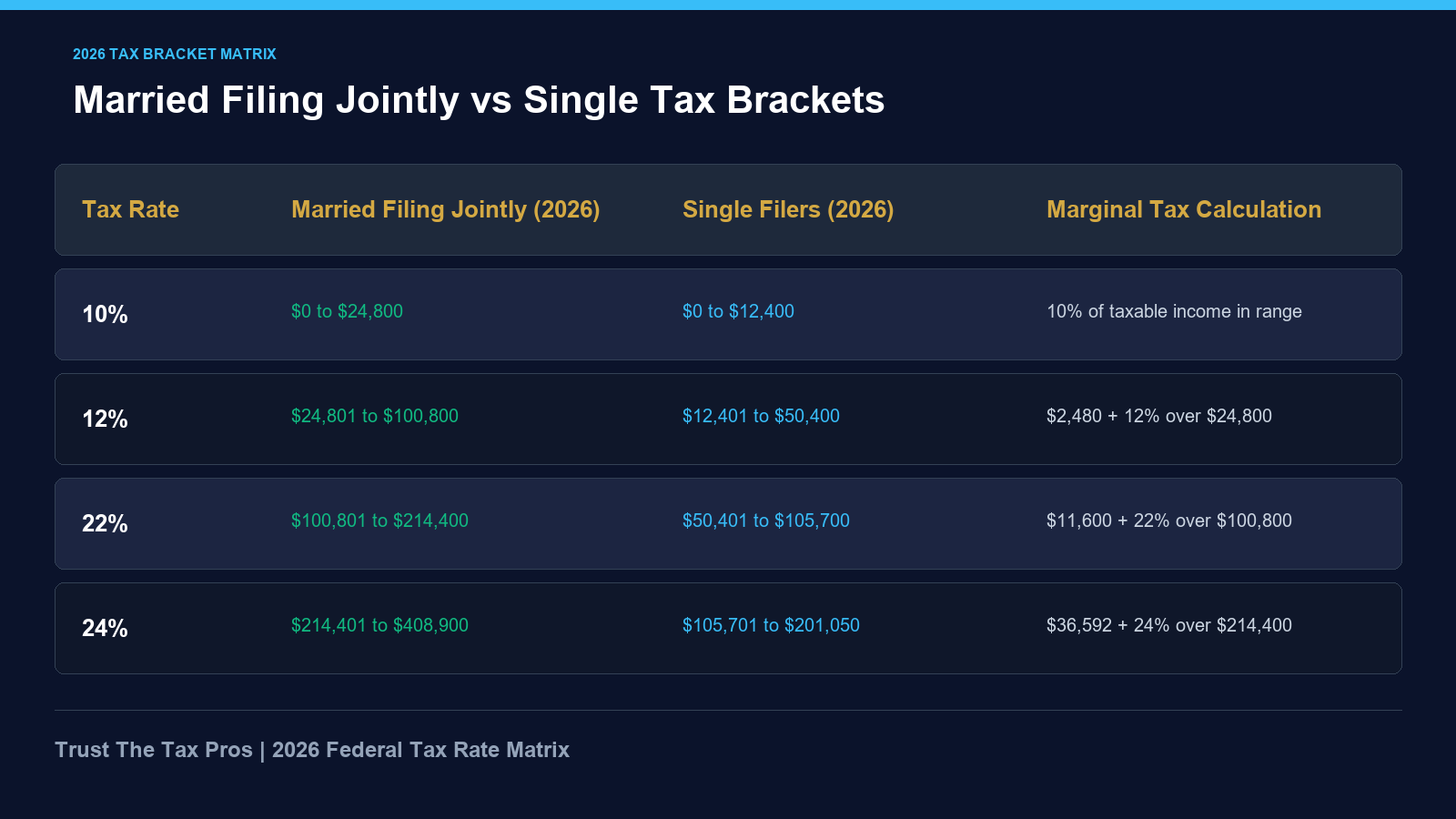
The 2026 statutory tax rates and income thresholds for married couples filing jointly are:
- 10% Tax Bracket: Taxable income from $0 to $24,800.
- 12% Tax Bracket: Taxable income from $24,801 to $100,800.
- 22% Tax Bracket: Taxable income from $100,801 to $214,400.
- 24% Tax Bracket: Taxable income from $214,401 to $408,900.
- 32% Tax Bracket: Taxable income from $408,901 to $519,300.
- 35% Tax Bracket: Taxable income from $519,301 to $778,900.
- 37% Tax Bracket: Taxable income over $778,900.
| Marginal Tax Rate | Married Filing Jointly (2026) | Single Filers (2026) | Standard Deduction (2026) |
|---|---|---|---|
| 10% Bracket | $0 – $24,800 | $0 – $12,400 | $32,200 (MFJ) |
| 12% Bracket | $24,801 – $100,800 | $12,401 – $50,400 | $16,100 (Single) |
| 22% Bracket | $100,801 – $214,400 | $50,401 – $105,700 | $24,150 (Head of Household) |
| 24% Bracket | $214,401 – $408,900 | $105,701 – $201,050 | Index adjustments applied |
2. 2026 Standard Deduction Amounts for Married Joint Filers
The standard deduction reduces your Adjusted Gross Income (AGI) before federal tax rates apply. Taxpayers can choose between claiming the statutory standard deduction or itemizing deductions on Schedule A.
For tax year 2026, standard deduction limits are:
- Married Couples Filing Jointly: $32,200
- Single Taxpayers & Married Filing Separately: $16,100
- Heads of Household: $24,150
- Additional Deduction for Seniors (65+) or Blind Filers: Additional $1,600 per eligible married spouse ($2,000 for single filers).
Married joint filers should itemize deductions on Schedule A only if total allowable expenses (mortgage interest, state/local tax SALT cap of $10,000, and charitable contributions) exceed $32,200. Over 90% of joint filers benefit more from claiming the standard deduction.
For self-employed 1099 contractor deduction strategies, explore our 1099 tax calculator guide.
3. Avoiding IRS Penalties for Late Tax Filing and Late Payment
Filing your tax return on time is critical to avoiding severe IRS penalties and interest charges. The IRS enforces two separate penalties for missed deadlines:
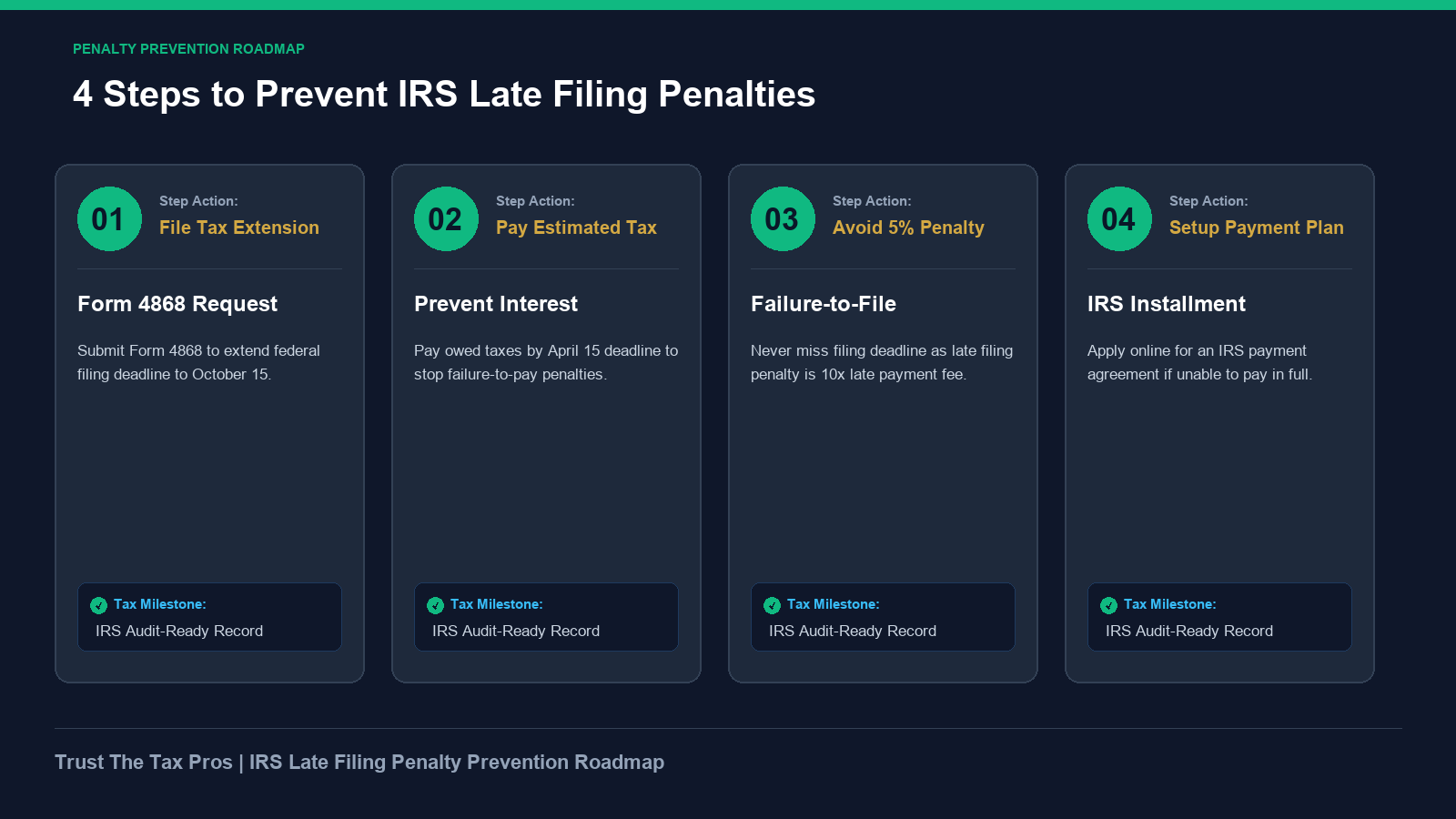
Failure-to-File vs Failure-to-Pay Penalties
- Failure-to-File Penalty: The IRS assesses a penalty of 5% of unpaid taxes for each month your return is late, up to a maximum of 25%. This penalty is ten times higher than the late payment penalty.
- Failure-to-Pay Penalty: If you file on time but do not pay owed taxes by April 15, the IRS charges 0.5% per month on the unpaid balance, up to a 25% maximum cap.
- Filing an Extension (Form 4868): Submitting IRS Form 4868 extends your filing deadline to October 15, eliminating the 5% monthly failure-to-file penalty. However, extensions do NOT extend the deadline to pay taxes owed.
Review federal filing standards directly through the Internal Revenue Service.
For affordable return prep solutions, read our affordable tax preparation guide.
4. California State Tax Filing Deadlines and Bracket Rules
California residents must file state Form 540 alongside federal Form 1040 returns. California state income tax rates range from 1% to 13.3% (plus a 1% mental health services tax for taxable income over $1,000,000).
Key California compliance rules:
- California State Filing Deadline: April 15.
- Automatic State Extension: California provides an automatic 6-month extension to October 15 to file Form 540, provided all state taxes owed are paid by April 15.
- CalEITC State Tax Relief: Low-to-moderate-income California joint filers can claim state cash back refunds up to $3,756 via FTB Form 3514.
Read our specialized guide on the California earned income tax credit.
If operating a business or filing in Northern California, review advice from a Sacramento tax accountant.
Frequently Asked Questions
What is the 2026 standard deduction for married filing jointly?
The statutory 2026 standard deduction for married couples filing jointly is $32,200, an increase of $700 compared to the 2025 standard deduction of $31,500.
What are the 2026 tax brackets for married filing jointly?
The 2026 marginal tax rates for joint filers are 10% ($0-$24,800), 12% ($24,801-$100,800), 22% ($100,801-$214,400), 24% ($214,401-$408,900), 32% ($408,901-$519,300), 35% ($519,301-$778,900), and 37% (over $778,900).
What happens if I file taxes late without an extension?
If you owe tax and file late without an extension, the IRS charges a failure-to-file penalty of 5% of unpaid taxes per month (up to 25%). Always file Form 4868 by April 15 to avoid this penalty.
Does filing a tax extension give me more time to pay taxes owed?
No. An IRS tax extension (Form 4868) extends your return filing deadline to October 15, but all estimated tax payments must still be submitted by April 15 to prevent late-payment interest.
Final Steps: Maximize Your Joint Tax Savings
Understanding statutory 2026 married filing jointly tax brackets and claiming the $32,200 standard deduction empowers couples to reduce their federal tax liabilities. Plan quarterly income estimates, organize itemized deductions early, and submit required returns by April 15.
Consult a credentialed CPA or Enrolled Agent to optimize joint tax returns, claim eligible tax credits, and protect your household finances.