For independent contractors, freelancers, gig workers, and small business owners, driving for work represents one of the largest ongoing operational costs. Fortunately, the IRS allows eligible self-employed taxpayers to offset business driving expenses through the Schedule C vehicle mileage deduction.
To write off vehicle costs on IRS Schedule C Line 9, you must choose between two calculation methods: the Standard Mileage Rate or the Actual Expense Method. Navigating IRS rules on commuting, maintaining audit-proof contemporaneous mileage logs, and selecting the highest-yielding deduction method can save you thousands of dollars each tax filing season.
1. Standard Mileage Rate vs Actual Expense Method
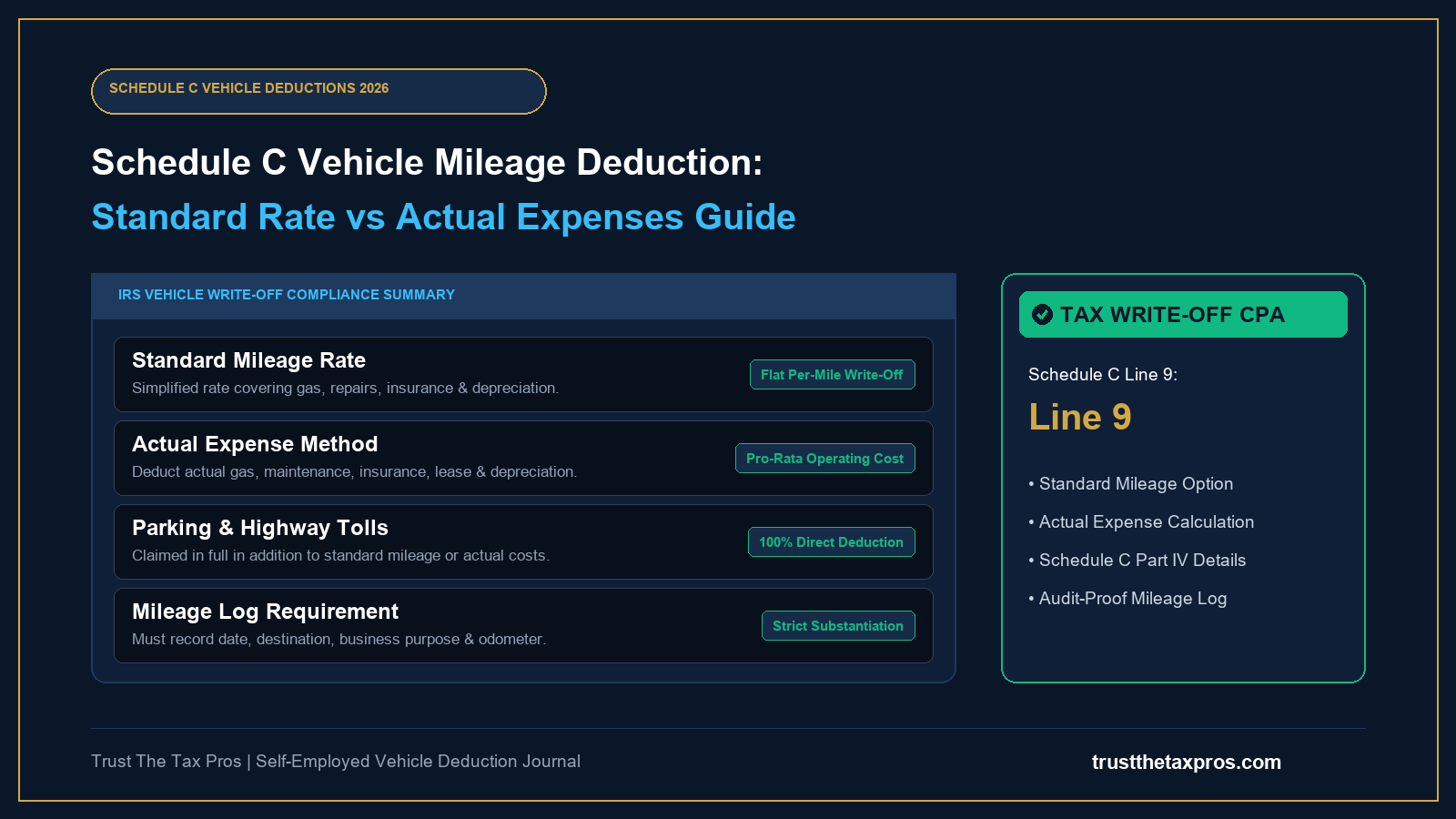
The IRS provides two statutory paths to deduct business vehicle costs on Form 1040 Schedule C:
- Standard Mileage Rate Method: Multiply your total validated business miles driven during the calendar year by the standard IRS mileage rate. This flat per-mile rate already factors in fuel, oil changes, tire replacement, routine maintenance, insurance, and vehicle depreciation.
- Actual Expense Method: Track every dollar spent operating your vehicle (gas, repairs, insurance, lease payments or depreciation, registration fees, and car washes), then multiply the total by your business-use percentage (Business Miles ÷ Total Annual Miles Driven).
- Additional Write-Offs Under Both Methods: Business parking fees and highway tolls are 100% deductible in addition to either the standard mileage rate or actual operating expenses.
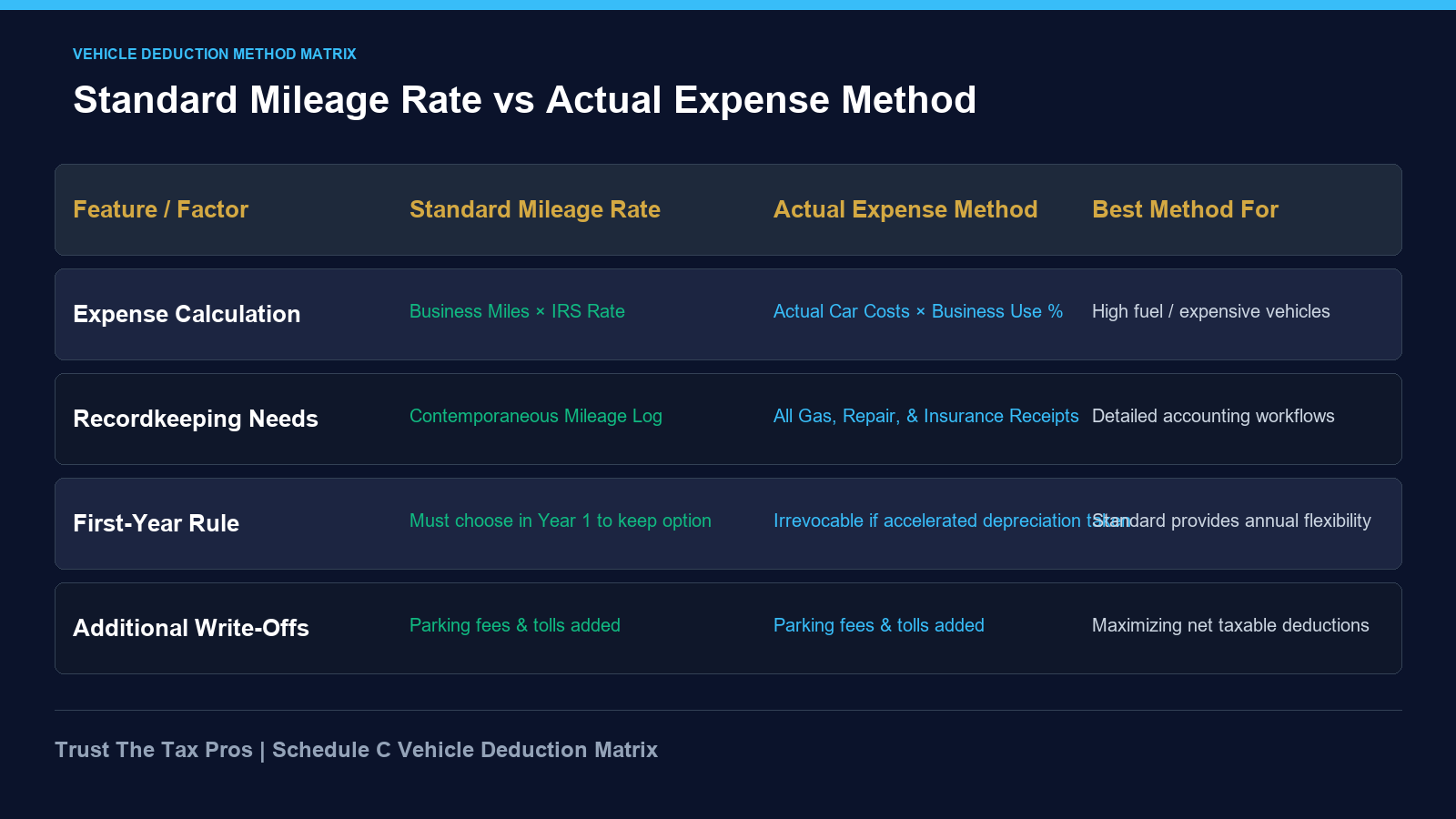
| Deduction Factor | Standard Mileage Rate | Actual Expense Method | Key IRS Rule / Advantage |
|---|---|---|---|
| Calculation Formula | Business Miles x IRS Rate | Total Costs x Business Use % | Actual favored for heavy luxury / gas vehicles |
| Recordkeeping Needs | Mileage Log Only | All Receipts + Mileage Log | Must retain all fuel and maintenance slips |
| First-Year Rule | Must choose in Year 1 | Irrevocable if Section 179 taken | Using standard in Year 1 allows switching later |
| Tolls & Parking | 100% Deductible | 100% Deductible | Added directly on Schedule C Line 9 |
2. The Critical Commuting vs Business Mileage Rule
One of the most common IRS audit flags on Schedule C is the misclassification of personal commuting miles as deductible business miles.
Non-Deductible Commuting: Daily round-trip travel between your personal home and your primary permanent workplace or main office is considered personal commuting and is 0% tax deductible.
Deductible Business Miles: Driving between your main office and client meeting locations, traveling between two separate job sites, traveling from a qualifying home office to visit customers, and driving to purchase business supplies are 100% deductible.
For home office tax deduction math, explore our home office deduction calculator guide.
3. Maintaining an Audit-Proof Contemporaneous Mileage Log
Under Internal Revenue Code Section 274(d), vehicle expenses are subject to strict substantiation rules. In an IRS audit, estimates, rounded numbers, or reconstructed logs created months later are routinely disallowed.
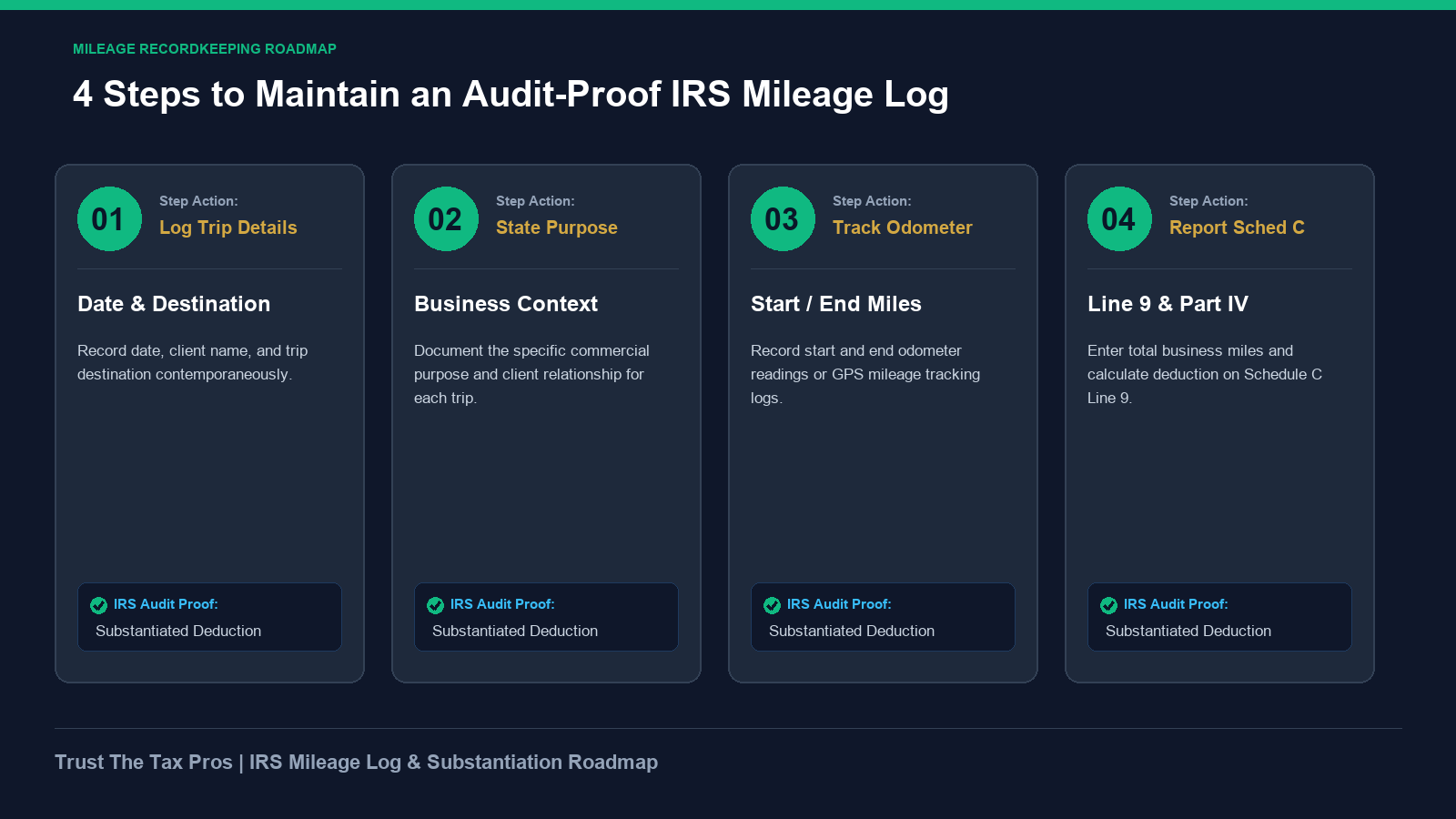
4 Mandatory Details on Every Mileage Record
- Date of the Trip: The exact calendar day the business driving occurred.
- Destination & Client Name: The specific city, address, or client company visited.
- Clear Business Purpose: A brief description of the commercial purpose (e.g. client proposal presentation, project site inspection, vendor pickup).
- Starting & Ending Odometer Readings: The exact vehicle odometer figures or verified GPS mileage tracking records from apps like MileIQ or QuickBooks Self-Employed.
Review comprehensive audit defense tips in our IRS audit avoidance guide.
Calculate your net quarterly tax liabilities in our LLC quarterly estimated taxes guide.
Access official vehicle expense forms directly on the Internal Revenue Service official portal.
If you operate a business in Northern California, review advice from a Sacramento tax accountant.
Frequently Asked Questions
Where do I enter vehicle mileage on Schedule C?
Report your total vehicle deduction on Schedule C Line 9 (Car and truck expenses) and complete Part IV (Information on Your Vehicle), providing total business, commuting, and personal miles.
Can I switch between standard mileage and actual expenses?
If you own the vehicle and choose the standard mileage rate in the first year it is placed in service for business, you can switch between standard mileage and actual expenses in later years. However, if you choose the actual expense method using accelerated depreciation (Section 179 or bonus depreciation) in Year 1, you can never switch to standard mileage for that vehicle.
Are parking fees and highway tolls included in the standard mileage rate?
No. Business parking fees and tolls are deductible separately from the standard mileage rate. You add 100% of business parking and tolls directly to your Line 9 total.
Can I deduct mileage if I drive a leased car for business?
Yes. You can use either the standard mileage rate or actual lease payments pro-rated by business-use percentage for the entire lease term.
Maximize Your Schedule C Vehicle Deductions
Claiming the Schedule C vehicle mileage deduction provides significant tax relief for self-employed professionals. Track your miles contemporaneously using a GPS app, separate commuting from valid business travel, and compare the standard rate against actual operating expenses.
Consult a licensed CPA or tax professional to review your vehicle depreciation strategy and optimize your small business deductions.