Earning income as an independent contractor, freelancer, or gig worker provides financial independence, but it also creates complex tax obligations. Unlike W-2 employees who have income tax and FICA contributions automatically withheld from paychecks, 1099 contractors must calculate and pay their own federal, state, and self-employment taxes.
Understanding how a 1099 tax calculator with deductions works allows you to estimate your total tax burden accurately. By subtracting ordinary and necessary business expenses from gross 1099 receipts, you lower your net taxable income, reduce self-employment tax liabilities, and prevent expensive quarterly estimated tax penalties.
1. How Self-Employment Taxes Are Calculated on 1099 Income
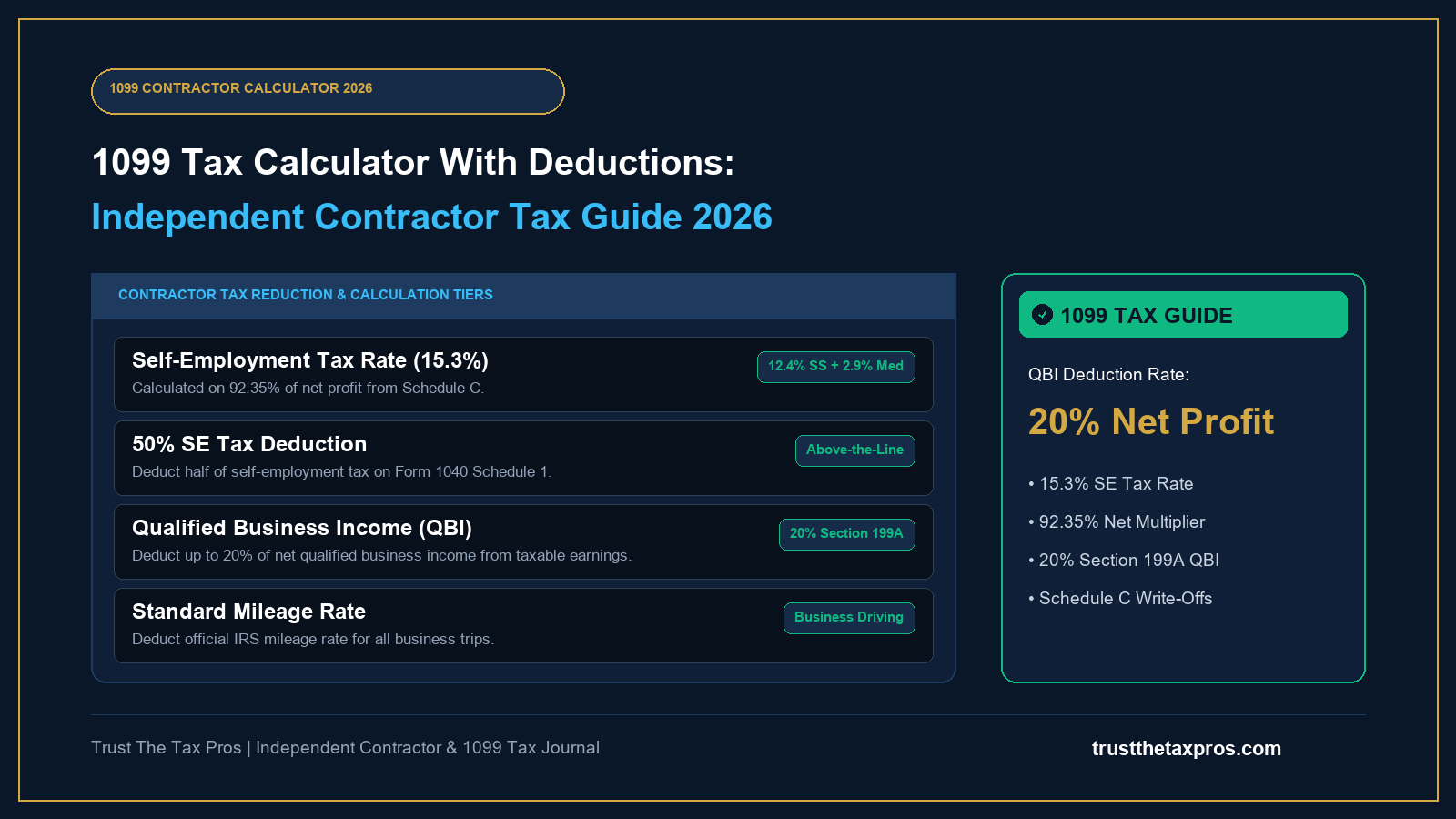
When working as an independent contractor, you pay self-employment tax in addition to regular federal and state income taxes. Self-employment tax covers Social Security and Medicare contributions that traditional employers usually split with W-2 workers.
Self-employment tax rates consist of two main parts:
- Social Security Tax: 12.4% on net self-employment earnings up to the annual statutory wage base cap.
- Medicare Tax: 2.9% on all net self-employment earnings, plus an additional 0.9% Medicare surcharge for high-income filers.
- Combined Self-Employment Tax Rate: 15.3% total tax rate applied to net taxable business earnings.
| Tax Component | Statutory Tax Rate | Application Base | Tax Prevention & Savings Mechanism |
|---|---|---|---|
| Social Security Tax | 12.4% | Net self-employment earnings up to statutory annual cap | Deduct business expenses on Form 1040 Schedule C |
| Medicare Tax | 2.9% | All net self-employment income without income limit | Claim QBI deduction under Section 199A |
| 50% SE Tax Deduction | Above-the-line deduction | 50% of calculated self-employment tax paid | Claim on Form 1040 Schedule 1 Line 15 |
| Federal Income Tax | 10% to 37% progressive | Taxable income after standard or itemized deductions | File quarterly estimated payments using Form 1040-ES |
The IRS applies self-employment tax to 92.35% of your net business income, rather than 100% of gross receipts. Furthermore, taxpayers claim an above-the-line deduction equal to 50% of the self-employment tax paid when completing Form 1040 Schedule 1.
2. Essential Schedule C Deductions to Lower 1099 Tax Liabilities
The primary method for reducing contractor tax liability is claiming all legitimate business deductions on Schedule C. Every dollar deducted reduces both self-employment tax (15.3%) and progressive income tax.
Essential 1099 Contractor Tax Deductions
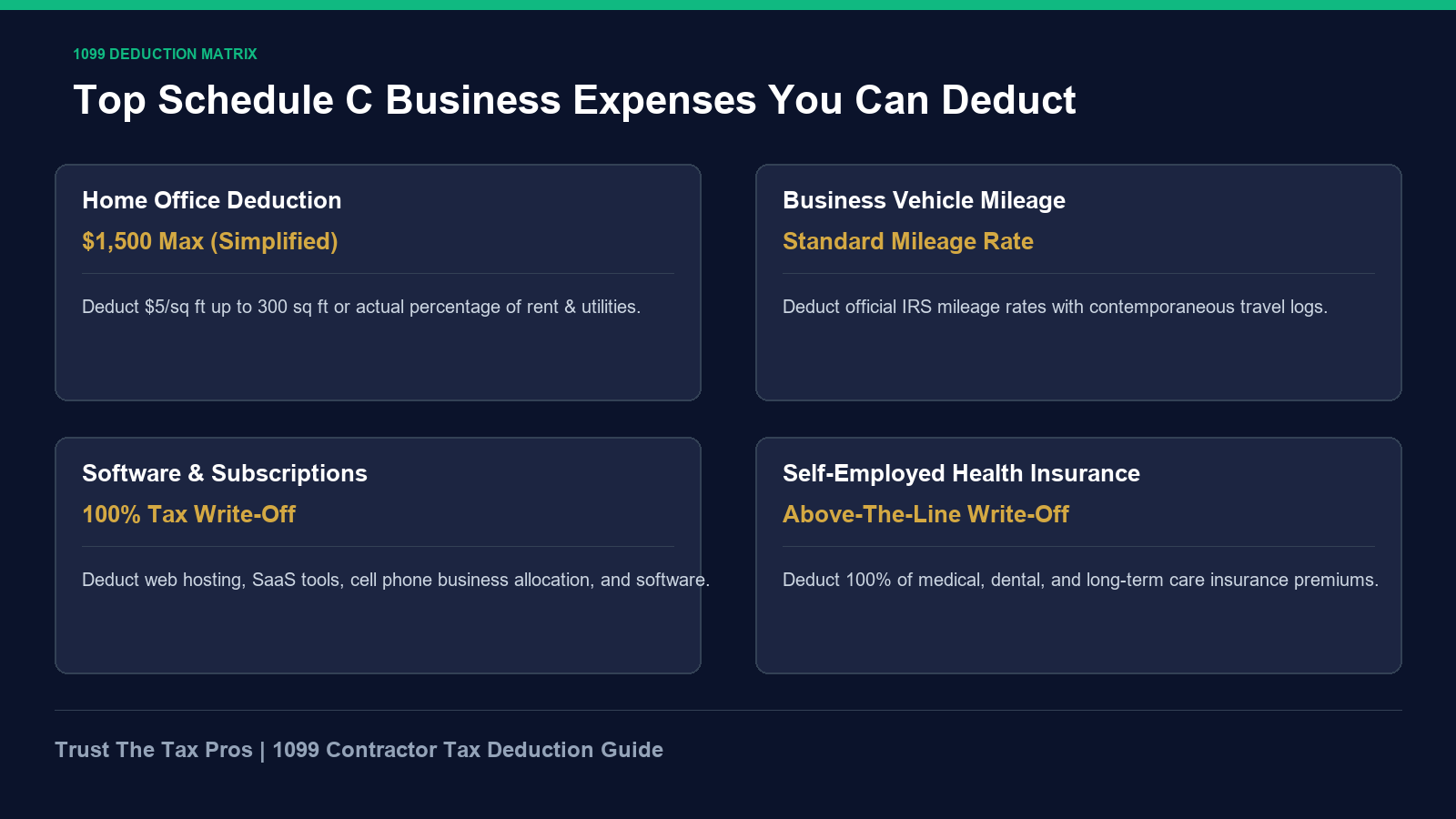
- Home Office Expense: Claim $5 per square foot up to 300 square feet ($1,500 maximum) using the simplified method or actual residential expenses.
- Vehicle Business Mileage: Deduct standard mileage rates for business trips while maintaining contemporaneous written mileage logs.
- Software and Technology: Write off 100% of business software subscriptions, web hosting, domain fees, and dedicated business phone lines.
- Self-Employed Health Insurance: Deduct monthly medical, dental, and long-term care insurance premiums directly on Schedule 1.
Home Office Deduction Rules
If you use a portion of your home exclusively and regularly for business, you qualify for the home office deduction. The IRS offers two calculation options:
- Simplified Method: Multiply qualifying square footage by 5 dollars, up to a maximum of 300 square feet (1,500 dollars cap).
- Actual Expense Method: Calculate actual housing expenses, including rent, mortgage interest, utilities, and property insurance based on the percentage of home square footage used for business.
Business Vehicle and Mileage Calculations
Contractors who use personal vehicles for client visits, supply runs, or travel between work locations can deduct vehicle costs. You can choose between the standard mileage rate or actual operational expenses (gas, oil changes, repairs, and insurance). Always record trip dates, starting locations, ending destinations, and business purpose to withstand IRS examination.
For comprehensive individual filing advice, review our individual tax filing guide.
3. Step-by-Step Guide to Calculating Net 1099 Taxes
Calculating your net 1099 tax obligation requires a clear four-step process. Following this workflow prevents filing errors and ensures accurate quarterly tax estimates.
Step 1: Calculate Gross 1099 Receipts
Add all gross income received from client payments, Forms 1099-NEC, 1099-MISC, and 1099-K. Include cash and digital payments received for contracting services.
Step 2: Subtract Allowable Business Expenses
Subtract total allowable Schedule C deductions from gross receipts. The remaining figure represents your Net Business Profit.
Step 3: Calculate Self-Employment Tax
Multiply your Net Business Profit by 92.35% (0.9235) to determine taxable self-employment income. Multiply that result by 15.3% (0.153) to determine your total self-employment tax liability.
Step 4: Apply the QBI Deduction and Tax Brackets
Subtract 50% of your calculated self-employment tax from your total income on Schedule 1. Eligible contractors can then apply the Qualified Business Income (QBI) deduction under Section 199A, deducting up to 20% of net business income before applying standard federal income tax brackets.
To explore affordable tax preparation options, check our affordable tax preparation guide.
4. Quarterly Estimated Tax Deadlines and Penalty Avoidance
Because independent contractors do not have taxes withheld automatically, the IRS requires quarterly estimated tax payments if you expect to owe 1,000 dollars or more when filing your annual return.
Official IRS Form 1040-ES Payment Schedule
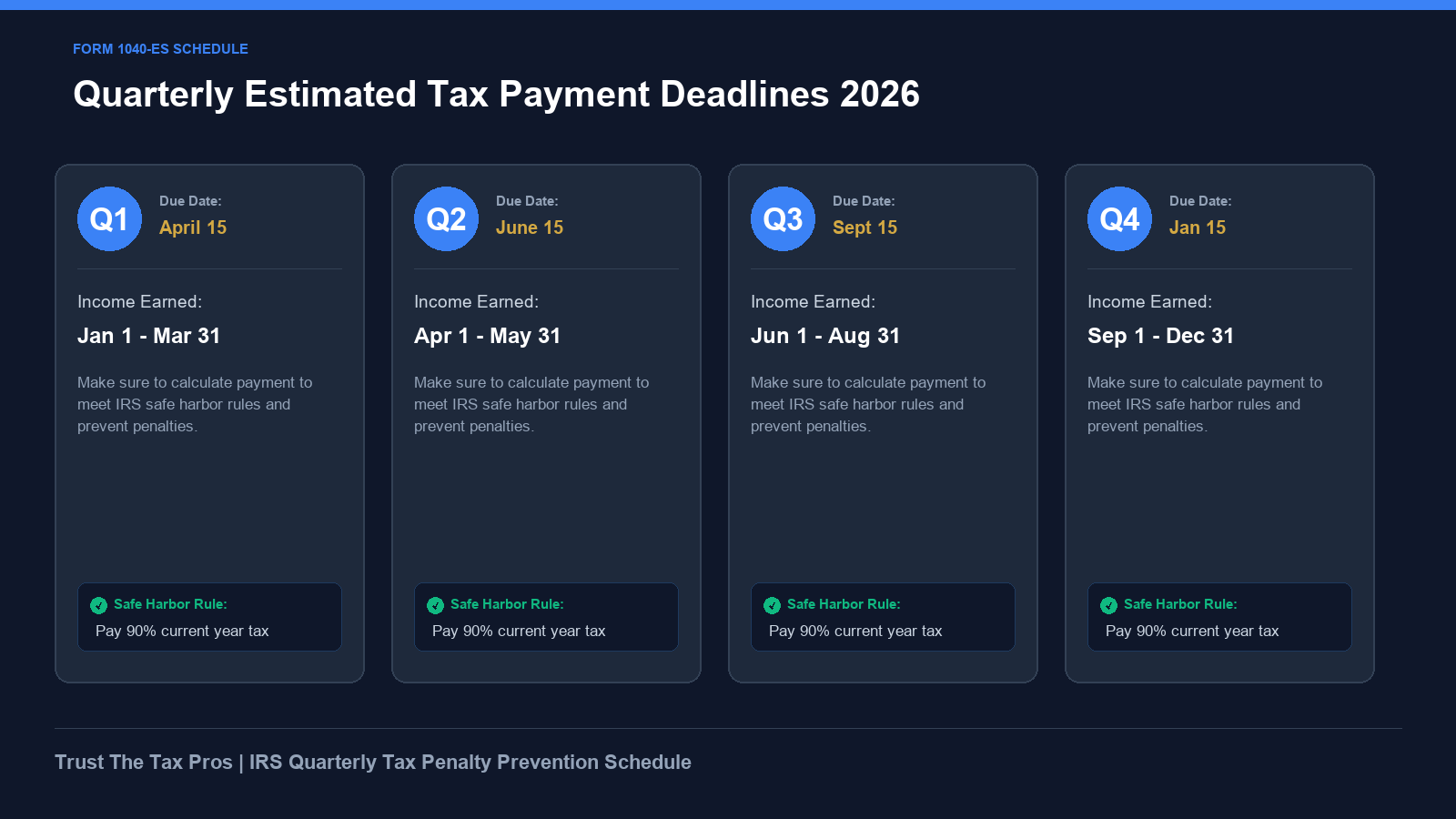
Quarterly estimated taxes are due four times per tax year:
- First Quarter (Q1): April 15
- Second Quarter (Q2): June 15
- Third Quarter (Q3): September 15
- Fourth Quarter (Q4): January 15 of the following year
Safe Harbor Rules to Prevent Penalties
To avoid underpayment penalties, ensure your quarterly payments meet IRS Safe Harbor requirements. You must pay either 90% of your total tax liability for the current tax year or 100% of the tax shown on your prior year tax return (110% if your Adjusted Gross Income exceeded 150,000 dollars).
Review official federal payment portals directly through the Internal Revenue Service.
For business accounting assistance, explore our detailed business tax services guide.
5. When to Seek Professional CPA Assistance for 1099 Filings
While simple single-client contracting returns are manageable with tax software, complex financial scenarios warrant working with a credentialed CPA or Enrolled Agent.
Consider hiring a professional tax advisor if:
- Your net 1099 earnings exceed 50,000 dollars, making S-Corporation tax election advantageous.
- You operate a multi-state business with physical or economic tax nexus in multiple jurisdictions.
- You receive IRS inquiry letters or need legal audit defense.
Members of the American Institute of CPAs and practitioners with the National Association of Enrolled Agents hold full legal rights to represent you during IRS examinations.
If you require local tax assistance in California, read our localized guide on selecting a Sacramento tax accountant.
Frequently Asked Questions
How much percentage should I save for 1099 taxes?
As a general rule, 1099 contractors should set aside 25% to 30% of net earnings in a dedicated business tax savings account. This covers self-employment tax (15.3%), federal income tax, and state income tax liabilities.
What is the difference between Form 1099-NEC and Form 1099-MISC?
Form 1099-NEC reports nonemployee compensation paid to independent contractors, freelancers, and sole proprietors. Form 1099-MISC reports miscellaneous income, such as rent payments, royalties, prize awards, and legal settlement proceeds.
Can 1099 contractors deduct health insurance premiums?
Yes. Self-employed contractors can claim the self-employed health insurance deduction on Form 1040 Schedule 1. This above-the-line deduction reduces your Adjusted Gross Income (AGI) even if you do not itemize deductions.
What happens if I miss a quarterly estimated tax deadline?
Missing a quarterly deadline triggers IRS underpayment penalties under Internal Revenue Code Section 6654. Penalties accumulate interest from the original payment due date until the tax liability is paid in full.
Do I need to pay self-employment tax if I earned less than $400?
If your net self-employment earnings are under 400 dollars, you do not owe self-employment tax. However, you must still report the income on your individual federal tax return if your total gross income exceeds standard filing thresholds.
Optimize Your 1099 Tax Strategy Today
Using a 1099 tax calculator with deductions empowers you to take control of your contractor finances. Reconcile all client 1099 statements, track every business expense with receipts, and make timely quarterly estimated tax payments to prevent interest penalties.
Gather your financial documentation early, review your allowable deductions, and consult a credentialed tax professional to maximize tax savings every tax season.