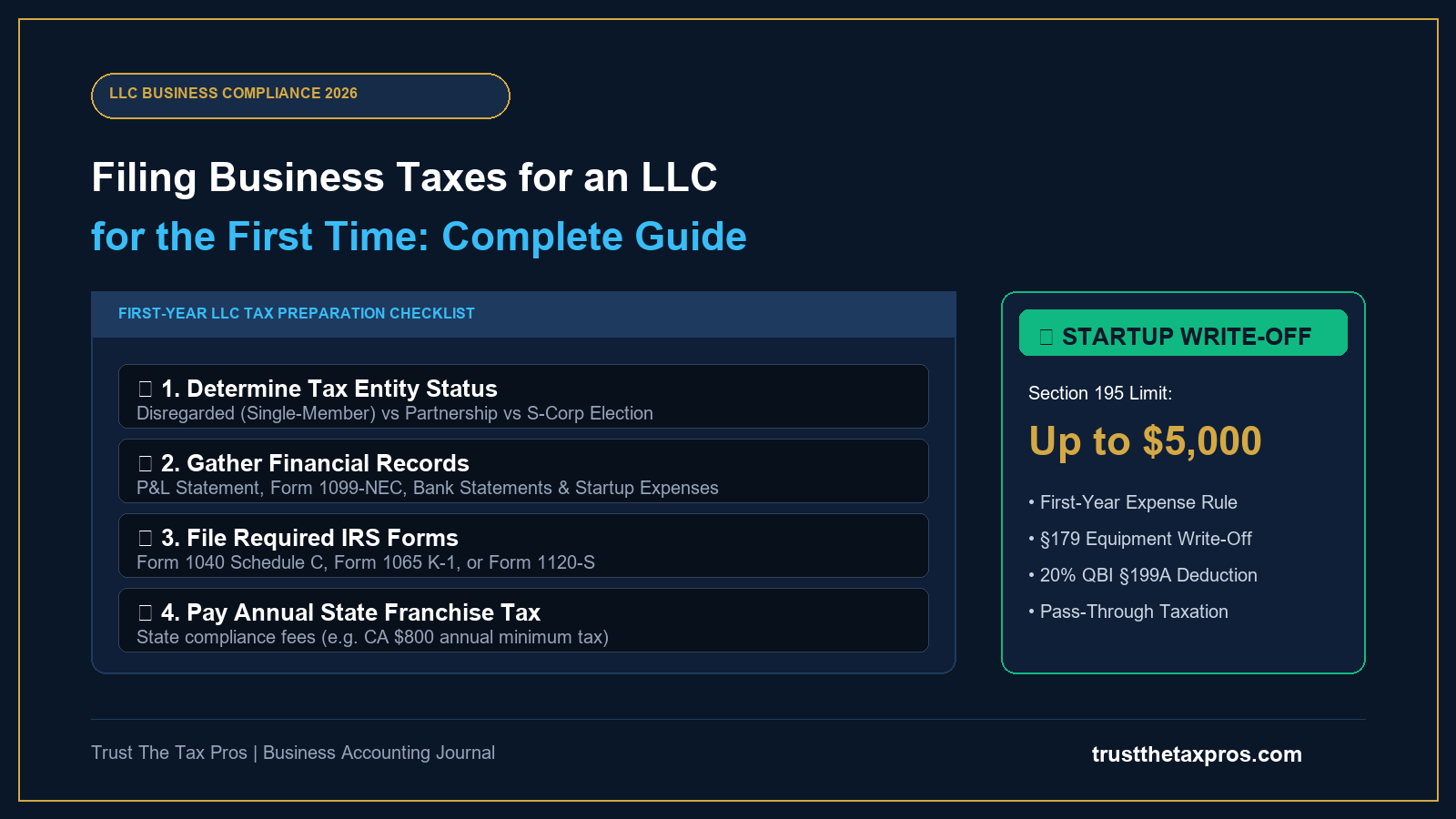
Forming a Limited Liability Company (LLC) is an exciting milestone for entrepreneurs, but filing business taxes for an LLC for the first time can feel overwhelming. Because the IRS does not recognize an LLC as a distinct federal tax classification, how your business is taxed depends entirely on your ownership structure and tax elections.
Whether you operate a single-member LLC, a multi-member partnership, or an LLC that elected S-Corporation status, this comprehensive guide explains first-year LLC filing rules, required IRS forms, state compliance fees, startup expense write-offs, and deadline avoidance strategies.
1. Understanding LLC Federal Tax Classifications
The IRS treats LLCs as pass-through tax entities by default. This means corporate net profits or losses pass directly through to the business owners’ personal income tax returns, avoiding double taxation at the federal level.
Default and elected LLC tax classifications include:
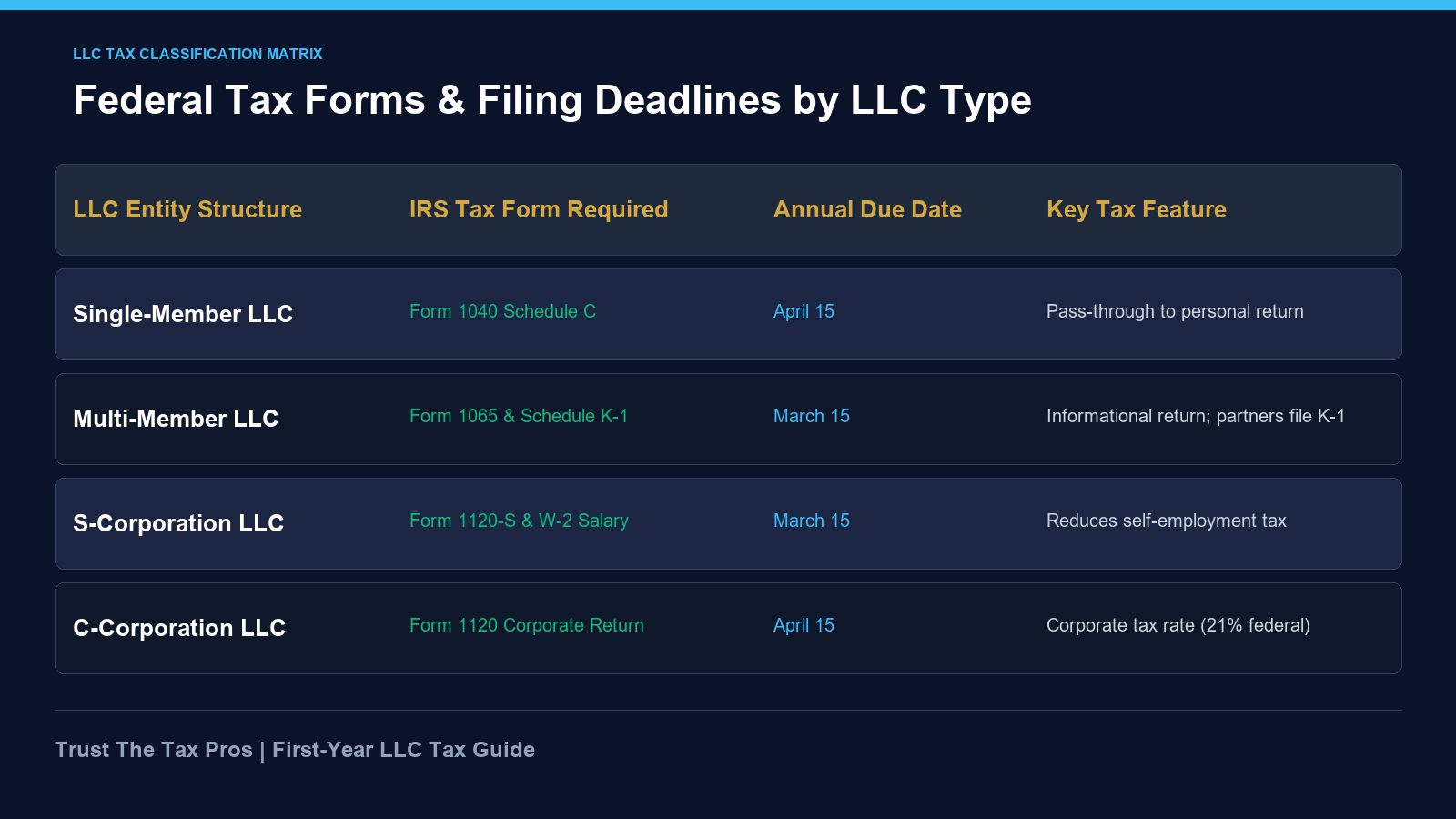
- Single-Member LLC (Disregarded Entity): By default, the IRS ignores the separate legal entity for tax purposes. Owners report business revenues and expenses on Schedule C attached to personal Form 1040 returns.
- Multi-Member LLC (Partnership): By default, multi-owner LLCs file Form 1065 (U.S. Return of Partnership Income) by March 15. The LLC issues Schedule K-1 forms to each partner reporting their share of profits.
- S-Corporation Tax Election (Form 2553): LLCs can elect S-Corp status to split income into W-2 owner compensation and distributions, saving up to 15.3% on self-employment payroll taxes once net profits exceed $50,000.
- C-Corporation Tax Election (Form 8832): LLCs can elect corporate taxation, filing Form 1120 and paying the flat 21% federal corporate tax rate.
| LLC Ownership Type | IRS Federal Tax Form | Annual Federal Filing Due Date | Pass-Through Tax Mechanism |
|---|---|---|---|
| Single-Member LLC | Form 1040 Schedule C & SE | April 15 | Direct report on personal Form 1040 return |
| Multi-Member LLC | Form 1065 & Schedule K-1 | March 15 | Informational return; partners report Schedule K-1 |
| S-Corp Electing LLC | Form 1120-S & Form W-2 | March 15 | W-2 payroll plus Schedule K-1 distribution reporting |
2. Claiming First-Year LLC Startup Expenses Under Section 195
Starting an LLC involves initial expenses before officially opening doors for business. Internal Revenue Code Section 195 allows new LLCs to deduct up to $5,000 in qualifying startup organizational costs in their first active tax year.
You can deduct up to $5,000 of startup costs and $5,000 of organizational costs (state filing fees, attorney fees, domain registration, initial marketing) in year one. Startup expenses exceeding $5,000 must be amortized ratably over 180 months (15 years).
Key First-Year LLC Tax Deductions
- Section 179 Property Expensing: Write off 100% of computers, machinery, and office furniture purchased in year one.
- Qualified Business Income (QBI) Deduction: Claim up to a 20% tax deduction on net LLC pass-through profit under Section 199A.
- Accounting & CPA Fees: 100% of professional tax preparation and bookkeeping fees are deductible business operating expenses.
For small business CPA evaluation tips, read our small business tax accountant guide.
3. Step-by-Step Roadmap to File First-Year LLC Taxes
Following a structured compliance roadmap ensures your first tax filing goes smoothly without incurring state or federal penalties.
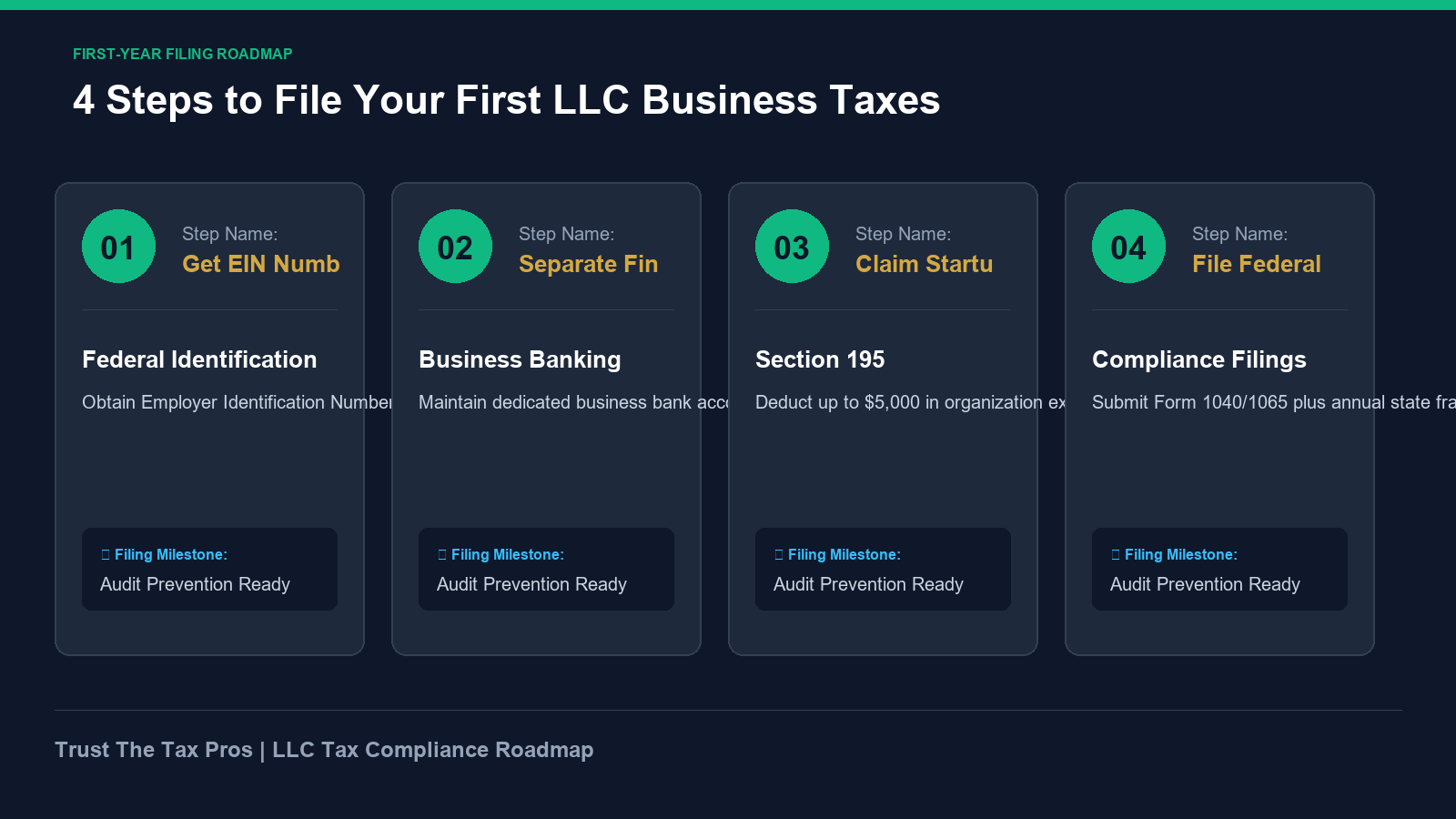
Step-by-Step Filing Workflow
- Obtain an Employer Identification Number (EIN): Get a free federal EIN from IRS.gov to establish separate business credit and open dedicated business banking accounts.
- Separate Business and Personal Bank Accounts: Never mix personal receipts with corporate accounts, as commingling funds pierces the corporate liability veil.
- Reconcile Year-End P&L Statements: Compile all gross income from Form 1099-NEC statements and categorize ordinary operating expenses.
- Pay Annual State Franchise Fees: Pay required annual state compliance fees (such as the California $800 minimum franchise tax due on the 15th day of the 4th month).
Review official federal business guidelines through the Internal Revenue Service.
To estimate self-employment contractor write-offs, explore our 1099 tax calculator guide.
4. State Franchise Taxes and Annual Compliance Fees
In addition to federal income taxes, LLC owners must comply with state-level business filing obligations. Many states charge annual report fees or franchise taxes regardless of whether the LLC made a profit or operated at a net loss during its first year.
Key state considerations include:
- California Minimum Franchise Tax: California charges an $800 annual minimum franchise tax for all registered LLCs (Form 3522). First-year LLCs receive a temporary exemption for the initial tax year, but annual tax filings remain mandatory.
- State Sales Tax Nexus: E-commerce and retail LLCs must register with state tax departments to collect and remit local sales tax.
Explore practitioner credential requirements through the American Institute of CPAs and the National Association of Enrolled Agents.
If you operate an LLC in Northern California, consult a Sacramento tax accountant.
Frequently Asked Questions
Do I have to file taxes for my LLC if it made no money in its first year?
Yes. Even if your LLC had zero revenue or operated at a net loss in its first year, you must file a tax return. Single-member LLCs report $0 income on Schedule C, while multi-member LLCs file Form 1065 to report startup expenses and maintain active corporate standing.
What is the tax deadline for filing LLC taxes for the first time?
For single-member LLCs, taxes are due April 15 alongside personal Form 1040 returns. For multi-member LLCs (Form 1065) and S-Corporations (Form 1120-S), federal returns are due March 15.
Can I deduct LLC formation fees on my first tax return?
Yes. Under IRS Section 195, state LLC formation filing fees, legal expenses, and initial accounting fees qualify as organizational startup costs deductible up to $5,000 in your first active tax year.
How much should I set aside for first-year LLC taxes?
LLC owners should set aside approximately 25% to 30% of net LLC profits in a separate business savings account to cover federal income tax, state tax, and self-employment tax obligations.
Final Steps: Establish Clean First-Year LLC Tax Compliance
Filing business taxes for an LLC for the first time sets the foundation for your long-term business success. Separate your business finances, organize your startup receipts, understand your entity tax classification, and file required federal and state returns on time.
Partnering with a credentialed CPA or Enrolled Agent ensures your first-year LLC return maximizes all eligible tax deductions while remaining fully compliant with state and federal tax codes.