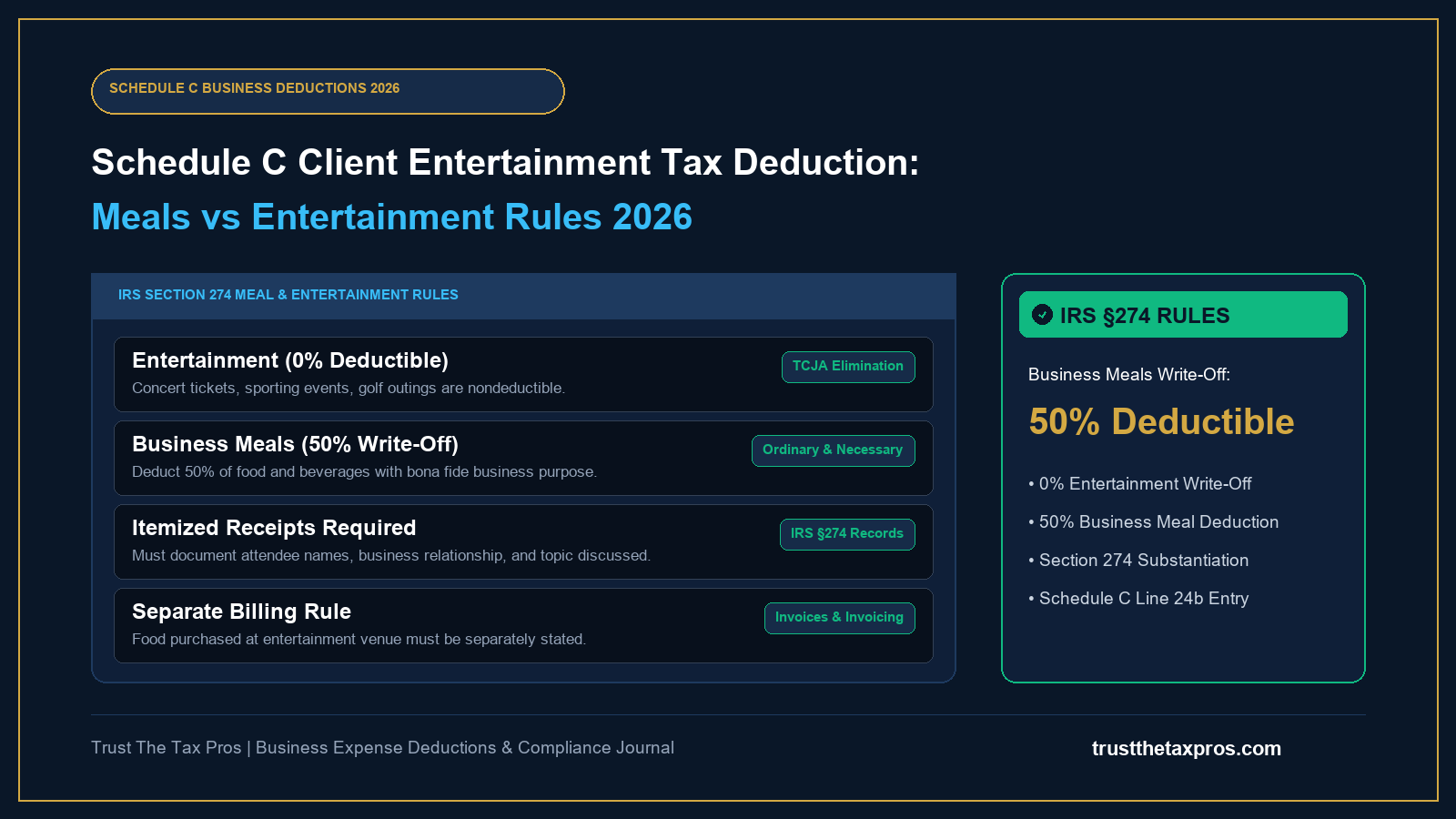
Self-employed business owners, freelancers, and independent contractors frequently entertain prospective clients and host business dinners to drive sales growth. However, claiming the Schedule C client entertainment tax deduction requires understanding significant statutory changes introduced under the Tax Cuts and Jobs Act (TCJA) and codified in Internal Revenue Code Section 274.
While entertainment activities like sporting events and concert tickets are strictly non-deductible, bona fide business meals with clients remain 50% tax deductible. This guide explains how to properly categorize business dining on Schedule C Line 24b, maintain audit-proof receipts, and avoid common IRS deduction disallowances.
1. The TCJA Elimination of Entertainment Deductions
Prior to tax reform, businesses could deduct 50% of client entertainment expenses (such as taking a customer to a golf outing or basketball game) if directly related to the active conduct of business. The TCJA permanently eliminated tax deductions for entertainment, amusement, and recreation expenses.
Under current IRS Section 274 regulations:
- Entertainment is 0% Deductible: Sporting event tickets, luxury skybox rentals, theater tickets, golf fees, fishing excursions, and ski trips are 100% non-deductible.
- Business Meals are 50% Deductible: Food and beverages provided to current or prospective clients, consultants, or referral partners remain 50% deductible on Schedule C.
- Separation Rule for Food at Events: If you purchase food and drinks while attending a sporting event or concert, the food cost is 50% deductible ONLY IF purchased separately or itemized separately on the invoice from the entertainment ticket cost.
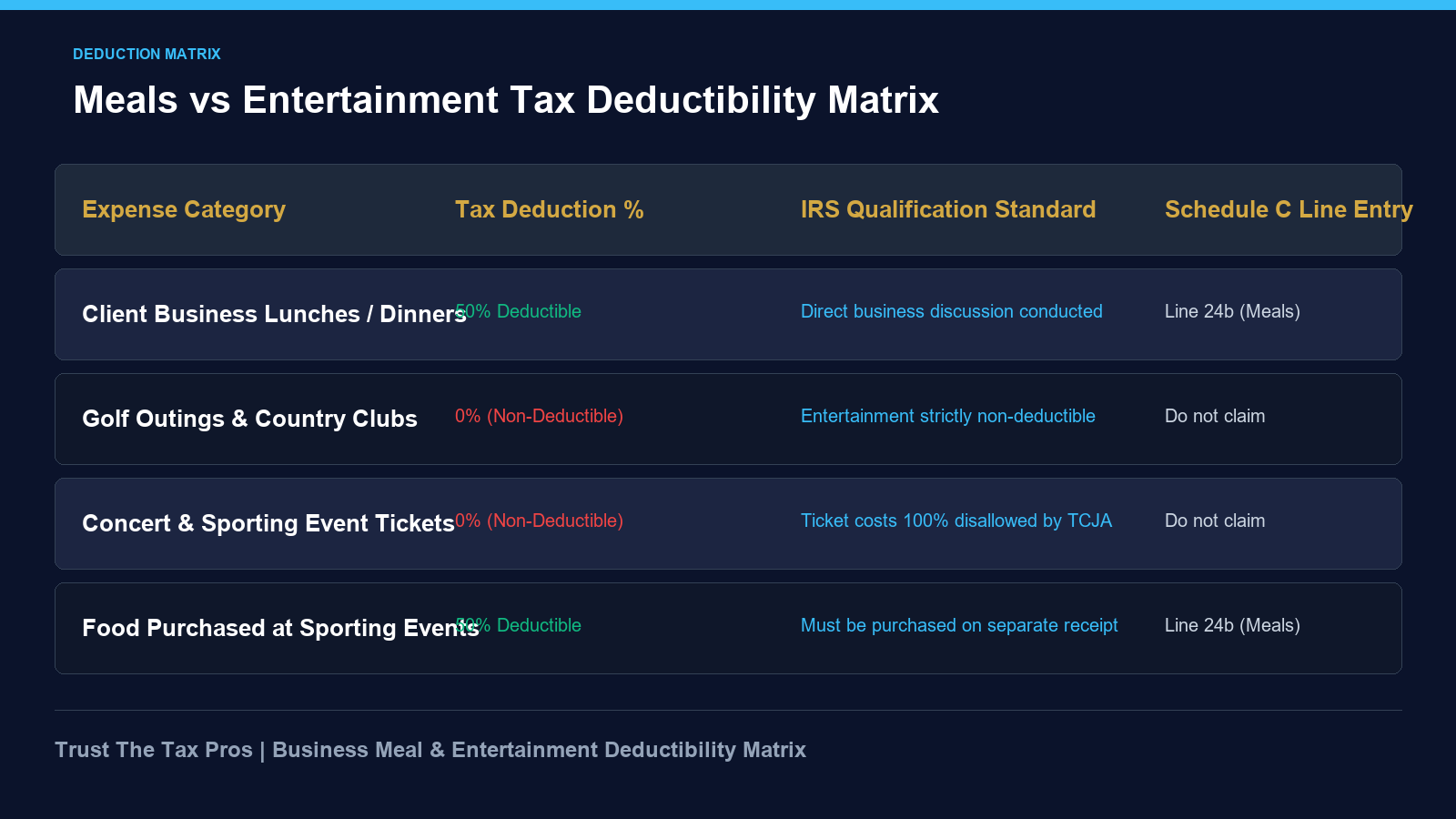
| Expense Category | Deductibility Rate | IRS Substantiation Requirement | Schedule C Form Line |
|---|---|---|---|
| Client Lunch or Dinner | 50% Deductible | Itemized receipt + business discussion log | Line 24b (Deductible Meals) |
| Golf Outings & Club Dues | 0% (Non-Deductible) | Entertainment disallowed by TCJA | Do not report on return |
| Sporting Event Food (Separate Bill) | 50% Deductible | Separate concession or restaurant receipt | Line 24b (Deductible Meals) |
2. The 5 IRS Criteria for Deducting Client Meals
To qualify for the 50% business meal deduction on Schedule C, your expense must satisfy all five statutory conditions established by IRS Notice 2018-76:
- Ordinary and Necessary: The meal expense is customary and appropriate in your line of business.
- Not Lavish or Extravagant: The expense must be reasonable under the specific circumstances.
- Taxpayer Presence: The business owner or an active employee must be present at the meal.
- Business Associate: The meal is provided to a current or prospective customer, client, consultant, or professional advisor.
- Separate Food Billing: If food is provided during an entertainment activity, it must be stated on a separate bill.
For self-employed 1099 write-off calculations, explore our 1099 tax calculator guide.
3. Audit-Proof Recordkeeping Requirements Under IRC Section 274
Because meal expenses are frequently scrutinized during IRS examinations, maintaining contemporaneous documentation is essential to withstand audit challenges.
Required Substantiation on Every Meal Receipt
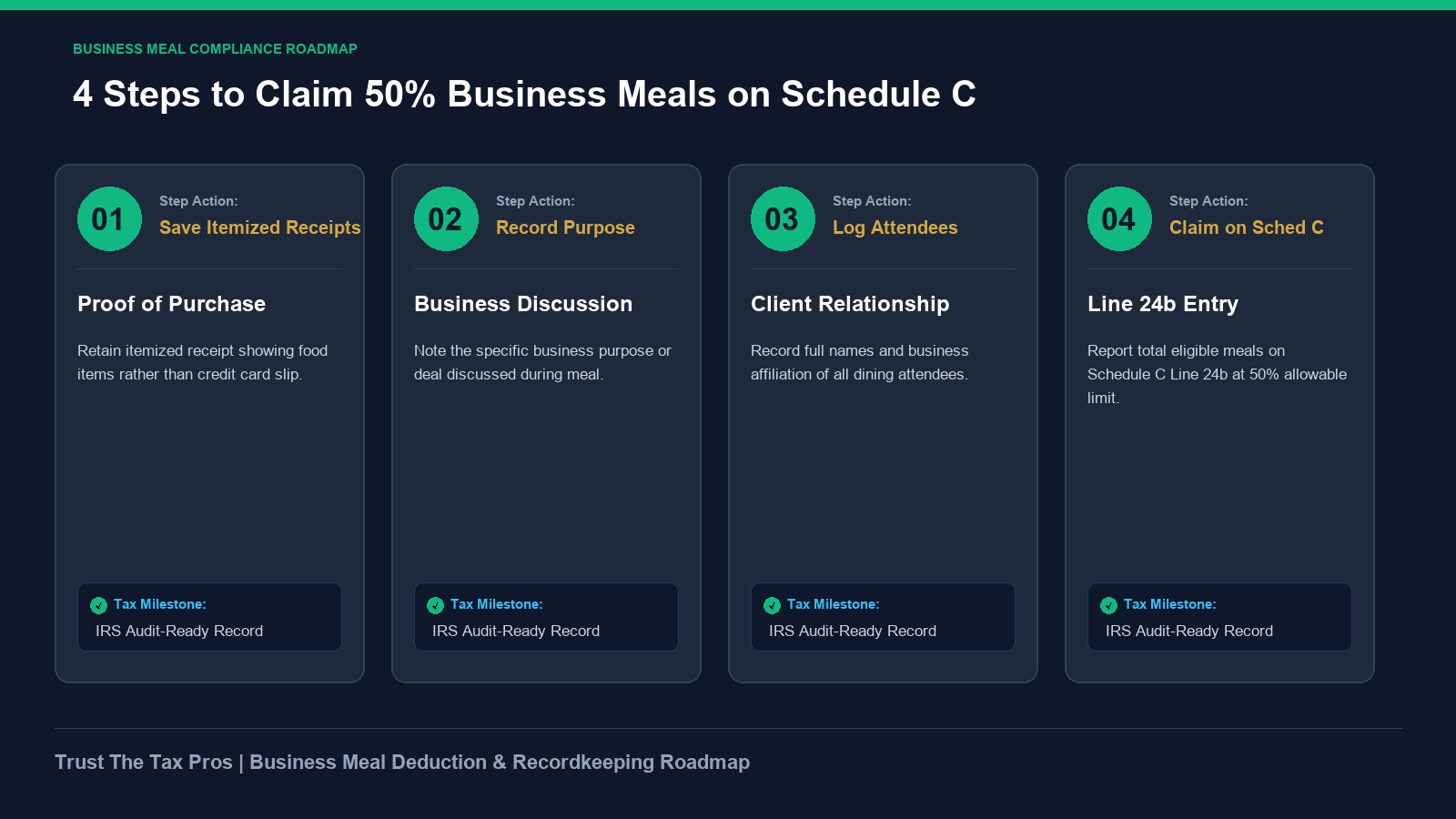
- Amount & Date: The total cost (including tax and tip) and the exact date of the meal.
- Restaurant Location: The name and city location of the restaurant or venue.
- Attendee Names & Business Relationship: The full names, professional titles, and company affiliations of everyone attending.
- Business Purpose & Discussion Summary: A brief note describing the specific commercial topic discussed (e.g. quarterly project review, contract proposal, client onboarding).
- Itemized Receipt: Keep the detailed itemized food receipt showing items ordered, not just the credit card signature slip.
Review comprehensive audit protection tips in our IRS audit avoidance guide.
Verify federal deduction guidelines directly on the Internal Revenue Service official portal.
If you need CPA bookkeeping support in Northern California, consult a Sacramento tax accountant.
Frequently Asked Questions
Are client entertainment expenses tax deductible in 2026?
No. Under the Tax Cuts and Jobs Act, entertainment expenses like golf games, sporting event tickets, and concerts are 0% deductible. Only business meals remain 50% deductible.
How do I report client meals on Schedule C?
Report your total business meal expenses on Schedule C Line 24b. Multiply the total eligible expense by 50% and enter the net deductible amount.
Can I deduct food bought at a sporting event with a client?
Yes, but only if the food and beverage cost is purchased on a separate transaction or stated separately on the itemized invoice from the sporting event ticket cost.
What receipts do I need to keep for business meal deductions?
You must keep the itemized receipt showing the date, restaurant name, total amount, names and titles of all attendees, and the specific business purpose discussed.
Final Steps: Maximize Your Schedule C Write-Offs
Understanding IRS Section 274 rules allows you to maximize allowable 50% business meal write-offs while avoiding disallowed entertainment claims. Maintain clear itemized receipts, document business discussions contemporaneously, and report accurate net meal expenses on Schedule C.
Consult a licensed CPA or Enrolled Agent to ensure all business operating deductions comply with federal tax guidelines.