Saving for higher education is a top financial priority for California families. A 529 college savings plan offers exceptional federal tax advantages, allowing investments to grow tax-free and withdrawals to be distributed tax-free for qualified education expenses. However, parents often ask: is a 529 tax deductible in California?
Understanding state-specific tax laws is essential. While California does not offer a state income tax deduction for contributions made to 529 plans, the tax-free growth and distribution benefits make ScholarShare 529 (California’s official 529 plan) one of the most powerful wealth-building tools for education savings.
1. Is a 529 Plan Tax Deductible in California?
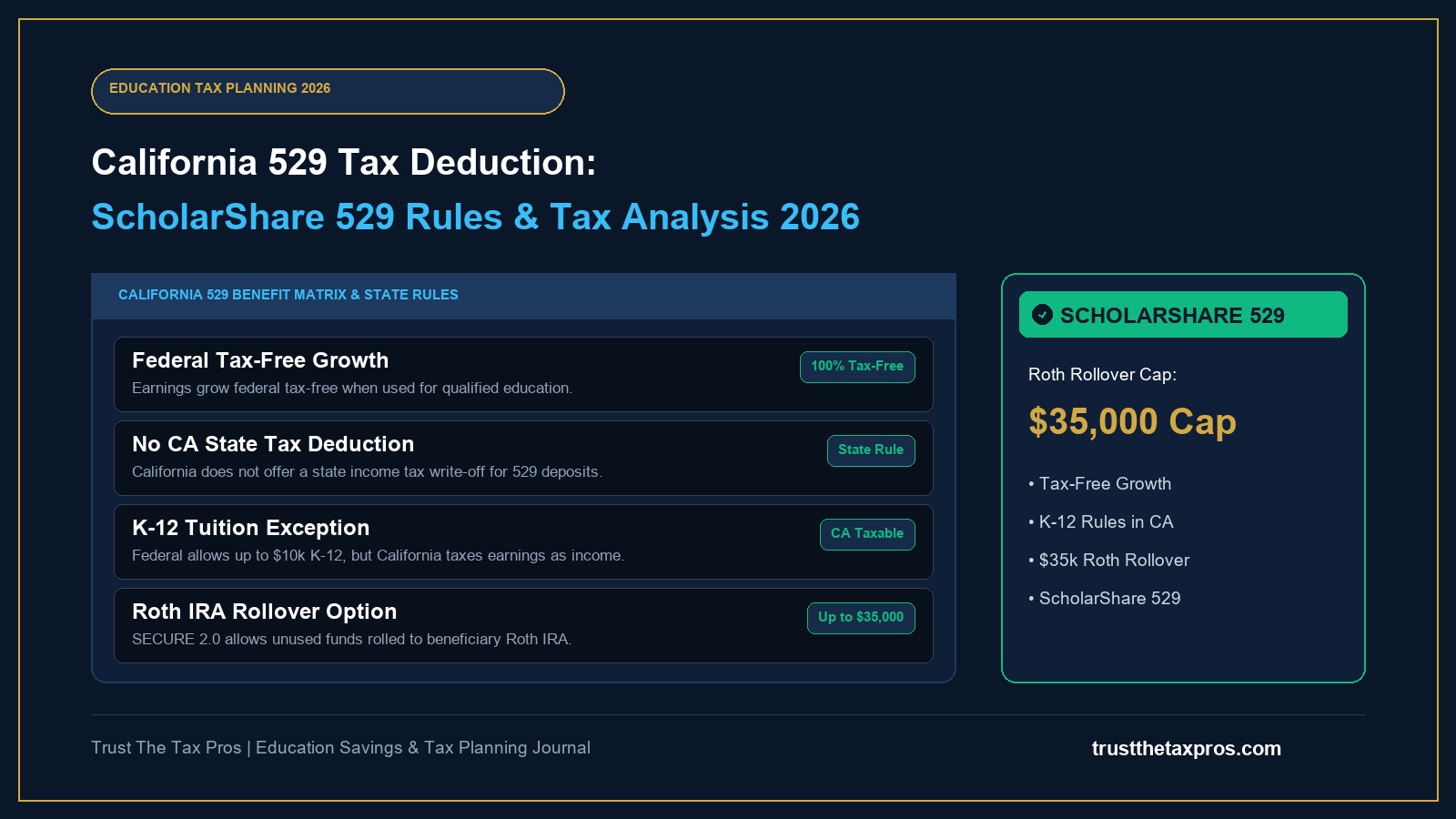
Under federal Internal Revenue Code Section 529, contributions to a college savings plan grow 100% tax-free from federal income tax. Furthermore, qualified distributions used for tuition, fees, room, board, books, and required technology are 100% exempt from federal and California state income taxes.
However, California state tax law differs from over 30 other US states regarding state tax deductions:
- No California State Income Tax Deduction: California taxpayers cannot claim a state income tax deduction or tax credit for contributions made to ScholarShare 529 or any out-of-state 529 plan.
- Parity for All 529 Plans: Because California does not provide a state tax break for its own plan, California residents can choose any state’s 529 plan without forfeiting state tax benefits.
- Tax-Free State Growth & Withdrawals: Despite the lack of a contribution deduction, California fully honors tax-free investment growth and tax-free qualified distributions.
| 529 Tax Benefit Category | Federal Tax Rule | California FTB State Tax Rule | Primary Savings Advantage |
|---|---|---|---|
| Contribution Deduction | No federal deduction | No CA state deduction | Freedom to choose low-cost 529 plans nationwide |
| Investment Growth | 100% Tax-Free | 100% Tax-Free | Compounding capital gains without annual tax drag |
| Qualified Withdrawals | 100% Tax-Free | 100% Tax-Free | Zero tax owed when used for college or trade school |

2. California ScholarShare 529 Plan Features and Benefits
California’s official state-sponsored 529 plan is ScholarShare 529, managed by TIAA-CREF Tuition Financing, Inc. under the direction of the California ScholarShare Investment Board.
- Low Expense Ratios: ScholarShare 529 offers some of the lowest management fees in the nation, ensuring more money stays invested.
- Flexible Investment Options: Choose age-based portfolios that automatically shift from growth stocks to conservative bonds as college approaches.
- High Contribution Limits: California permits maximum lifetime 529 account balances up to $529,000 per beneficiary.
SECURE 2.0 Act: Tax-Free 529 to Roth IRA Rollover Rules
A major concern for parents is overfunding a 529 plan if a child receives scholarships or decides not to attend college. Thanks to the federal SECURE 2.0 Act, account owners can roll over unused 529 funds directly into a Roth IRA for the beneficiary without federal or California state tax penalties, subject to specific rules:
- Lifetime Rollover Limit: Maximum lifetime rollover of $35,000 per beneficiary.
- Account Longevity Requirement: The 529 account must have been open for at least 15 years.
- Contribution Seasoning: Rollover funds must have been contributed to the 529 account at least 5 years prior to the transfer.
For small business tax planning advice, explore our small business tax accountant guide.
3. Qualified Education Expenses Covered by 529 Plans
To avoid tax penalties, 529 withdrawals must be used for IRS and Franchise Tax Board approved higher education costs.
Qualified vs Non-Qualified Expenses
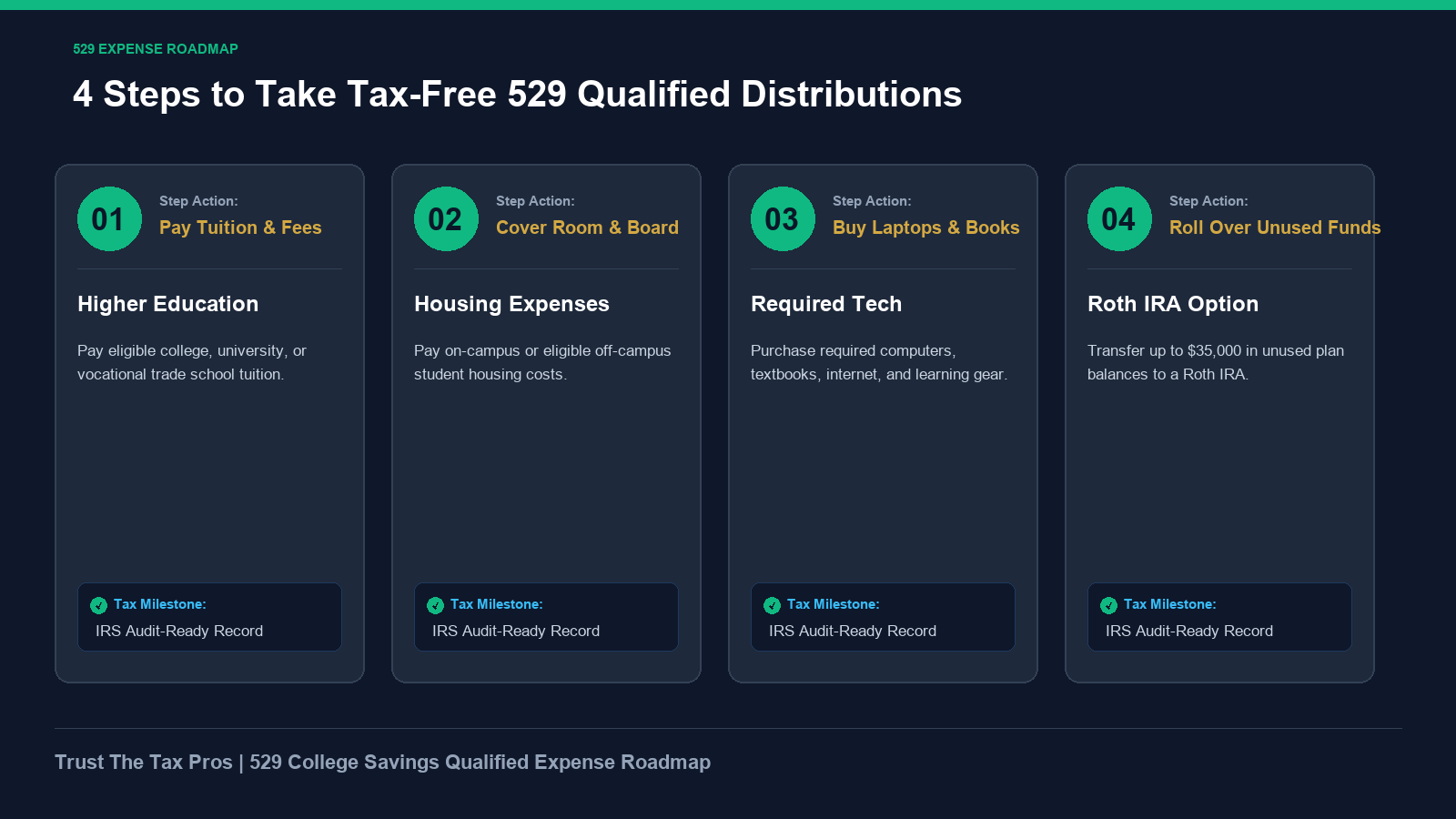
- Qualified College Expenses (100% Tax-Free): College tuition, mandatory fees, room and board (for students enrolled at least half-time), textbooks, computers, software, and internet access.
- Apprenticeship & Student Loan Payments: Up to $10,000 lifetime in 529 funds can be used to pay off qualified student loan debt.
- Non-Qualified Expenses (Penalty Applies): Withdrawals used for non-educational expenses incur regular income tax plus a 10% federal penalty and 2.5% California state tax penalty on the earnings portion.
Review official state credit relief through the California earned income tax credit guide.
Verify official 529 regulatory guidelines on the California Franchise Tax Board official portal.
If you need personalized wealth management or tax advice in California, consult a Sacramento tax accountant.
Frequently Asked Questions
Is a 529 contribution state tax deductible in California?
No. California state tax code does not allow a state income tax deduction or credit for 529 plan contributions.
Are 529 plan withdrawals tax-free in California?
Yes. As long as withdrawals are used for qualified higher education expenses, all investment growth and distributions are 100% tax-free at both federal and California state levels.
Can California residents invest in out-of-state 529 plans?
Yes. Because California does not offer a state tax deduction for its own ScholarShare 529 plan, California residents can invest in any state’s 529 plan without giving up state tax benefits.
Can unused 529 funds be transferred to a Roth IRA?
Yes. Under SECURE 2.0 Act rules, up to $35,000 in unused 529 funds can be rolled over tax-free into a Roth IRA for the account beneficiary, provided the 529 account has been open for at least 15 years.
Final Steps: Build Your College Savings Tax Strategy
Although California does not grant a state tax deduction for 529 contributions, the tax-free compounding growth and tax-free distribution benefits make 529 plans an essential component of smart family financial planning.
Start early, select low-cost investment options, and consult a credentialed financial advisor or CPA to maximize your education savings tax efficiency.