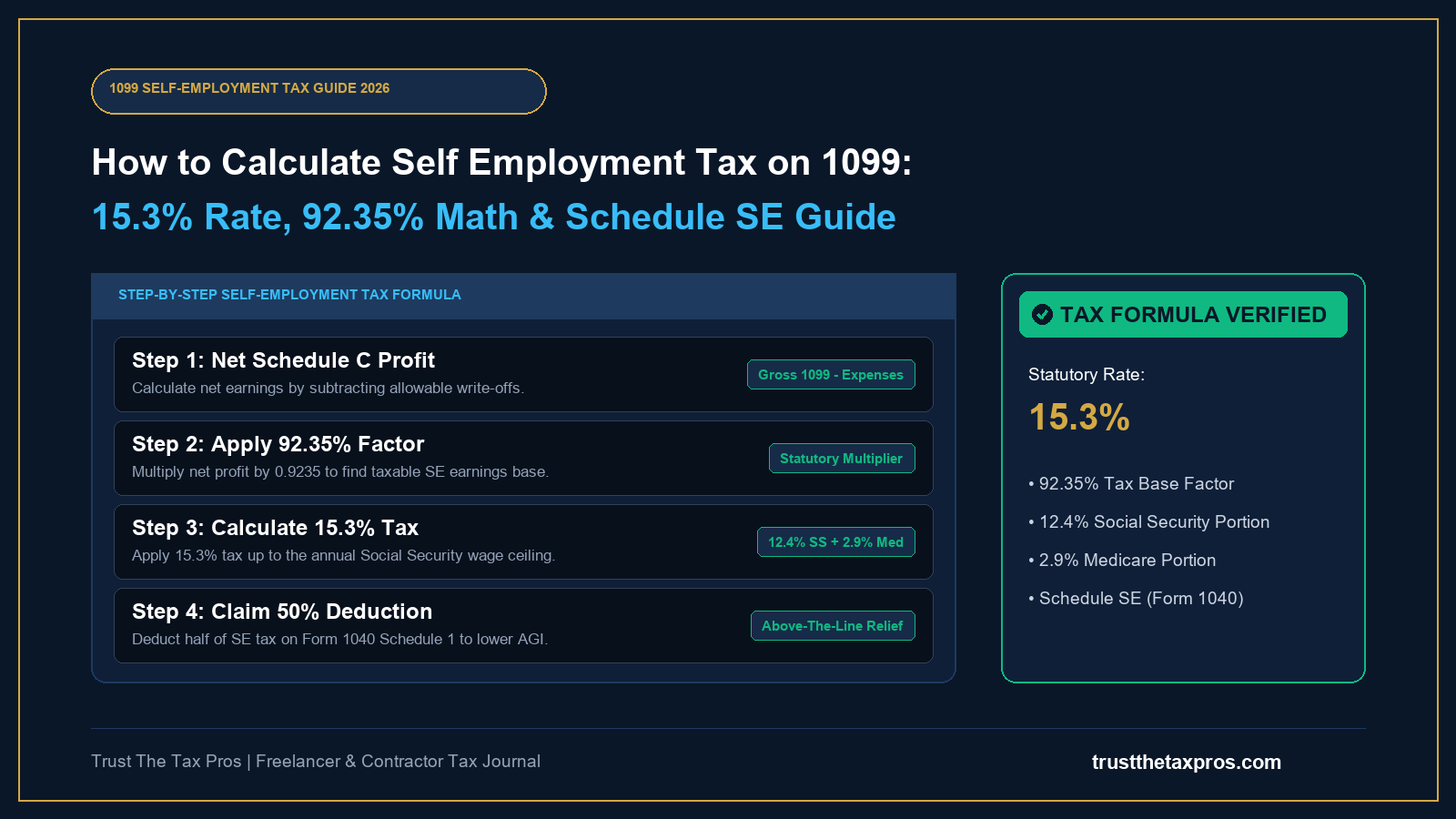
- The Statutory Tax Rate: Self-employment tax equals 15.3% (12.4% Social Security + 2.9% Medicare) under IRC Section 1401.
- The 92.35% Tax Base Adjustment: Tax is not computed on 100% of your profit. You multiply net Schedule C earnings by 0.9235 (92.35%) before applying the 15.3% rate.
- Social Security Wage Cap: The 12.4% Social Security tax only applies up to the annual statutory wage threshold ($168,600+), while the 2.9% Medicare tax has no income ceiling.
- Above-the-Line Write-Off: You deduct 50% of your total SE tax on Form 1040 Schedule 1 Line 15 to reduce your Adjusted Gross Income (AGI).
Switching from a traditional W-2 job to 1099 independent contractor or freelance work delivers immense financial freedom, but it frequently leads to unpleasant tax surprises. Traditional employees only see half of FICA taxes deducted from their paychecks because employers pay the matching 7.65% share. In contrast, 1099 independent workers are classified as both the employer and employee.
Consequently, self-employed individuals must pay the complete 15.3% self-employment tax on their net business earnings. Learning how to calculate self employment tax on 1099 income is essential for estimating quarterly payments, avoiding IRS penalties, and claiming legal tax deductions that protect your cash flow.
This comprehensive guide details the exact mathematical formula used on IRS Schedule SE, explains the statutory 92.35% multiplier, breaks down Social Security wage base thresholds, and demonstrates how to claim the 50% above-the-line deduction to lower your federal income tax burden. Freelancers in California can see the state side of this math in our guide to the self employment tax rate in California.
What Is Self-Employment Tax and Who Is Required to Pay It?
Federal self-employment tax is authorized under Chapter 2 of the Internal Revenue Code (IRC § 1401). It funds your contributions to the federal Old-Age, Survivors, and Disability Insurance (Social Security) and Hospital Insurance (Medicare) trust funds.
If you operate as a sole proprietor, independent contractor, freelance professional, or single-member LLC, you must pay self-employment tax if your net profit from self-employment reaches $400 or more during the calendar year. Gross revenue reported in Box 1 of your Form 1099-NEC or Form 1099-K does not determine your tax; rather, tax is calculated solely on your net taxable business earnings.
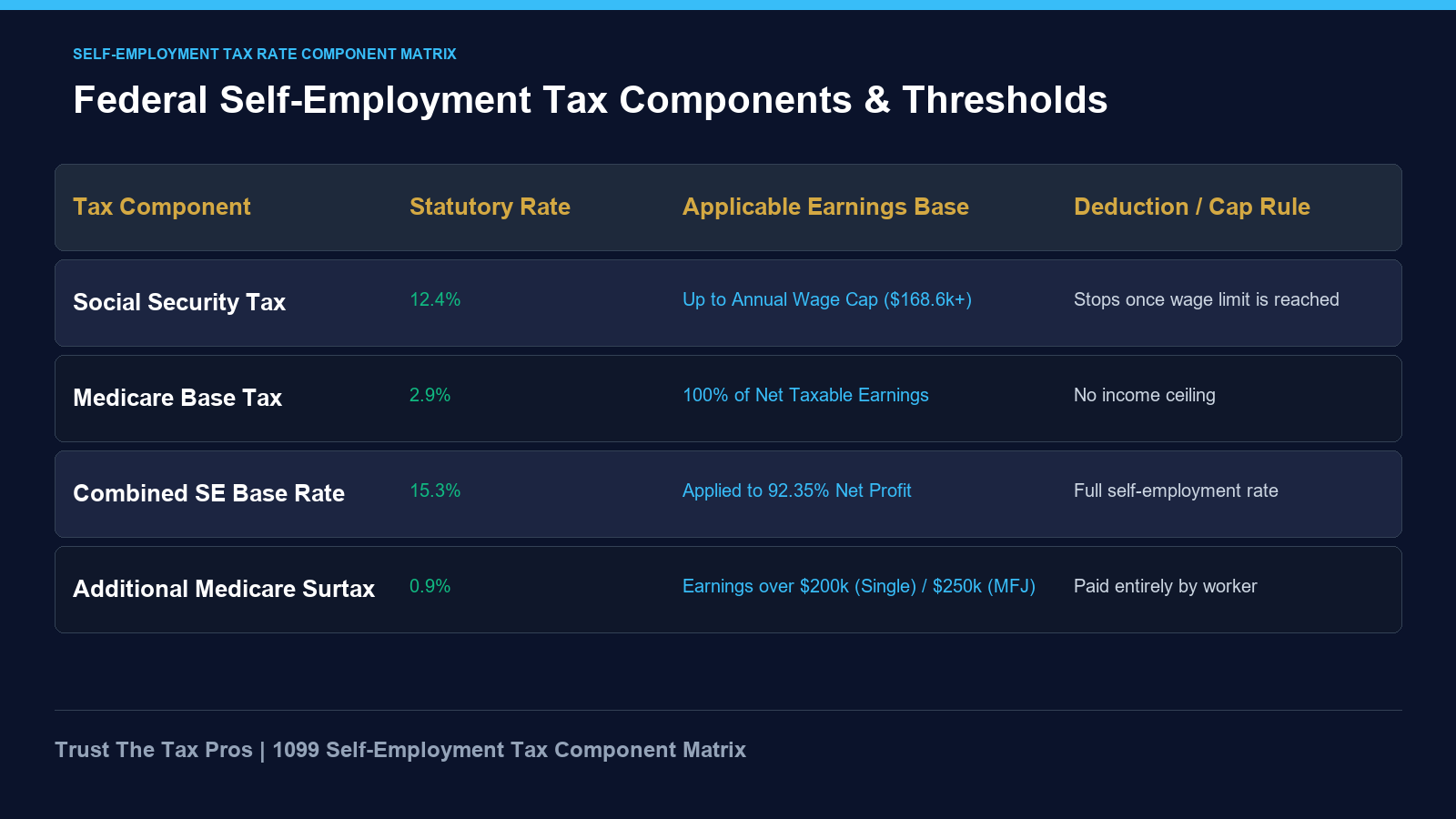
| Tax Component | Statutory Rate | Applicable Wage Base | Cap or Threshold Rule |
|---|---|---|---|
| Social Security (OASDI) | 12.4% | First $168,600+ of earnings | Stops once annual wage base cap is met |
| Medicare Base (HI) | 2.9% | 100% of Net Taxable Profit | No income ceiling (unlimited base) |
| Combined Base SE Rate | 15.3% | 92.35% of Schedule C Net Profit | Standard rate for self-employed workers |
| Additional Medicare Surtax | 0.9% | Profit above $200k (Single) / $250k (MFJ) | Paid solely by taxpayer; no employer match |
To verify which business expenses you can legally subtract before calculating self-employment tax, use our interactive 1099 tax calculator with deductions.
The Step-by-Step Formula to Calculate Self Employment Tax
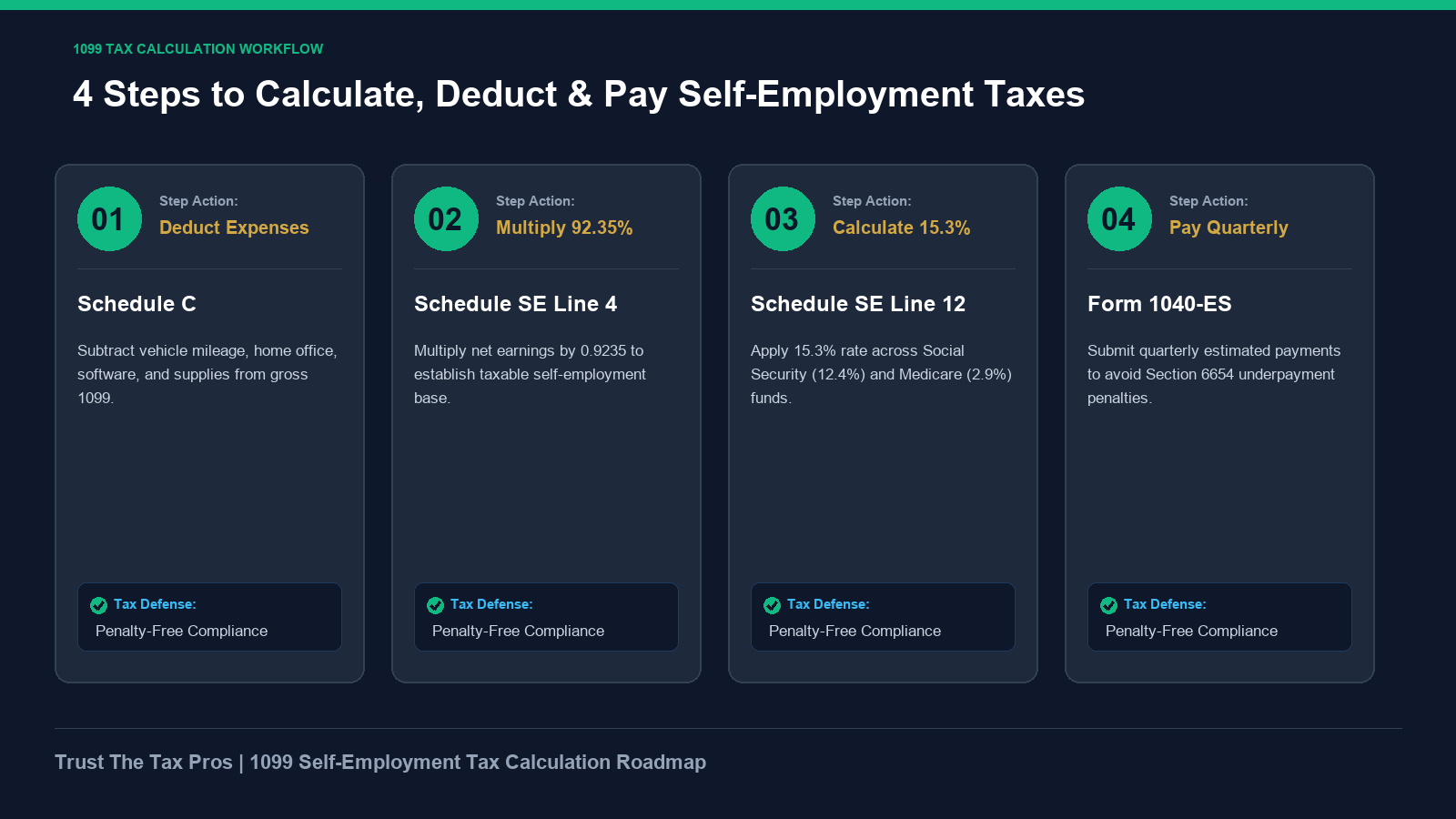
Calculating your self-employment tax liability involves four distinct mathematical steps. Following this standardized workflow prevents arithmetic errors when completing your annual federal return.
- Calculate Net Schedule C Profit: Take your total gross 1099 income and subtract all allowable trade or business expenses (vehicle mileage, supplies, advertising, and home office costs).
- Multiply by the 92.35% Factor: Multiply your net profit from Step 1 by 0.9235. This establishes your net earnings subject to self-employment tax.
- Compute the 15.3% Tax Rate: Multiply the adjusted net earnings by 15.3% (or calculate 12.4% for Social Security up to the wage limit, plus 2.9% for Medicare on the full amount).
- Calculate the 50% Above-the-Line Deduction: Divide your total self-employment tax liability from Step 3 by 2. This amount is entered on Form 1040 Schedule 1 to reduce your Adjusted Gross Income.
Let us look at a real-world numerical example. Suppose an independent software developer generates $120,000 in gross 1099 revenue and incurs $20,000 in qualifying business write-offs, leaving a net profit of $100,000.
- Step 1: Net Profit: $100,000
- Step 2: Adjusted Base (92.35%): $100,000 × 0.9235 = $92,350
- Step 3: Social Security Tax (12.4%): $92,350 × 0.124 = $11,451.40
- Step 4: Medicare Tax (2.9%): $92,350 × 0.029 = $2,678.15
- Total Self-Employment Tax: $11,451.40 + $2,678.15 = $14,129.55
- Above-the-Line Deduction (50%): $14,129.55 ÷ 2 = $7,064.78
If you also operate a home office for client meetings and administrative work, claim additional write-offs following our step-by-step IRS Form 8829 instructions.
- Quarterly Payment Mandate: If you expect to owe $1,000 or more in federal taxes (income tax plus self-employment tax), you must submit quarterly estimated payments.
- Safe Harbor Rule: Pay 100% of your prior year tax liability (110% if prior year AGI exceeded $150,000) or 90% of your current year tax to eliminate penalties.
- Filing Schedule: Quarterly installments are due April 15, June 15, September 15, and January 15 using Form 1040-ES.
For complete quarterly compliance deadlines and safe harbor calculation examples, consult our guide on quarterly estimated taxes for LLC.
Why the IRS Multiplies Net 1099 Profit by 92.35% (0.9235)
Taxpayers often wonder why the IRS does not apply the 15.3% tax rate to 100% of net self-employment earnings. The statutory 92.35% adjustment factor exists to create parity between independent contractors and traditional W-2 employees.
In a traditional W-2 employment setting, an employer pays a 7.65% payroll tax match out of corporate funds. This 7.65% employer payment is not included in the employee gross taxable wages. In contrast, if a self-employed individual had to pay 15.3% on 100% of their net profit, they would effectively pay self-employment tax on the employer portion of their own tax.
To eliminate this inequity, Congress designed the statutory adjustment: 100% minus 7.65% equals 92.35% (0.9235). By multiplying your net business profit by 0.9235 on Line 4 of Schedule SE, you remove the employer share before computing your tax obligation.
The 50% Above-the-Line Self-Employment Tax Deduction
Beyond the 92.35% initial base reduction, the tax code provides a second major tax advantage to self-employed workers under IRC Section 164(f): the 50% self-employment tax deduction.
Corporations and employers are legally permitted to deduct the 7.65% employer payroll tax match as a deductible business expense. To grant self-employed individuals equivalent treatment, the IRS allows you to deduct exactly half (50%) of your total calculated self-employment tax directly on Schedule 1 (Form 1040), Line 15.
Crucially, this is an above-the-line deduction that reduces your Adjusted Gross Income (AGI). It is available to every self-employed taxpayer, even if you claim the standard deduction instead of itemizing write-offs on Schedule A. Reducing your AGI also helps you qualify for other income-sensitive tax credits and phase-outs.
Business owners seeking to shelter additional 1099 profits can also set up tax-deferred retirement accounts. Review our breakdown of SEP IRA contribution limits for small business to write off up to 25% of net adjusted earnings.
How to Report Self-Employment Tax on IRS Schedule SE
Self-employment tax is officially calculated and documented using IRS Schedule SE (Form 1040). Below is the line-by-line procedure for completing Part I of Schedule SE:
- Line 2 (Net Farm / Nonfarm Profit): Transfer your net profit or loss from Schedule C, Line 31.
- Line 3: Combine your net profit amounts from all business activities.
- Line 4a: Multiply Line 3 by 92.35% (0.9235). If the result is less than $400, you do not owe self-employment tax.
- Line 10 (Social Security Calculation): Enter the smaller of your Line 4a amount or the annual Social Security maximum wage limit ($168,600+), then multiply by 12.4%.
- Line 11 (Medicare Calculation): Multiply your total Line 4a amount by 2.9%.
- Line 12 (Total Self-Employment Tax): Add Lines 10 and 11. Enter this total on Form 1040, Schedule 2, Line 4 (Other Taxes).
- Line 13 (Deduction for One-Half of SE Tax): Multiply Line 12 by 50% (0.50). Enter this result on Form 1040, Schedule 1, Line 15.
Frequently Asked Questions About 1099 Self-Employment Tax
What is the self-employment tax rate on 1099 income?
The federal self-employment tax rate is 15.3%. This is made up of two distinct components: 12.4% for Social Security and 2.9% for Medicare. It applies to 92.35% of your net business profit after subtracting legitimate business expenses.
Do I have to pay self-employment tax if I have a W-2 job as well?
Yes. 1099 income is subject to self-employment tax regardless of whether you have W-2 wages. However, if your W-2 wages already reach or exceed the annual Social Security wage cap ($168,600+), your 1099 income is exempt from the 12.4% Social Security portion and only pays the 2.9% Medicare tax.
What expenses can I deduct to reduce my self-employment tax?
Any ordinary and necessary trade or business expense deducted on Schedule C reduces your net profit, which directly lowers your self-employment tax. Common deductions include business vehicle mileage, advertising, software subscriptions, office supplies, equipment depreciation, and the home office deduction.
Is self-employment tax the same as federal income tax?
No. Self-employment tax is separate from federal income tax. Self-employment tax covers Social Security and Medicare obligations at a flat statutory rate, whereas federal income tax is calculated on your taxable income using progressive tax brackets ranging from 10% to 37%.
How do I avoid high self-employment tax legally?
Small business owners earning substantial profits often elect S-Corporation tax status under IRS Form 2553. Under an S-Corp, owners pay self-employment tax only on a reasonable W-2 salary, while remaining business profits are distributed as dividends exempt from the 15.3% tax.