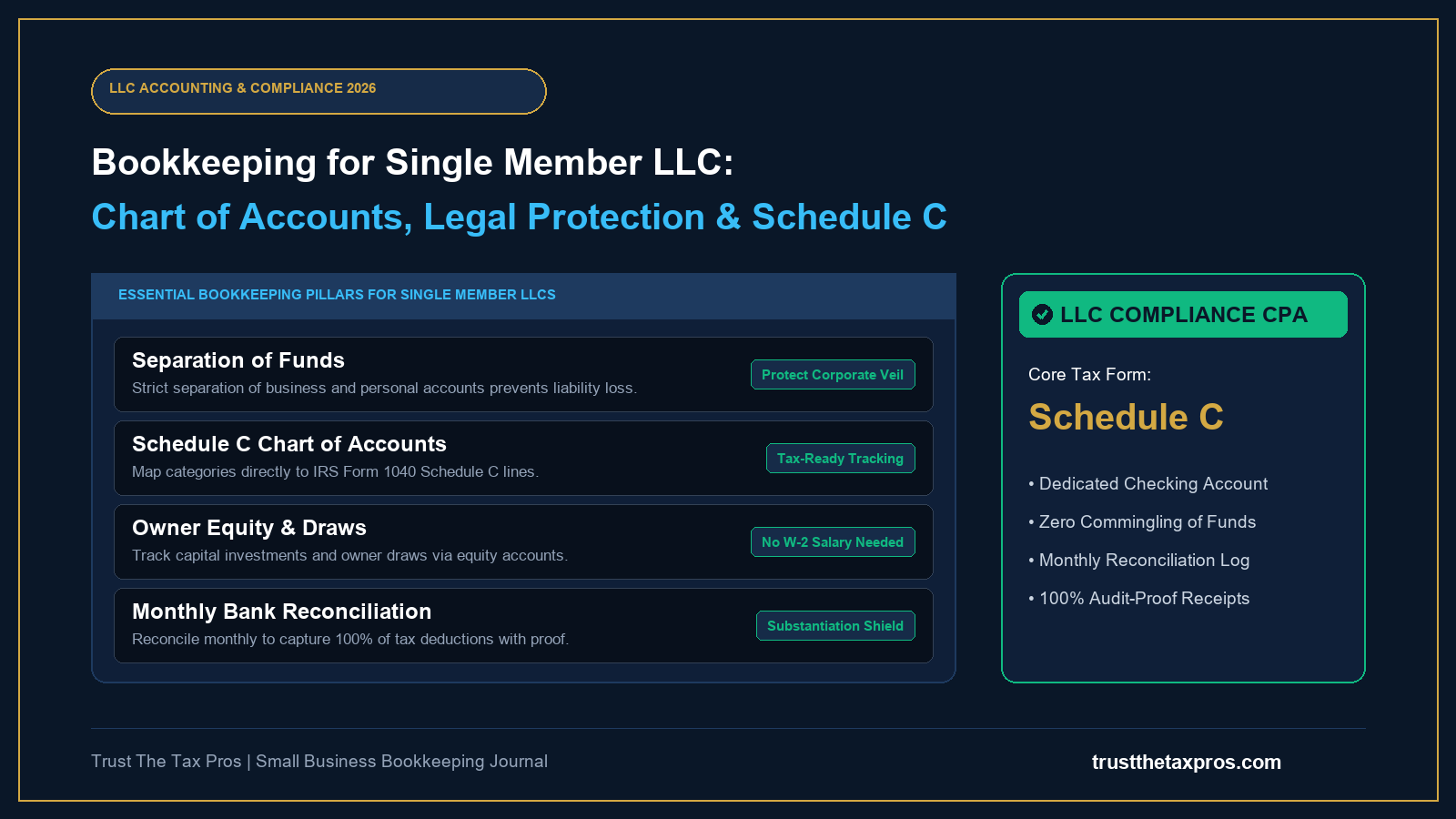
Forming a Single-Member Limited Liability Company (SMLLC) is one of the most popular ways for entrepreneurs, freelancers, and independent contractors to protect their personal assets. However, many business owners mistakenly believe that forming the LLC is enough to maintain legal protection. Without disciplined accounting, your limited liability shield can easily vanish.
Effective bookkeeping for single member llc owners accomplishes two non-negotiable goals: it prevents courts from “piercing the corporate veil” through illegal commingling of funds, and it builds a clean, audit-proof record that maps directly into IRS Schedule C. This comprehensive guide covers chart of accounts setup, owner draws vs. salary, and monthly reconciliation workflows.
1. Why Proper LLC Bookkeeping is Legally Mandatory
By default, the IRS classifies a single-member LLC as a “disregarded entity” for federal tax purposes. This means the entity itself does not pay corporate income tax; instead, all revenue and deductions flow directly onto Schedule C (Form 1040) of your personal return.
The primary reason to form an LLC is to shield your personal savings, home, and personal investments from business lawsuits and debts. However, if you commingle business and personal funds—such as paying for personal groceries with an LLC debit card—a judge can rule that the LLC is a mere “alter ego.”
This legal doctrine is known as piercing the corporate veil. Once pierced, creditors can seize your personal assets to satisfy business liabilities. Meticulous bookkeeping and separate banking are your primary legal defense.
Learn how to file your business taxes for the first time in our LLC first-time tax filing guide.
2. Designing a Schedule C-Aligned Chart of Accounts
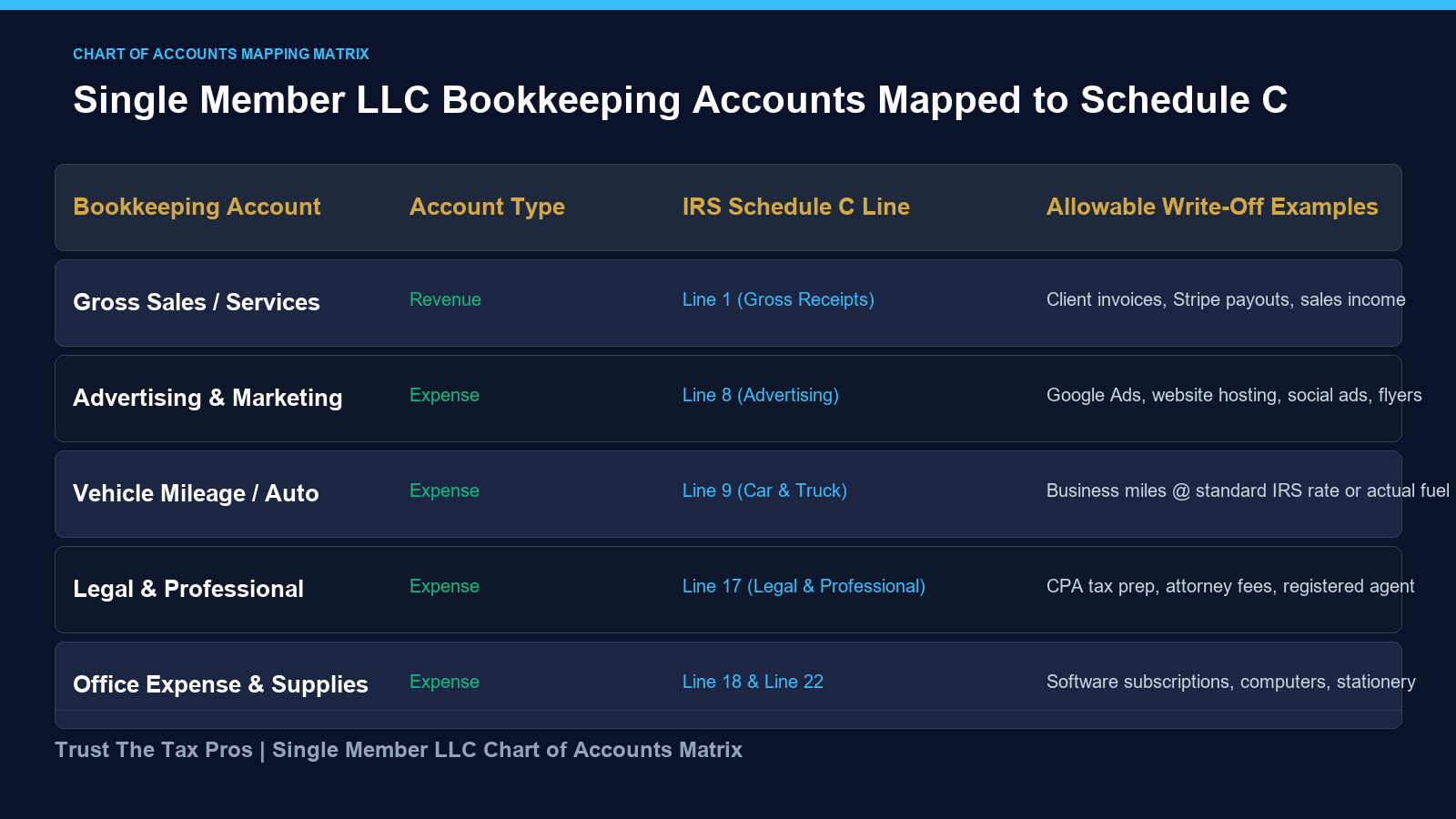
A Chart of Accounts (COA) is the structural backbone of your bookkeeping system. To eliminate tax preparation friction at year-end, structure your expense categories to mirror the exact line numbers on IRS Form 1040 Schedule C:
| Account Category | Account Type | IRS Schedule C Line | Typical Allowable Expenses |
|---|---|---|---|
| Gross Sales & Revenue | Income | Line 1 (Gross Receipts) | Client payments, consulting fees, product sales |
| Advertising & Marketing | Expense | Line 8 (Advertising) | Google/Meta Ads, website hosting, design |
| Car and Truck Expenses | Expense | Line 9 (Car & Truck) | Business mileage @ IRS rate or actual fuel |
| Legal & Professional | Expense | Line 17 (Legal & Professional) | CPA tax prep, attorney fees, registered agent |
| Office Expenses & Software | Expense | Line 18 (Office Expense) | QuickBooks, Slack, Zoom, printer supplies |
| Owner Equity / Draws | Equity | Balance Sheet (Not Deductible) | Transfers to owner’s personal bank account |
3. Owner Draws vs. W-2 Salary: How to Pay Yourself
A frequent error among new single-member LLC owners is attempting to put themselves on payroll. Under IRS guidelines:
- You Cannot Pay Yourself a W-2 Salary: As a sole owner of a disregarded entity, you are not considered an employee of the LLC. You cannot issue yourself a Form W-2 or withhold payroll taxes on your earnings.
- Pay Yourself via Owner Draws: Transfer funds from your business checking account to your personal bank account. Categorize this transfer in your bookkeeping software as an “Owner’s Draw” (an equity account, NOT an operating expense).
- Taxes are Based on Net Profit, Not Draws: You pay federal income and self-employment taxes on the net profit of the business regardless of how much money you withdraw or leave in the business checking account.
For tracking vehicle write-offs, explore our Schedule C vehicle mileage deduction guide.
4. The Monthly 4-Step Bookkeeping Workflow
Maintaining clean books takes less than two hours a month when following a structured monthly cadence:
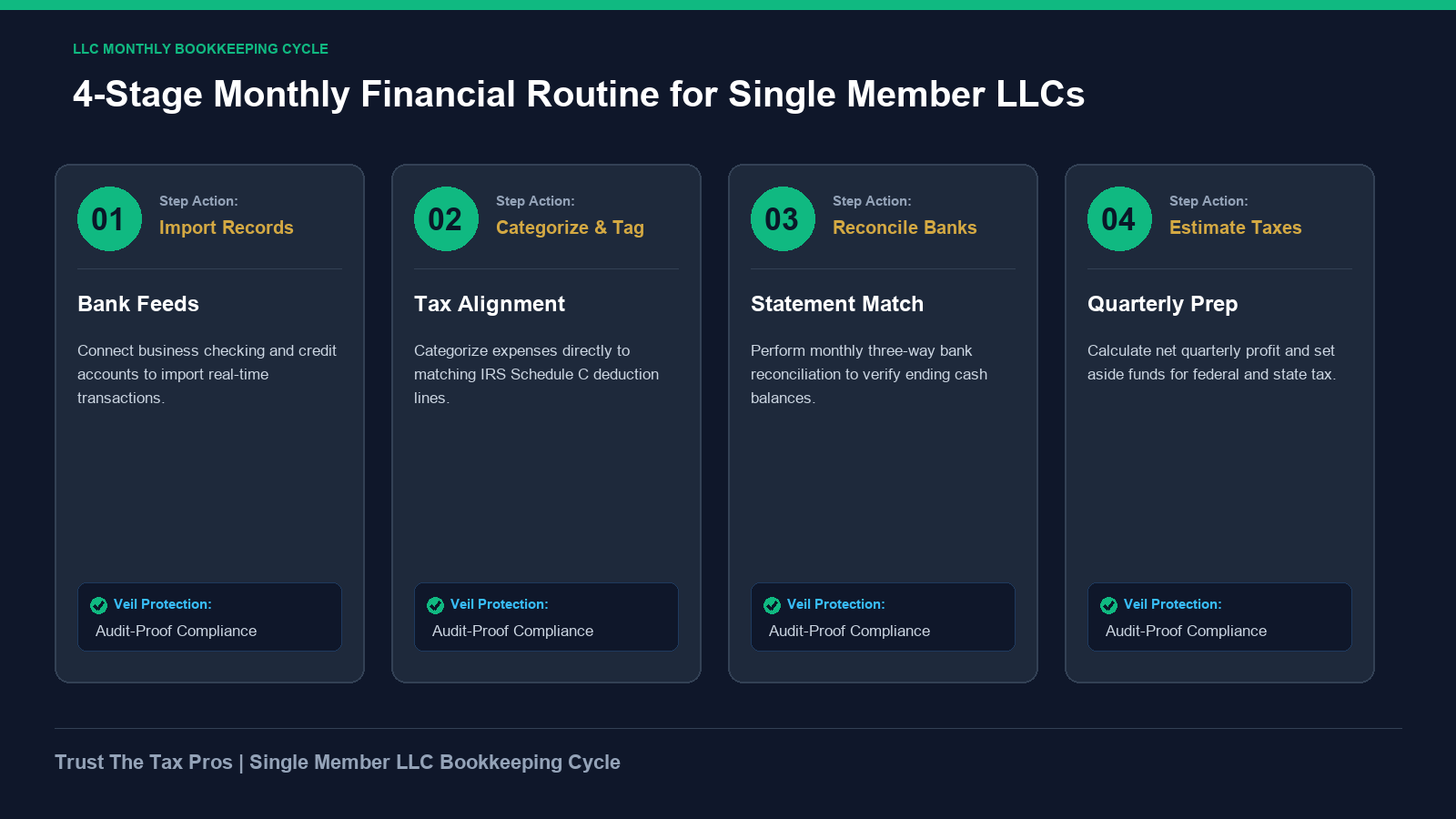
4-Step Monthly Routine
- Maintain Strict Account Separation: Ensure 100% of client deposits flow into the dedicated LLC account. Never use personal cards for business purchases, and never use LLC funds for personal bills.
- Categorize Every Transaction Weekly: Tag every bank and credit card transaction into your standardized Schedule C Chart of Accounts. Store digital receipts for any expense over $75 to comply with IRC Section 274 substantiation.
- Perform Monthly Bank Reconciliations: Reconcile your bookkeeping software ledger against official bank and credit card monthly statements to eliminate duplicate transactions or missed fees.
- Transfer Quarterly Tax Reserves (25–30%): Calculate your monthly net profit and transfer 25% to 30% of that figure into a dedicated high-yield business savings account reserved exclusively for IRS and state estimated tax payments.
Review estimated tax payment timelines in our quarterly estimated taxes for LLC guide.
Access official business deduction publications directly on the Internal Revenue Service official portal.
Frequently Asked Questions
Does a single-member LLC file a separate tax return?
By default, a single-member LLC is treated as a disregarded entity by the IRS. Its financial activity is reported on Schedule C (Profit or Loss From Business) attached to the owner’s personal Form 1040 tax return.
How does an owner pay themselves from a single-member LLC?
Single-member LLC owners do not take a W-2 paycheck. Instead, owners take Owner Draws (equity distributions) by transferring money from the business bank account to their personal bank account.
What does piercing the corporate veil mean for LLC bookkeeping?
Piercing the corporate veil occurs when a court removes an LLC’s limited liability protection because the owner commingled business and personal funds. Maintaining strict separation of bank accounts and accurate bookkeeping preserves your personal asset shield.
What is the best accounting method for a single-member LLC?
Most single-member LLCs use the Cash Method of accounting because it records income when cash is received and expenses when bills are paid, making tax filing on Schedule C simpler and directly matching bank statements.
Protect Your Business with Bulletproof Accounting
Disciplined bookkeeping for your single member LLC safeguards your personal wealth, optimizes every allowable tax deduction, and eliminates tax season panic. Set up a dedicated business bank account, align your chart of accounts with Schedule C, and reconcile statements every month.
Consult a certified public accountant or professional bookkeeping advisor to set up your accounting system and protect your business foundation.