Launching an independent tax preparation business is one of the most lucrative and resilient service ventures in the modern economy. Every working American and business entity faces mandatory annual tax filing requirements, ensuring built-in commercial demand year after year.
Contrary to common belief, you do not need to be a Certified Public Accountant (CPA) or hold an advanced accounting degree to prepare returns professionally. With the right federal credentials, professional software, and data security infrastructure, you can build a highly profitable seasonal or year-round practice operating from home or an office.
This comprehensive roadmap walks you through IRS credentialing steps, EFIN application rules, software comparisons, state registration mandates, fee pricing models, and client acquisition strategies.
Step 1: Obtain Your IRS PTIN and State Licenses
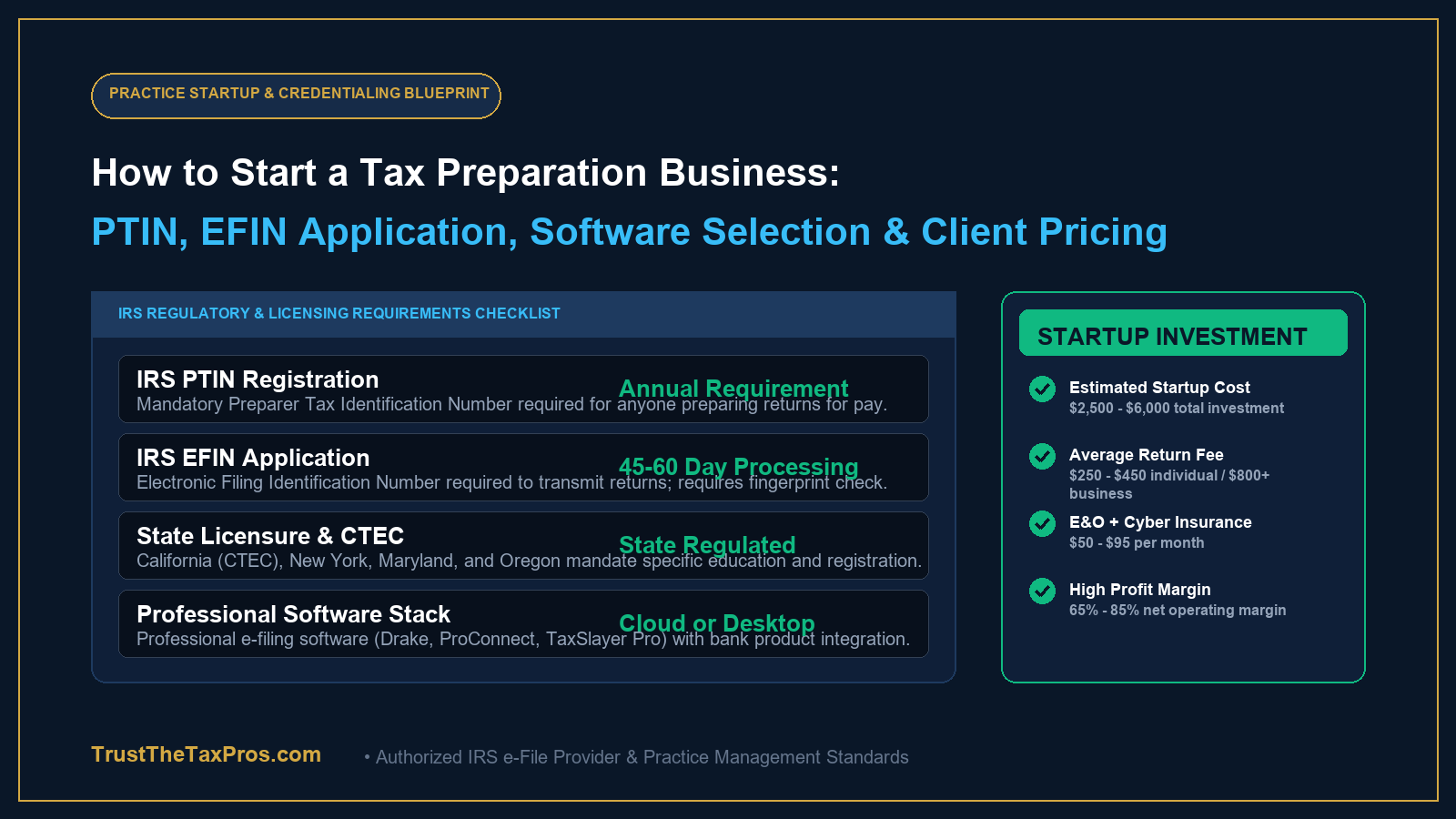
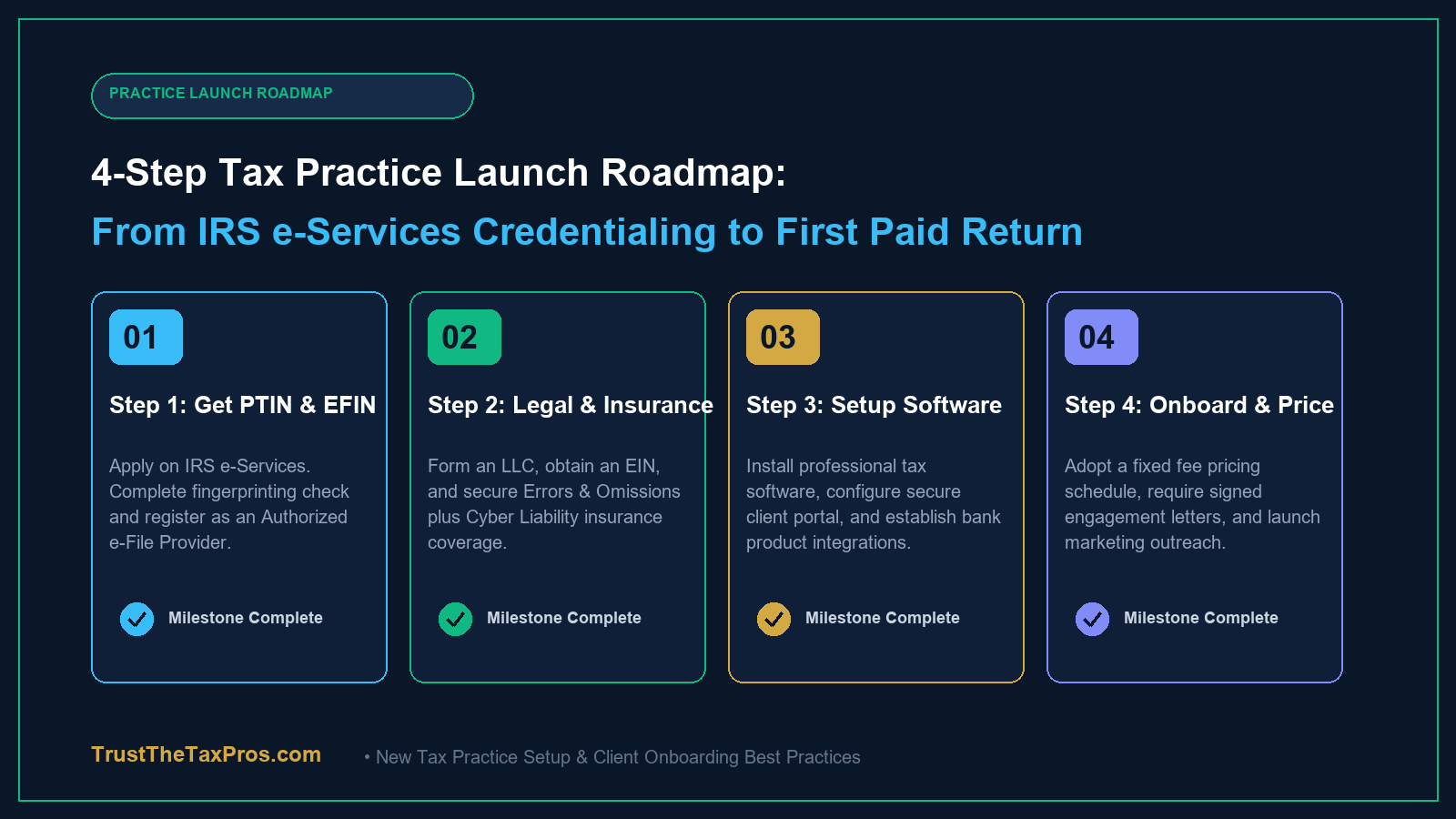
Federal law requires anyone who prepares or assists in preparing federal tax returns for compensation to have a valid Preparer Tax Identification Number (PTIN). Preparing returns without an active PTIN exposes you to severe civil penalties under Internal Revenue Code Section 6695.
You can register for a PTIN online in less than fifteen minutes through the IRS PTIN System for Paid Tax Return Preparers. The annual registration fee is modest (approximately $19.75), and renewals open each October for the upcoming filing season.
While the federal government does not require a testing license for basic preparers, several states enforce strict consumer protection laws. If you prepare returns in any of the following jurisdictions, you must fulfill state licensing mandates:
- California: Must complete 60 hours of qualifying education, purchase a $5,000 tax preparer surety bond, and register with the California Tax Education Council (CTEC).
- New York: Must register annually with the New York Department of Taxation and Finance and fulfill continuing education credits.
- Maryland: Requires passing the Maryland Tax Preparer Examination and registering with the state board.
- Oregon: Operates the strictest standards, requiring 80 hours of education and passing a state board examination for a Licensed Tax Preparer credential.
| Credential / Requirement | Governing Body | Processing Time | Cost Benchmark |
|---|---|---|---|
| IRS PTIN | Internal Revenue Service | Instant (Online) | ~$20 / year |
| IRS EFIN | IRS e-Services Division | 45 – 60 Days | Free (Plus ~$50 fingerprinting) |
| State License (CTEC / NY / OR / MD) | State Department of Revenue | 2 – 4 Weeks | $150 – $400 (Course + Bond + Fee) |
| Errors & Omissions Insurance | Commercial Insurance Carrier | Same Day | $400 – $800 / year |
For individuals seeking long-term professional credibility, earning the IRS Enrolled Agent credential provides unlimited representation rights across all fifty states. Review representation standards in our guide to IRS audit representation rights.
- What Is an EFIN? An Electronic Filing Identification Number (EFIN) authorizes your firm to transmit client tax returns directly to IRS processing centers. You cannot e-file returns with only a PTIN.
- Start 60 Days Before Tax Season: The IRS conducts an FBI criminal background check and credit check on all applicants. Applying through IRS Authorized e-File Provider Services by October guarantees your credentials arrive before January filing opening.
Step 2: Choose Your Business Entity and Secure Insurance
Operating as a sole proprietor exposes your personal assets (home, personal savings, personal vehicles) to client malpractice claims. Forming a Single-Member LLC or Professional LLC establishes a legal barrier protecting personal wealth from business debts.
Register your LLC with your Secretary of State and request a free Employer Identification Number (EIN) from the IRS website. Consult our foundational tutorial on filing business taxes for an LLC to set up corporate compliance properly.
Never file a tax return for pay without active Errors and Omissions (E&O) insurance and Cyber Liability insurance. If a calculation mistake causes an underpayment, insurance covers legal defense fees and client penalties. Explore coverage limits and provider comparisons in our detailed guide on tax preparer liability insurance.
Step 3: Select Your Professional Tax Software Stack
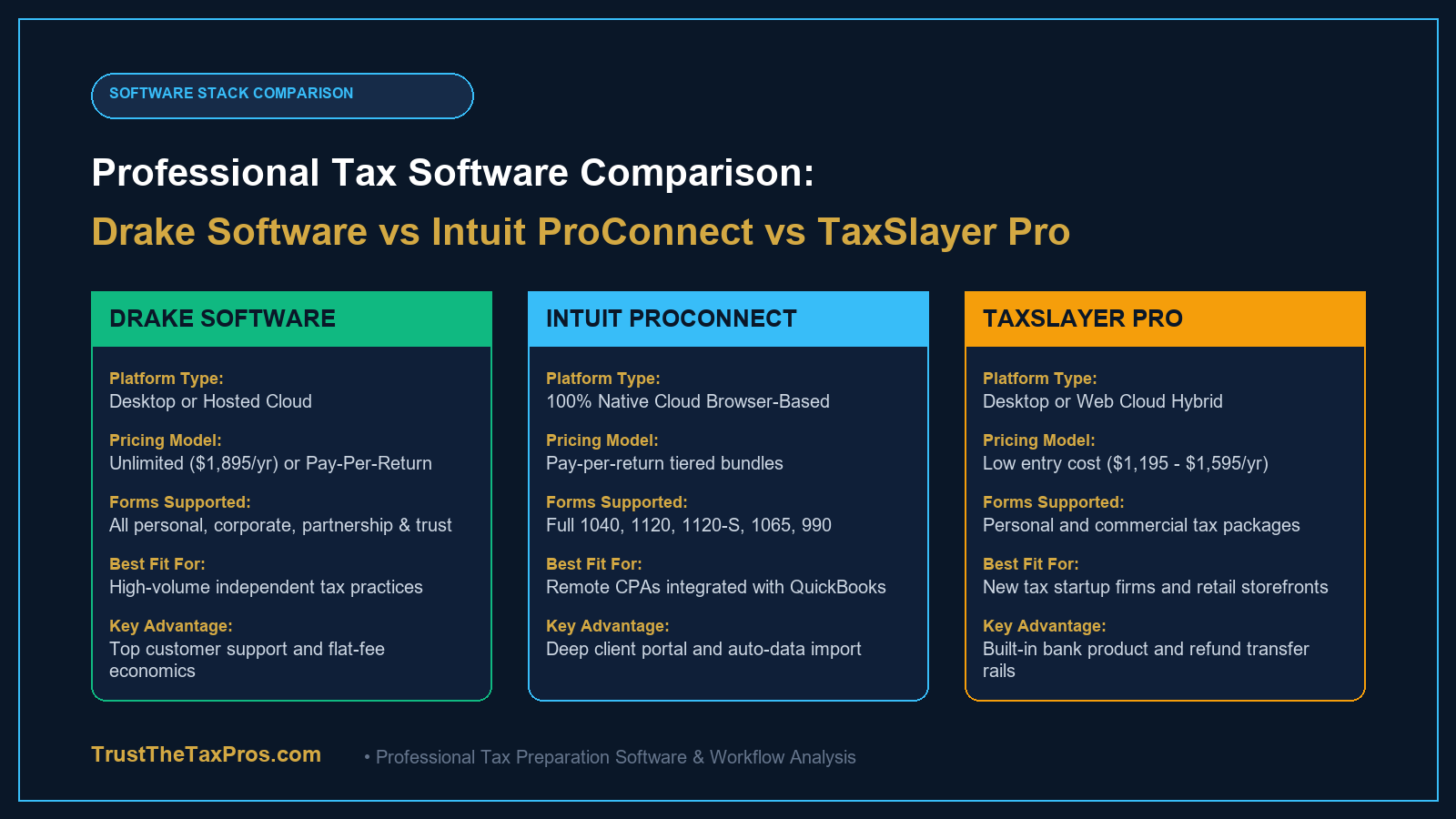
Consumer tax software (like TurboTax or H&R Block retail editions) cannot be legally used to prepare returns for compensation. You must invest in commercial tax software designed for professional tax preparers:
1. Drake Software
Drake Software is the most popular choice for independent and high-volume tax offices. It offers comprehensive coverage for individual, corporate, partnership, estate, and non-profit returns. Drake provides an unlimited filing package for approximately $1,895 per year or a flexible Pay-Per-Return option for startups.
2. Intuit ProConnect Tax
ProConnect is a 100% cloud-based software that runs directly inside your web browser. It integrates seamlessly with QuickBooks Online Accountant, making it ideal for bookkeepers expanding into tax preparation. ProConnect operates on a pay-per-return model, eliminating hefty upfront capital expenditures.
3. TaxSlayer Pro
TaxSlayer Pro is an affordable, user-friendly desktop and cloud hybrid solution widely favored by retail storefronts and mobile preparers. Packages range from $1,195 to $1,595 annually, featuring robust integrations with bank refund transfer products.
Step 4: Establish Mandatory Data Security Safeguards (WISP)
The IRS requires all tax professionals to safeguard sensitive client financial records. Federal law under the Federal Trade Commission Safeguards Rule mandates that every tax practice must maintain a Written Information Security Plan (WISP).
Your security plan must document password standards, multi-factor authentication protocols, firewall configurations, and secure document disposal routines. Tax practices can access free implementation templates through the National Association of Tax Professionals (NATP).
Ensure that all client documents (W-2s, 1099s, bank records) are collected through an encrypted client portal rather than unencrypted email attachments. Transmitting unencrypted Social Security Numbers via email violates federal privacy rules and exposes your firm to substantial regulatory fines.
Step 5: Set Your Fee Structure and Onboard First Clients
Establishing confident pricing from day one prevents undercharging and burnout. Accounting practices generally utilize one of three pricing models:
- Flat-Fee by Return Complexity (Recommended): Set transparent flat prices based on form schedules. Charge $250 for basic W-2 returns, $450 for Schedule C self-employed returns, and $1,200 for business entities (Form 1120-S / 1065).
- Per-Form Pricing: Charge a base fee plus line-item charges for each schedule filed (e.g., $150 base + $75 for Schedule C + $50 for Schedule E). While common in franchise chains, clients often find this model unpredictable.
- Value-Based Advisory Retainers: Bundle tax return filing with quarterly tax planning sessions, bookkeeping reviews, and year-round consultation for $250 to $750 per month. Review advisory fee structures in our small business CPA selection guide.
Acquire initial clients by networking with local real estate agents, independent mortgage brokers, and small business attorneys who regularly encounter clients needing trusted tax referrals. Launch a professional website, optimize your Google Business Profile, and offer clear digital appointment scheduling.
Frequently Asked Questions
Do you need a degree or CPA license to start a tax preparation business?
No. You do not need a college accounting degree or a CPA license to prepare federal tax returns for compensation. You only need to obtain a Preparer Tax Identification Number (PTIN) and an Electronic Filing Identification Number (EFIN) from the IRS, subject to any state-specific registration laws.
How much does it cost to start a tax preparation business?
Starting a home-based or virtual tax preparation practice typically costs between $2,000 and $5,500. Major expenses include tax preparation software ($1,200 to $2,000), LLC formation and legal filing ($200 to $800), E&O insurance ($400 to $800), computer equipment, and client portal security.
How long does it take to get an IRS EFIN?
Obtaining an Electronic Filing Identification Number (EFIN) typically takes between 45 and 60 days. The IRS requires applicants to pass a suitability background check and submit digital fingerprint cards unless they are an active CPA, attorney, or Enrolled Agent.
Which states require independent tax preparers to be licensed?
Currently, California (CTEC registration), New York, Maryland, and Oregon have formal regulatory requirements, continuing education mandates, and registration fees for non-credentialed paid tax return preparers. Most other states only require standard IRS federal registration.
How much should a new tax preparer charge per return?
Industry fee surveys indicate that independent preparers charge an average of $225 to $350 for a standard Form 1040 with itemized deductions, $450 to $700 for Schedule C freelancer returns, and $900 to $1,800+ for corporate returns (Form 1120-S and 1065).