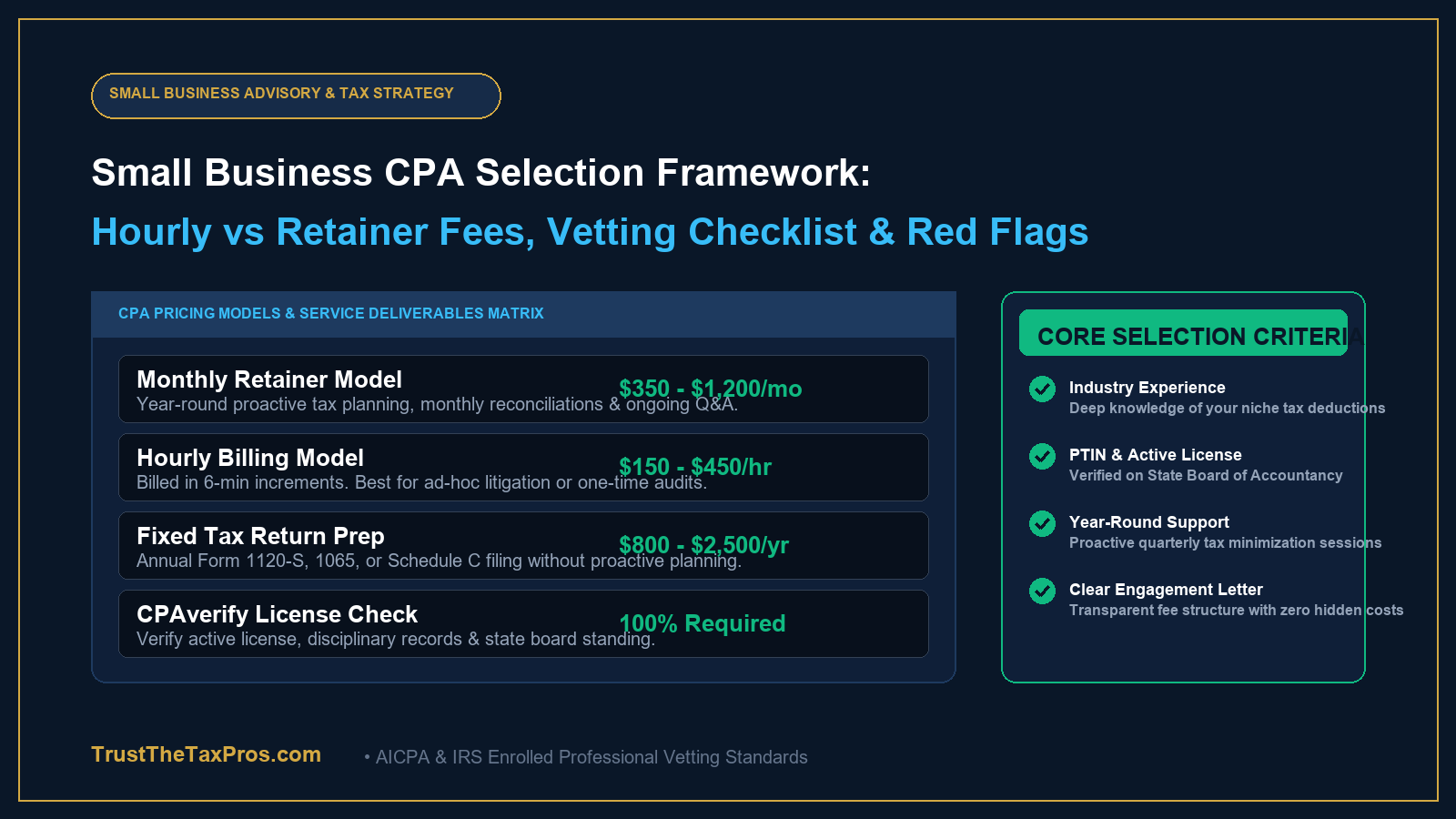
Searching for a qualified small business cpa near me is one of the highest-leverage financial moves an entrepreneur can make. A seasoned Certified Public Accountant protects your cash flow, identifies legal tax deductions, and keeps your entity fully compliant with federal and state revenue authorities.
Many business owners wait until tax season to reach out to an accountant. That reactive approach often leads to missed write-offs, costly filing penalties, and rushed advisory conversations. Finding an accounting professional who understands your industry allows you to plan your tax obligations proactively throughout the entire year.
This comprehensive advisory guide breaks down exact CPA fee structures, credential verification steps, must-ask interview questions, and warning signs to watch out for before signing an engagement letter.
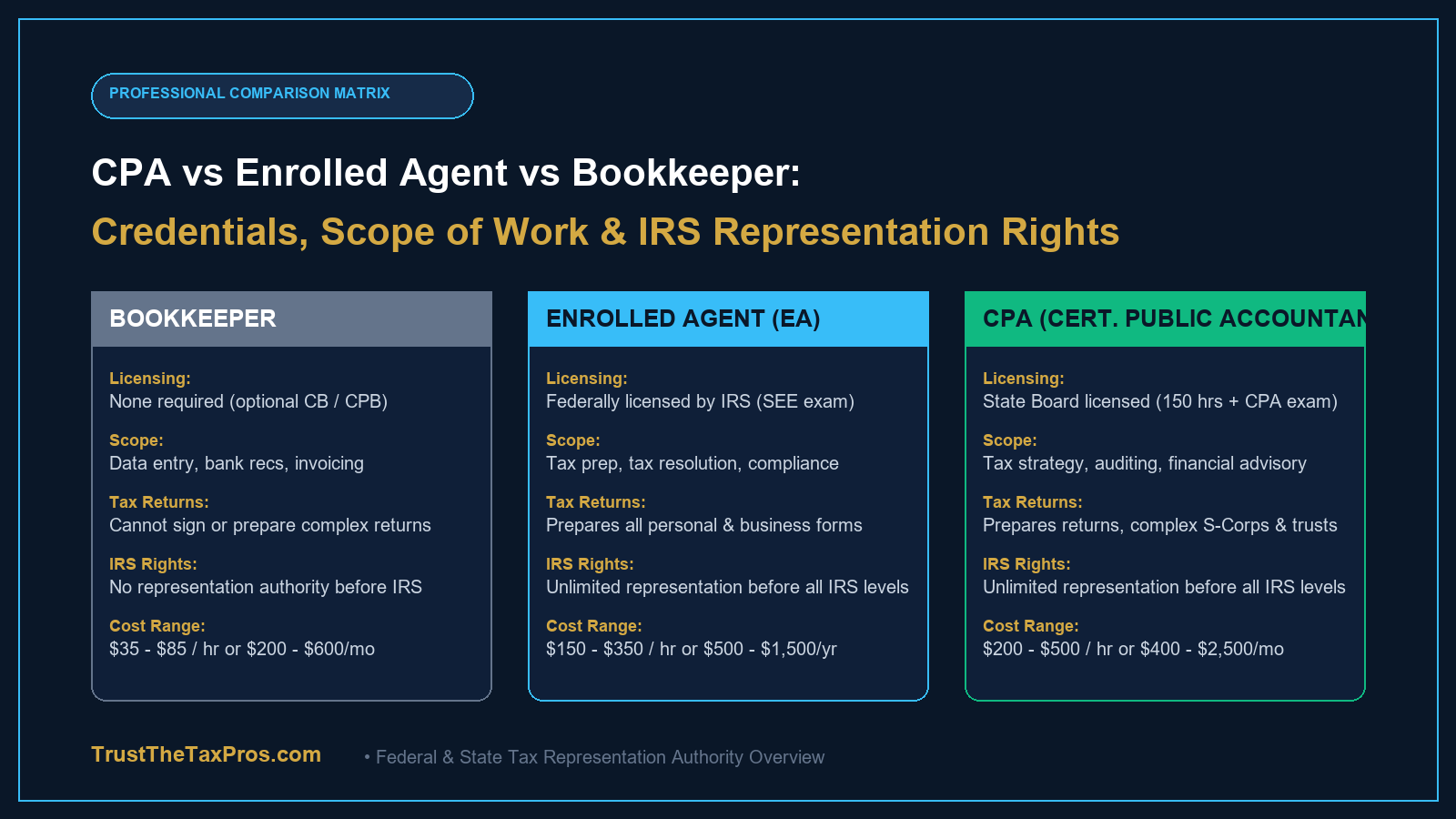
CPA vs Enrolled Agent vs Bookkeeper: Who Does Your Business Need?
Before contacting local accounting firms, you must understand the distinction between the three primary financial professionals. Hiring the wrong specialist can cause frustration and unnecessary overhead.
A bookkeeper manages daily financial transactions. They record customer invoices, balance bank reconciliations, and track vendor payments in accounting software like QuickBooks or Xero. Bookkeepers do not hold professional state licenses, nor can they represent your company before the IRS during an audit.
An Enrolled Agent (EA) earns their credential directly from the federal government through the Internal Revenue Service. EAs specialize exclusively in tax preparation and tax dispute resolution. Like CPAs, EAs hold unlimited representation rights to defend taxpayers before all examination branches of the IRS.
A Certified Public Accountant (CPA) is licensed by their respective State Board of Accountancy after completing at least 150 college semester hours, passing a rigorous four-part uniform examination, and fulfilling strict ethical criteria. CPAs deliver deep financial advisory, cash flow forecasting, audited financial statements, and advanced business structure planning.
| Professional Role | Licensing Authority | IRS Representation Rights | Typical Pricing Model |
|---|---|---|---|
| Bookkeeper | None (Optional CB/CPB Certification) | No Representation Authority | $35 – $85 / hour or $200 – $600 / mo |
| Enrolled Agent (EA) | Federal Licensing (IRS Examination) | Unlimited (Audits, Appeals, Collections) | $150 – $350 / hour or $500 – $1,800 / return |
| Certified Public Accountant (CPA) | State Board of Accountancy | Unlimited (Audits, Appeals, Tax Court prep) | $200 – $500 / hour or $400 – $2,500 / mo |
If your enterprise requires accurate tax compliance paired with long-term strategic guidance, working with a CPA or EA is indispensable. You can explore our foundational guide on filing business taxes for an LLC to identify the compliance schedules your firm must maintain.
- Tax Preparation Looks Backward: A tax preparer merely tallies your historical income and records expenses from the prior calendar year. By April 15, very few legal options remain to lower that tax bill.
- Tax Strategy Looks Forward: A strategic CPA consults quarterly, modeling tax-advantaged retirement accounts, equipment expensing, entity restructuring, and owner distribution timing before the year closes.
How Much Does a Small Business CPA Cost?
Understanding fee models prevents unpleasant invoice surprises. Accounting firms typically operate under three distinct pricing structures depending on your transaction volume and advisory scope.
The hourly billing structure ranges from $175 to $450 per hour. Junior staff work may be billed at $125 per hour, while senior partner consultation often exceeds $400 per hour. Hourly billing works best for discrete, non-recurring projects such as IRS penalty abatement or historical audit reviews.
The fixed-fee model sets an established price for a specific deliverable. Preparing an annual Form 1120-S (S-Corporation return) or Form 1065 (Partnership return) commonly ranges between $800 and $2,500. This structure provides pricing certainty for businesses that handle their own daily recordkeeping.
The monthly retainer model is the most prevalent approach among modern accounting practices. Retainers range from $350 to $1,500 per month. Under this arrangement, the CPA manages monthly bookkeeping reviews, sales tax filings, quarterly estimated taxes for LLCs, and year-round advisory calls.
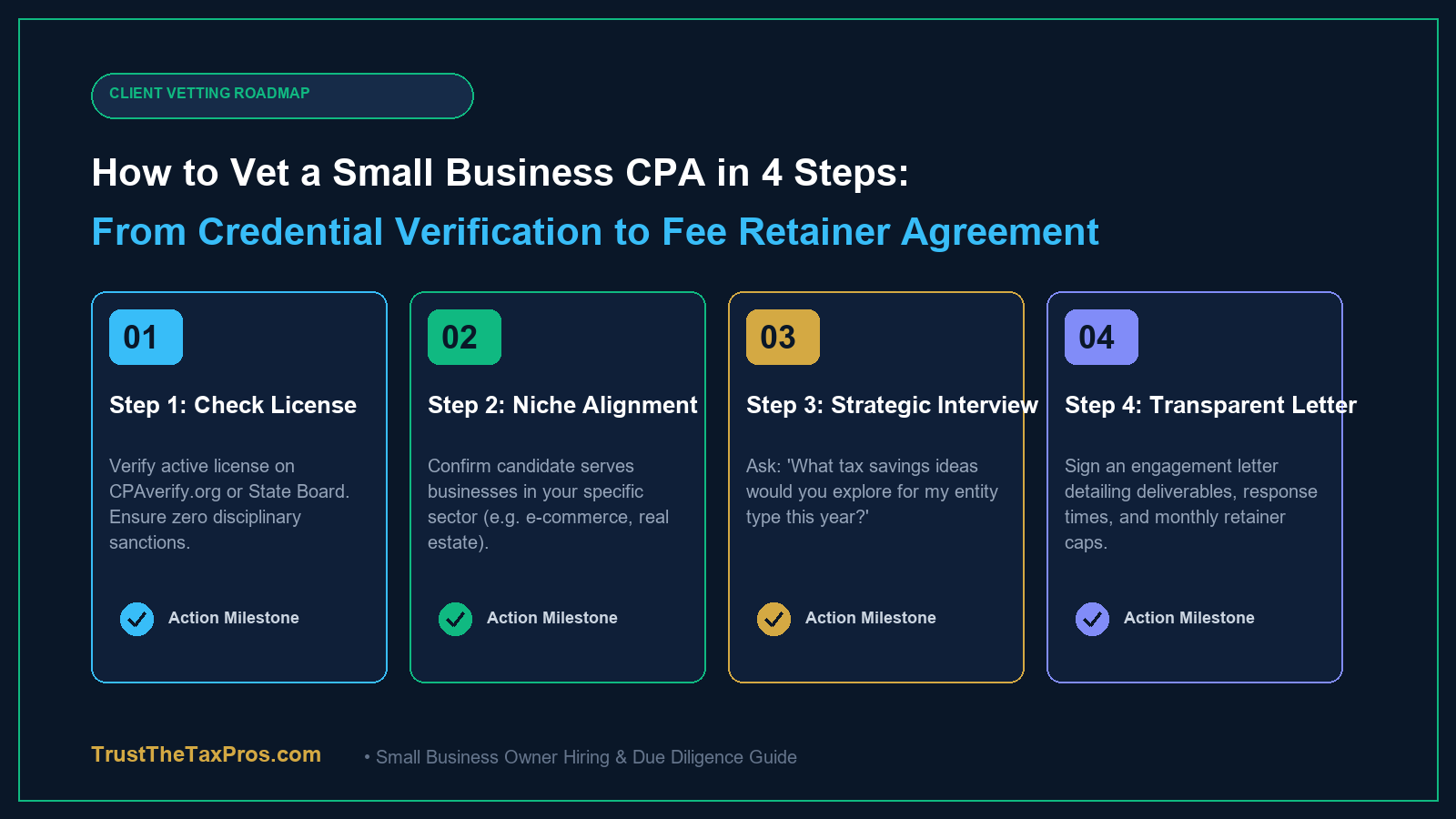
Step-by-Step Roadmap: How to Vet a Local Small Business CPA
Selecting the right financial partner requires deliberate due diligence. Follow this four-stage evaluation process before committing to an engagement.
1. Verify State Licensing and Disciplinary Records
Every legitimate CPA must maintain an active license in good standing with their state board. Never rely solely on website claims or business cards. Utilize the free public verification tool provided by the National Association of State Boards of Accountancy (NASBA) CPAverify directory to verify license status, expiration dates, and any formal disciplinary history.
2. Confirm Industry-Specific Experience
Tax regulations vary significantly across different sectors. A CPA who excels in medical practice accounting may lack expertise in digital e-commerce inventory, commercial construction job costing, or multi-state sales tax nexus. Ask candidates how many active clients they currently advise in your specific line of work.
3. Inquire About Year-Round Advisory Rhythms
Inquire how the firm handles client communication outside of tax season. Do they schedule mandatory mid-year tax projection reviews in June and November? If a firm only communicates in March and April, they are operating as a filing mill rather than a strategic business partner.
4. Review the Formal Engagement Letter
Never begin working with an accountant without a signed engagement letter. This binding contract outlines the exact scope of services, response turnaround windows, data security measures, software subscriptions included, and out-of-scope billing rates. Transparent firms also follow the ethical guidelines set forth by the American Institute of CPAs professional ethics standards.
Critical Questions to Ask During Your CPA Consultation
Treat your introductory meeting like an executive employment interview. Ask these specific questions to uncover the candidate’s strategic capability and communication style:
- “Who will handle my account day-to-day?” Determine whether work is performed by the CPA you are speaking with or delegated to junior staff or offshore contractors.
- “What tax planning strategies have you applied to businesses like mine?” An experienced professional should immediately mention strategies like Section 179 expensing, Augusta rule planning, or accountable reimbursement plans.
- “How do you bill for phone calls and email questions?” Ensure that routine five-minute clarification questions are included in your agreement rather than billed at fifteen-minute hourly increments.
- “Are you registered on the IRS preparer directory?” Confirm their federal status on the IRS Tax Professional Credentials and Qualifications directory.
- “What technology stack do you support?” Ensure their practice integrates smoothly with your current payroll and bookkeeping platforms.
If you are exploring regional tax firms, review our analysis of local tax preparation services to understand typical regional fee benchmarks.
5 Red Flags to Watch Out for When Choosing an Accountant
Certain practices signal poor professionalism or aggressive compliance risk. Walk away immediately if an accountant exhibits any of the following warning signs:
- Guaranteeing a Specific Refund Before Reviewing Books: Legitimate CPAs never promise a fixed tax refund amount prior to examining your financial records and depreciation schedules.
- Charging a Percentage of Your Tax Savings: Contingent fee arrangements for tax return preparation violate IRS Circular 230 regulations and represent a serious ethical breach.
- Refusing to Sign Your Tax Return as Paid Preparer: Anyone who prepares your return for compensation must sign it and include their valid Preparer Tax Identification Number (PTIN). Unsigned “ghost preparers” are illegal.
- Slow Response Times During the Off-Season: If an accountant takes more than a week to return calls in July or August, they will be completely unreachable during high-stress filing deadlines.
- Suggesting Questionable or Unsupported Write-Offs: Aggressive preparers who encourage claiming 100% personal vehicle usage or unsubstantiated travel write-offs leave your business vulnerable to severe audit penalties.
Frequently Asked Questions
How much does a small business CPA cost per month?
Most small business CPAs charge between $350 and $1,200 per month on a fixed retainer basis. This fee typically covers monthly bookkeeping reconciliations, payroll tax compliance, quarterly estimated tax calculations, and ongoing strategic consulting.
What is the difference between a CPA and an Enrolled Agent?
A Certified Public Accountant (CPA) is licensed at the state level with broad authority over financial audits, attestation, tax strategy, and corporate planning. An Enrolled Agent (EA) is federally licensed directly by the IRS specializing exclusively in taxation and tax resolution. Both possess unlimited representation rights before the IRS.
Should I hire a local CPA or a virtual CPA firm?
Hire a local CPA if your business has significant state-specific excise taxes, local city business licenses, retail sales tax, or physical inventory. Virtual CPAs work well for service-based digital agencies, consultants, and online e-commerce brands.
Can a CPA represent my business during an IRS audit?
Yes. CPAs hold unlimited representation rights before all administrative levels of the Internal Revenue Service. They can speak on your behalf, manage document requests, negotiate penalty abatements, and attend examination meetings without you being present.