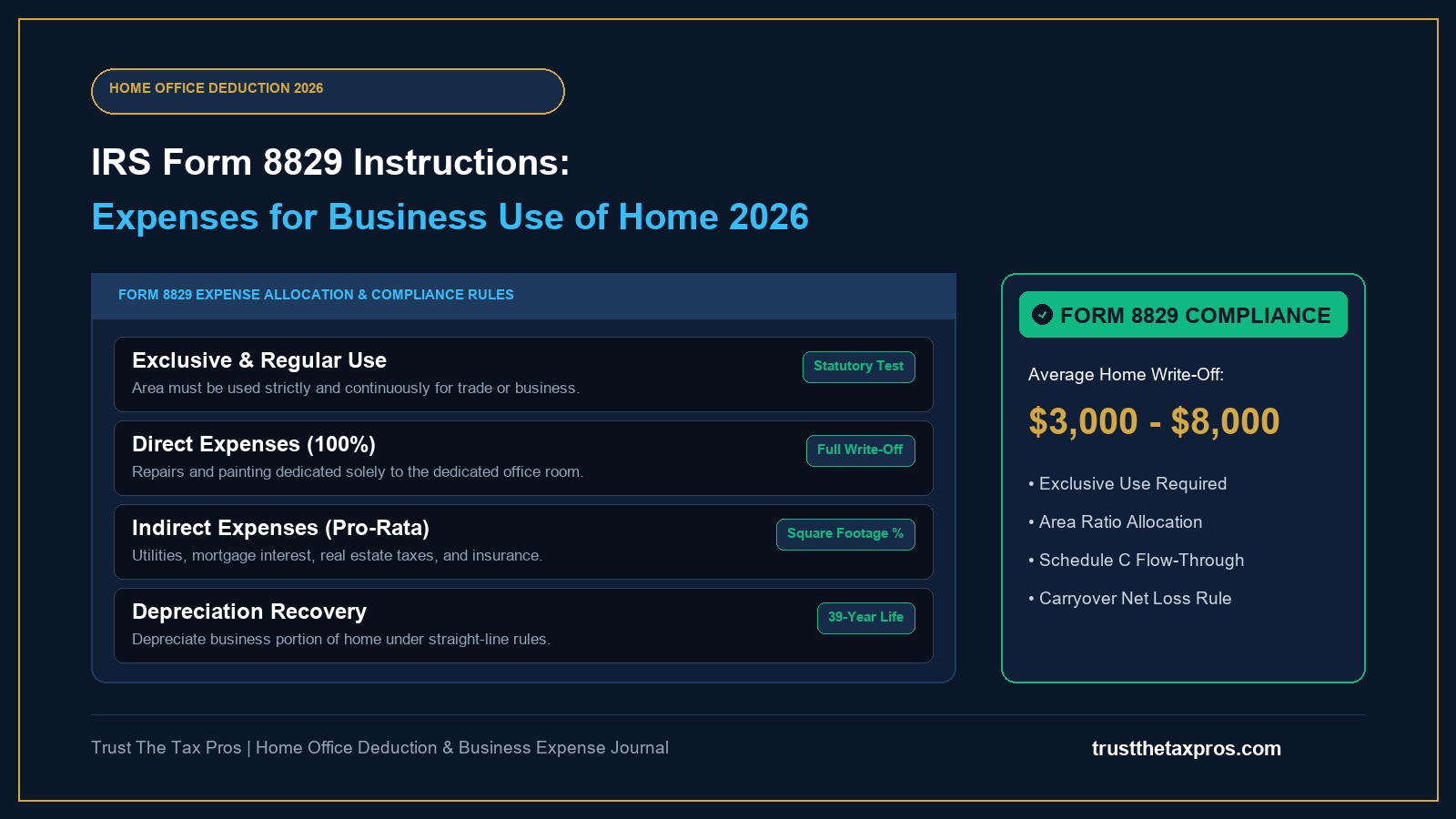
When self-employed individuals, independent contractors, and sole proprietors operate a business from their residence, claiming actual household expenses often produces a substantially larger tax write-off than the simplified $1,500 standard option. To claim actual housing expenses, you must complete and attach IRS Form 8829 (Expenses for Business Use of Your Home) to your annual tax return.
IRS Form 8829 calculates the allowable portion of rent, mortgage interest, utilities, real estate taxes, home insurance, maintenance, and 39-year building depreciation allocable to your trade or business. Understanding the official IRS Form 8829 instructions, classifying direct versus indirect expenses correctly, and observing net business profit deduction limits helps ensure an audit-proof return on Schedule C Line 30.
1. Structure and Architecture of IRS Form 8829
Form 8829 is organized into four distinct sections that guide taxpayers through square footage ratios, expense allocations, and depreciation:
- Part I (Lines 1–7) – Part of Your Home Used for Business: Computes your business percentage by dividing the square footage of your dedicated office workspace (Line 1) by the total square footage of your entire home (Line 2).
- Part II (Lines 8–36) – Figure Your Allowable Deduction: Applies your business percentage to housing expenses, establishing the allowable write-off based on net business income limits.
- Part III (Lines 37–43) – Depreciation of Your Home: Calculates building depreciation for homeowners using the 39-year nonresidential real property MACRS recovery schedule.
- Part IV (Lines 44–45) – Carryover of Unallowed Expenses: Tracks operating expenses and depreciation that exceeded current-year business income, allowing them to carry forward indefinitely to offset future profits.
| Form 8829 Section | IRS Line Numbers | Core Calculation Purpose | Reporting Destination |
|---|---|---|---|
| Part I: Area Percentage | Lines 1 – 7 | Office Sq Ft ÷ Total Home Sq Ft % | Transfers % to Part II Column (b) |
| Part II: Allowable Deductions | Lines 8 – 36 | Direct + (% x Indirect Expenses) | Line 36 -> Schedule C Line 30 |
| Part III: Depreciation | Lines 37 – 43 | 39-Year Building Depreciation Basis | Transfers to Line 29 (Part II) |
| Part IV: Carryover Losses | Lines 44 – 45 | Unallowed deductions above profit limit | Carried to next year’s Form 8829 |
2. Direct vs Indirect Expenses: Column (a) vs Column (b)
Properly categorizing your expenses on Form 8829 is crucial to avoid underclaiming or overclaiming write-offs:
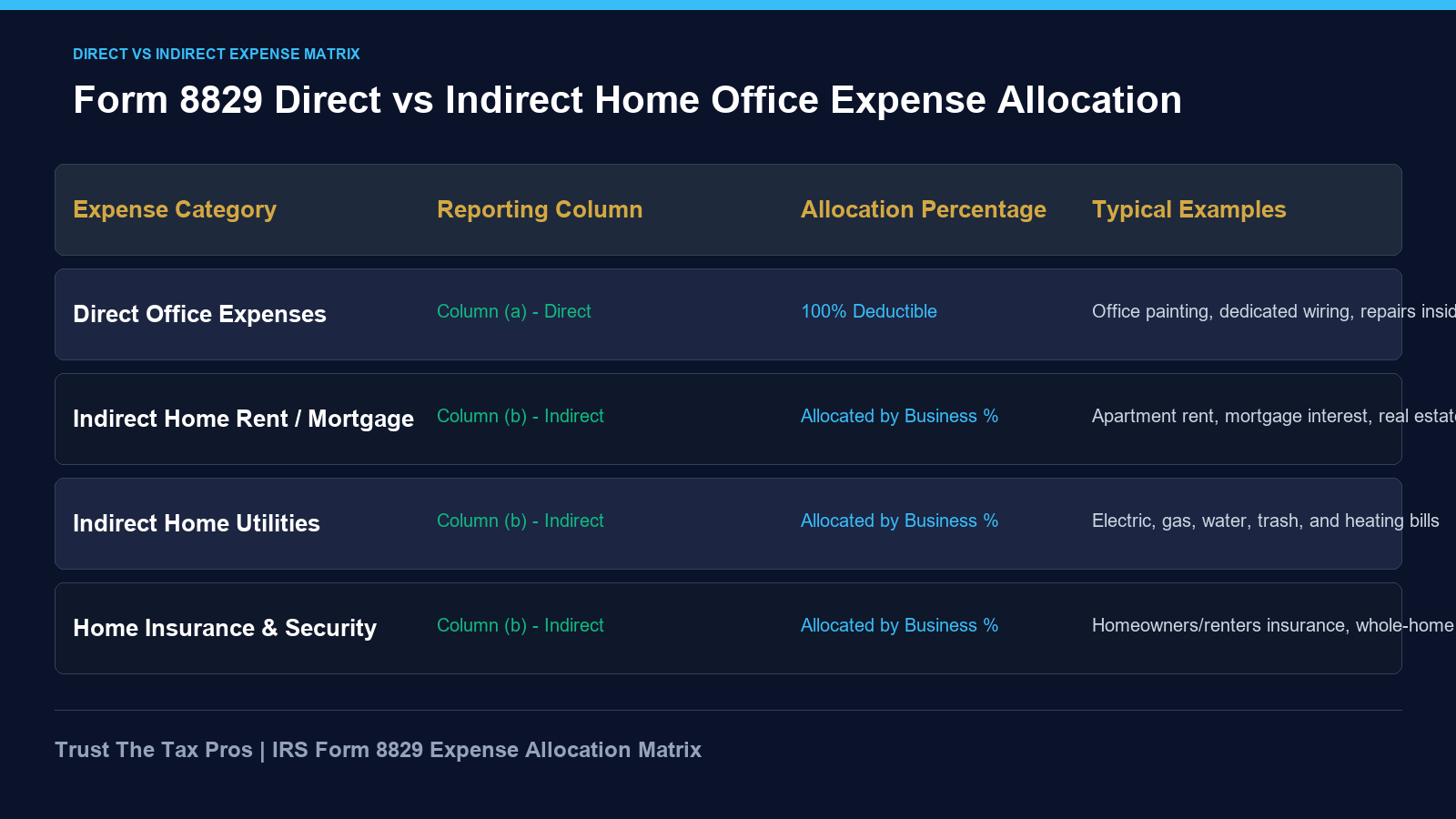
Direct Expenses (Column A): Costs that benefit ONLY your business workspace (e.g. repainting office walls, repairing an office window, installing dedicated shelving). These expenses are 100% deductible and are not reduced by your area percentage.
Indirect Expenses (Column B): Costs required to operate and maintain the entire home (e.g. rent, mortgage interest, real estate taxes, electric, gas, water, internet, whole-home security, and general roof repairs). These expenses are multiplied by your Part I business percentage.
For home office square footage formulas, explore our home office deduction calculator guide.
3. Step-by-Step Instructions to Complete Form 8829
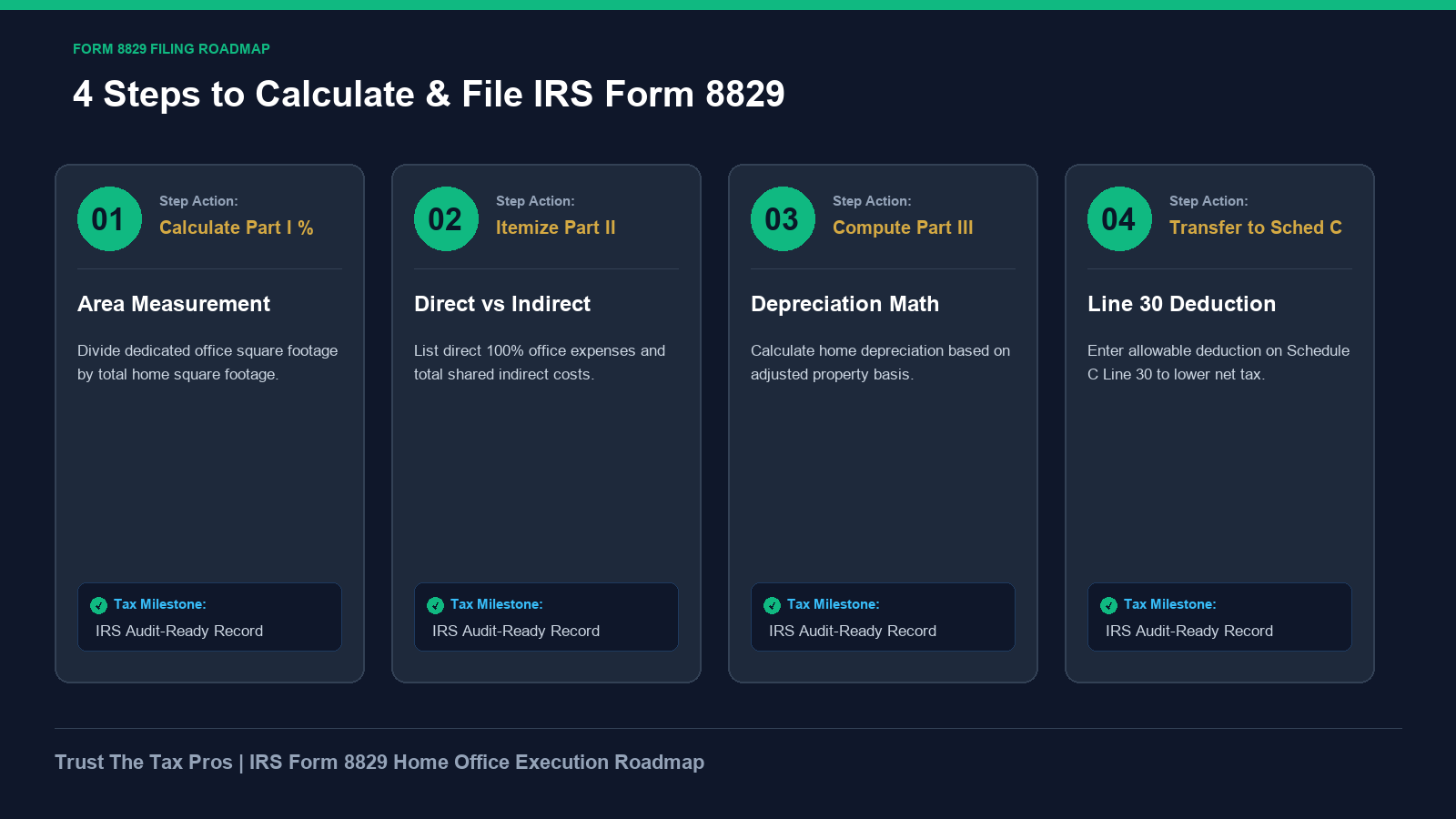
Follow this 4-step workflow to complete Form 8829 accurately and transfer your final deduction to Schedule C.
Step-by-Step Line Instructions
- Part I (Lines 1–3): Enter the exact square footage of your office on Line 1. Enter total home square footage on Line 2. Divide Line 1 by Line 2 and enter the percentage on Line 3 (e.g. 300 sq ft ÷ 2,000 sq ft = 15%).
- Part II (Lines 8–28): Enter your Schedule C tentative net profit on Line 8. Enter direct costs in Column (a) and full indirect housing bills (rent, utilities, insurance) in Column (b). Multiply Column (b) totals by your Line 3 percentage.
- Part III (Lines 37–43): For owned homes, enter the lesser of your home’s adjusted basis or fair market value (excluding land value) on Line 38. Multiply by the 39-year MACRS nonresidential depreciation percentage (typically 2.564% per full year).
- Transfer to Schedule C Line 30: Enter the allowable deduction from Form 8829 Line 36 directly onto Schedule C Line 30 (Expenses for business use of your home).
Review comprehensive audit avoidance guidance in our IRS audit avoidance guide.
Review vehicle travel write-offs in our Schedule C vehicle mileage deduction guide.
Access official federal tax forms directly on the Internal Revenue Service official portal.
If you operate a small business in Northern California, review advice from a Sacramento tax accountant.
Frequently Asked Questions
Can Form 8829 create a net business loss on Schedule C?
No. Under IRC Section 280A, home office deductions cannot create or increase a net business loss. Allowable expenses are capped at your tentative net profit on Line 8. Any excess deductions are carried forward to Part IV and deducted in future profitable years.
Do renters fill out Part III (Depreciation) on Form 8829?
No. Renters enter their full annual rent on Line 20, Column (b) (Rent), and skip Part III entirely because they do not own the property.
What is the difference between Form 8829 and the Simplified Method?
Form 8829 calculates actual housing costs (rent, utilities, depreciation) proportional to square footage, with no dollar cap. The simplified method uses a flat $5 per square foot up to 300 sq ft ($1,500 cap) and is reported directly on Schedule C Line 30 without filing Form 8829.
What happens to home office depreciation when I sell my house?
If you claimed depreciation on Form 8829 while owning your home, the total depreciation taken must be recaptured and taxed at a maximum rate of 25% under IRC Section 1250 upon sale, even if you qualify for the $250,000/$500,000 primary residence capital gains exclusion.
Optimize Your Form 8829 Home Office Deductions
Completing IRS Form 8829 with exact receipts and correct area percentages allows self-employed business owners to unlock thousands of dollars in legitimate tax savings. Keep all utility and lease documentation, separate direct repairs from whole-home costs, and carry forward any excess deductions.
Consult a licensed CPA or tax professional to ensure your Form 8829 filing complies with IRS home office regulations and maximizes your Schedule C write-offs.