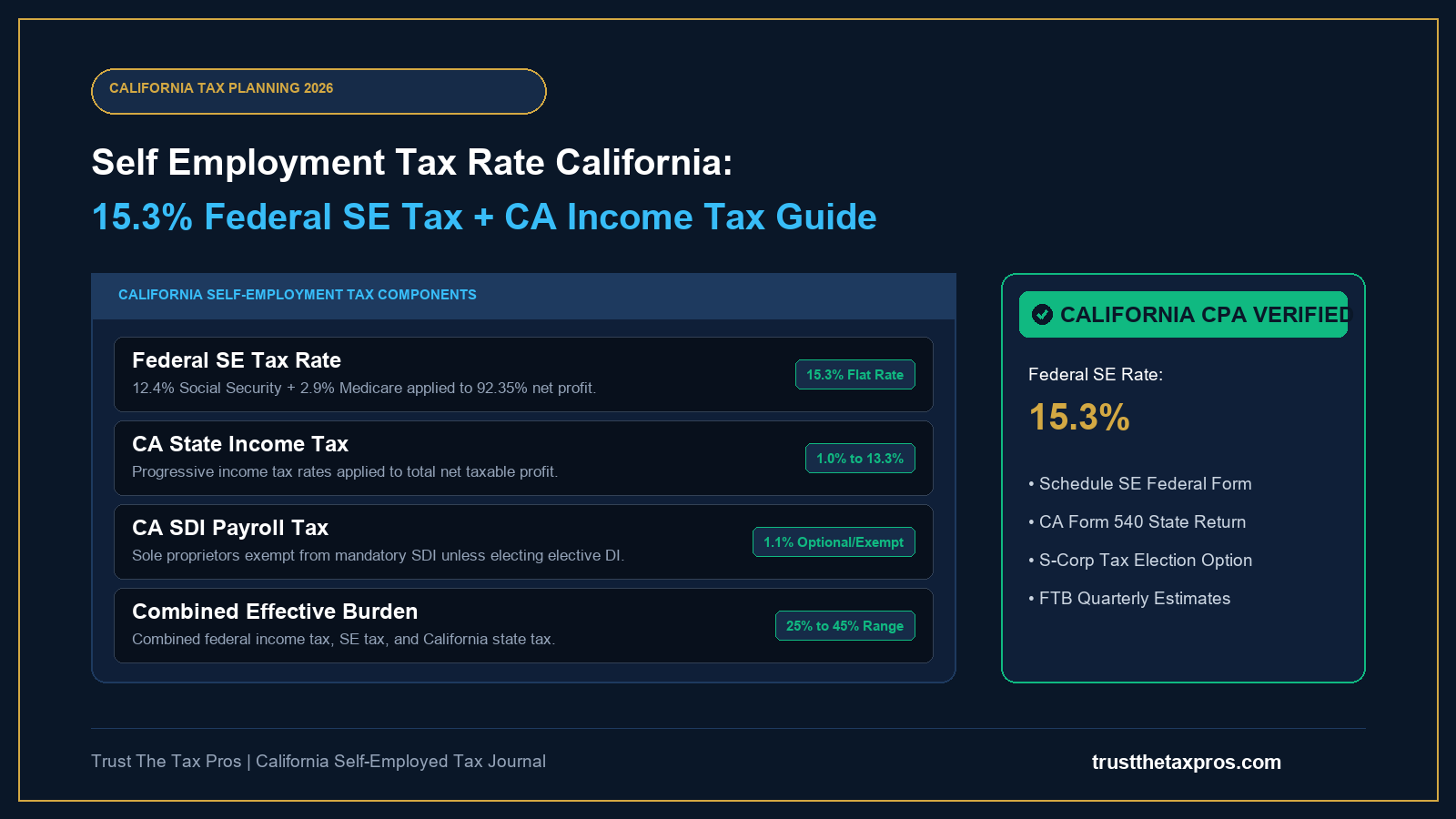
Operating as a freelancer, independent contractor, sole proprietor, or single-member LLC in California provides incredible entrepreneurial opportunities. However, navigating the tax burden in the Golden State requires understanding that self-employed workers are subject to both federal self-employment taxes and California state income taxes.
Unlike traditional W-2 employees whose employers cover half of FICA payroll taxes, self-employed individuals must pay both the employer and employee portions of Social Security and Medicare taxes. Understanding the self employment tax rate in California, calculating your 15.3% federal base, and structuring deductions on Schedule C and California Form 540 can save you thousands of dollars annually.
1. Breakdown of the 15.3% Federal Self-Employment Tax
Federal self-employment tax is established under the Self-Employed Contributions Act (SECA) and codified in Internal Revenue Code Section 1401:
- Total Combined Federal Rate: 15.3% on net business earnings.
- Social Security Component: 12.4% applied up to the annual statutory Social Security wage base limit ($168,600+).
- Medicare Component: 2.9% applied to 100% of net self-employment earnings with no statutory ceiling.
- Additional Medicare Tax: An extra 0.9% surtax applies to self-employment income exceeding $200,000 for single filers ($250,000 for married filing jointly).
- 92.35% Taxable Base Adjustment: The IRS applies the 15.3% tax rate to only 92.35% (0.9235) of your net Schedule C profit, factoring in an adjustment for the employer-equivalent portion.
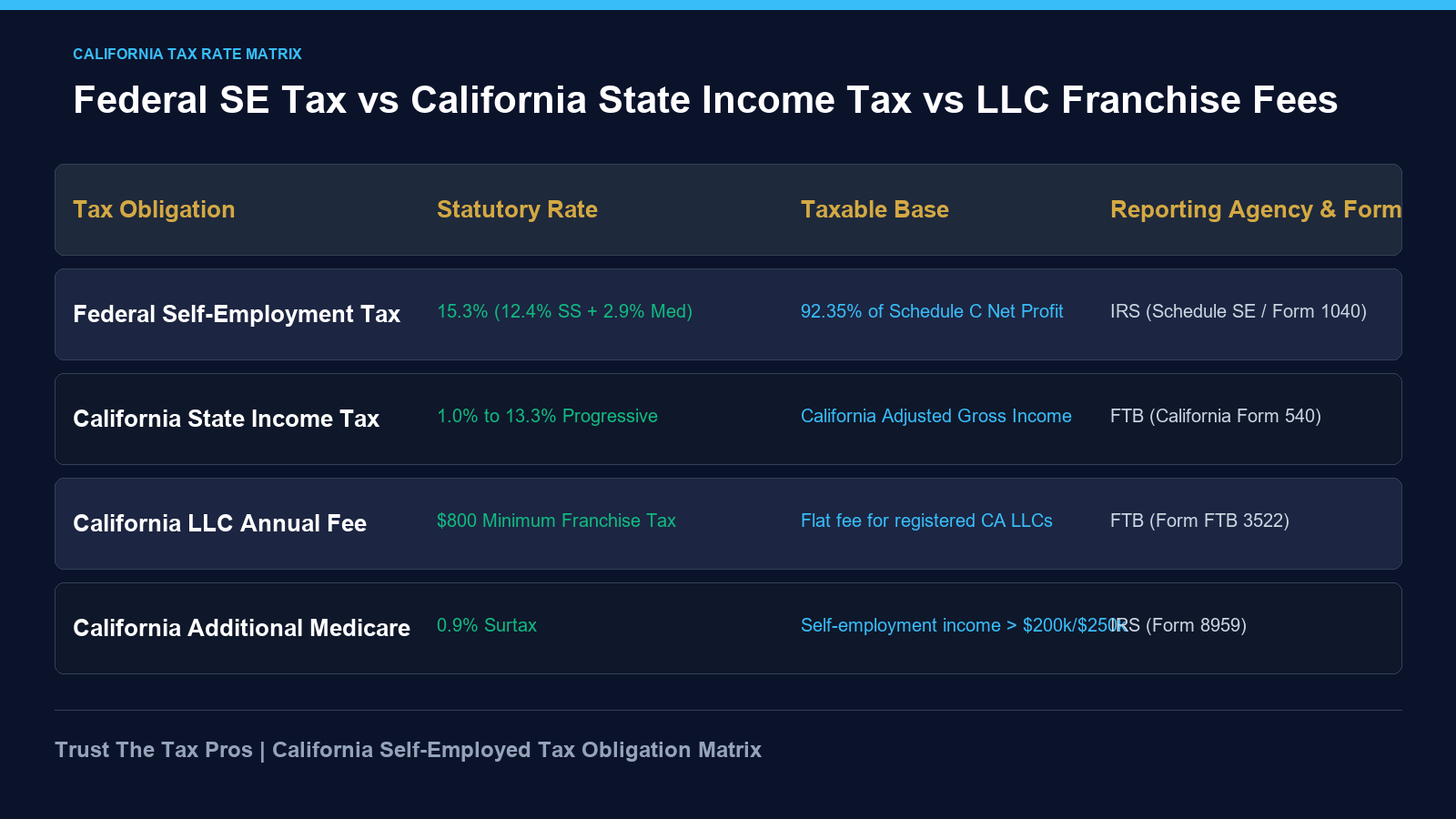
| Tax Component | Statutory Tax Rate | Taxable Income Ceiling | Tax Authority & Form |
|---|---|---|---|
| Federal Social Security | 12.4% | Wage base cap ($168,600+) | IRS (Schedule SE) |
| Federal Medicare | 2.9% | No Ceiling (All Net Earnings) | IRS (Schedule SE) |
| California State Income Tax | 1.0% to 13.3% Progressive | California Taxable Income | FTB (California Form 540) |
| California LLC Franchise Fee | $800 Annual Minimum | Flat annual statutory fee | FTB (Form FTB 3522) |
2. How California State Taxes Apply to Self-Employed Income
California does not levy a separate state-level “self-employment tax.” Instead, your net self-employment earnings flow from federal Schedule C to California Form 540, where they are subject to California’s progressive personal income tax brackets ranging from 1.0% to 13.3% (including the 1% Mental Health Services tax on income over $1,000,000).
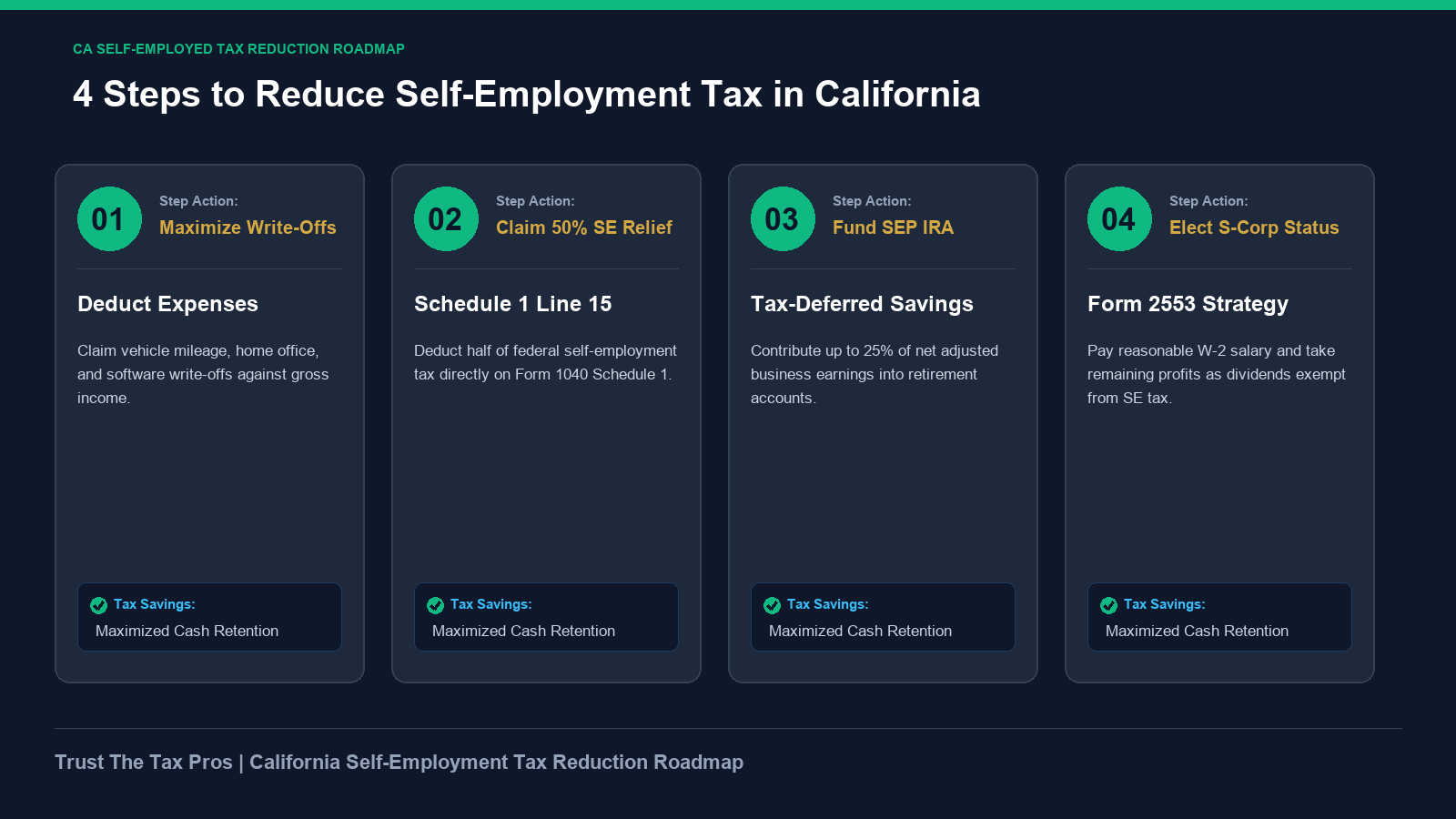
You are entitled to deduct exactly half (50%) of your total federal self-employment tax as an above-the-line deduction on federal Form 1040 Schedule 1 (Line 15). This deduction flows through to reduce your California Adjusted Gross Income on Form 540, lowering both federal and state income tax liabilities.
For small business CPA advisory services, explore our small business tax accountant guide.
3. 4 Proven Strategies to Reduce Self-Employment Taxes in California
Implementing strategic tax mitigation techniques allows self-employed Californians to keep more of their hard-earned revenue.
Tax Reduction Playbook
- Maximize Schedule C Business Deductions: Write off all ordinary and necessary business expenses, including home office square footage, vehicle mileage, business meals (50%), equipment depreciation (Section 179), and software subscriptions.
- Fund a Pre-Tax SEP IRA: Contribute up to 20% of net self-employment earnings (up to $69,000+) to a SEP IRA to slash current-year taxable profits.
- Elect S-Corporation Taxation (Form 2553): Once net business profit exceeds $80,000–$100,000, electing S-Corp taxation allows you to split profits between a reasonable W-2 salary (subject to payroll tax) and shareholder dividend distributions (exempt from 15.3% SE tax).
- Submit Timely Quarterly Estimated Taxes: Pay quarterly estimates via IRS Direct Pay and FTB Web Pay to avoid Section 6654 underpayment penalties.
Calculate your retirement shelter in our SEP IRA contribution limits guide.
Review vehicle travel write-offs in our Schedule C vehicle mileage deduction guide.
Access official tax forms directly on the California Franchise Tax Board official portal.
If you need CPA assistance in Northern California, review advice from a Sacramento tax accountant.
Frequently Asked Questions
What is the self-employment tax rate in California?
Self-employed Californians pay the federal self-employment tax rate of 15.3% (12.4% Social Security + 2.9% Medicare on 92.35% of net profit), plus California state income tax ranging from 1% to 13.3%.
Does California charge a separate state self-employment tax?
No. California does not have a separate state self-employment tax. However, net business profit is subject to regular California progressive income tax brackets on Form 540.
How does an S-Corp reduce self-employment tax in California?
An S-Corporation allows owners to take a “reasonable salary” subject to FICA taxes, while taking remaining net profits as shareholder distributions which are completely exempt from the 15.3% self-employment tax.
When are California self-employment estimated taxes due?
Estimated quarterly taxes are due April 15, June 15, September 15, and January 15 for both federal (Form 1040-ES) and California (Form FTB 540-ES).
Take Control of Your California Self-Employment Taxes
Understanding the self employment tax rate in California empowers independent contractors and small business owners to minimize tax liabilities and avoid unexpected year-end bills. Track all eligible business deductions, make accurate quarterly estimated payments, and evaluate S-Corp election timing with a professional.
Consult a licensed California CPA or tax accountant to structure your business entity and maximize your net self-employed earnings.