Operating as an S-Corporation provides business owners with substantial self-employment tax savings and pass-through simplicity. However, maintaining S-Corp status requires strict compliance with annual federal corporate tax filings. The centerpiece of this compliance framework is IRS Form 1120-S (U.S. Income Tax Return for an S Corporation).
Unlike standard C-Corporations that pay entity-level income tax on Form 1120, S-Corporations generally do not pay federal income tax. Instead, corporate profits, deductions, and credits pass through to shareholders’ personal tax returns via Schedule K-1. Mastering official form 1120 s instructions for s corp filings ensures your business reports officer compensation accurately, complies with balance sheet rules, and avoids severe IRS late-filing penalties.
1. Overview and Core Structure of Form 1120-S
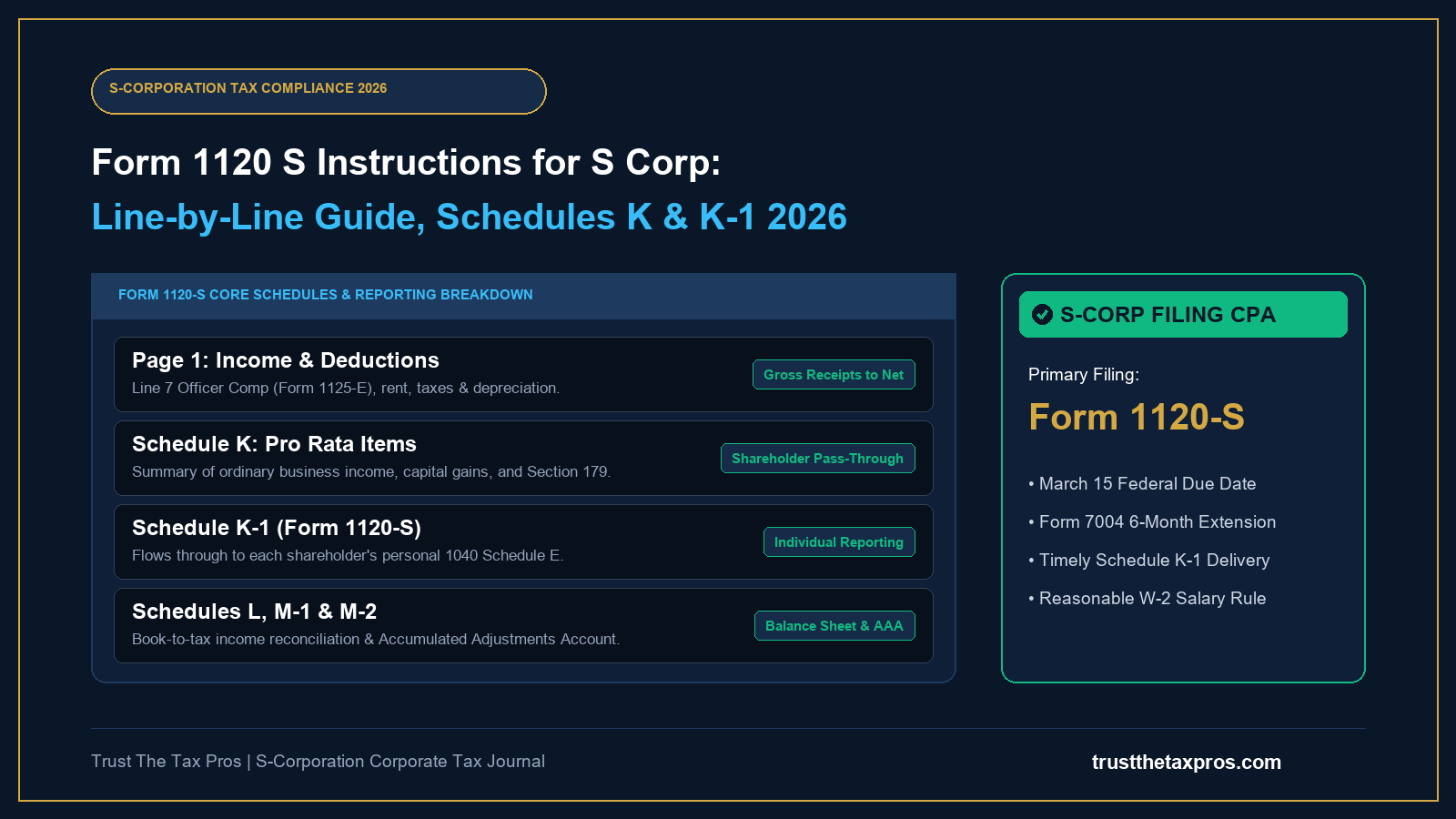
Form 1120-S consists of five primary pages and multiple mandatory schedules designed to capture the company’s operating income, shareholder allocations, and financial condition:
- Page 1 (Lines 1–21) – Income and Deductions: Records gross sales, cost of goods sold, allowable business operating deductions, officer compensation, and determines total ordinary business income (Line 21).
- Schedule B – Other Information: Gathers key corporate intelligence including accounting method (cash vs. accrual), business activity codes, and ownership percentages.
- Schedule K – Shareholders’ Pro Rata Share Items: Summarizes all pass-through items (ordinary income, net rental income, capital gains, charitable contributions, Section 179 deductions) across all shareholders.
- Schedule K-1 (Form 1120-S): The individual statement prepared for each shareholder reporting their exact pro-rata percentage of Schedule K items.
- Schedules L, M-1, and M-2: The corporate balance sheet per books (Schedule L), reconciliation of book income to tax return income (Schedule M-1), and tracking of the Accumulated Adjustments Account (Schedule M-2).
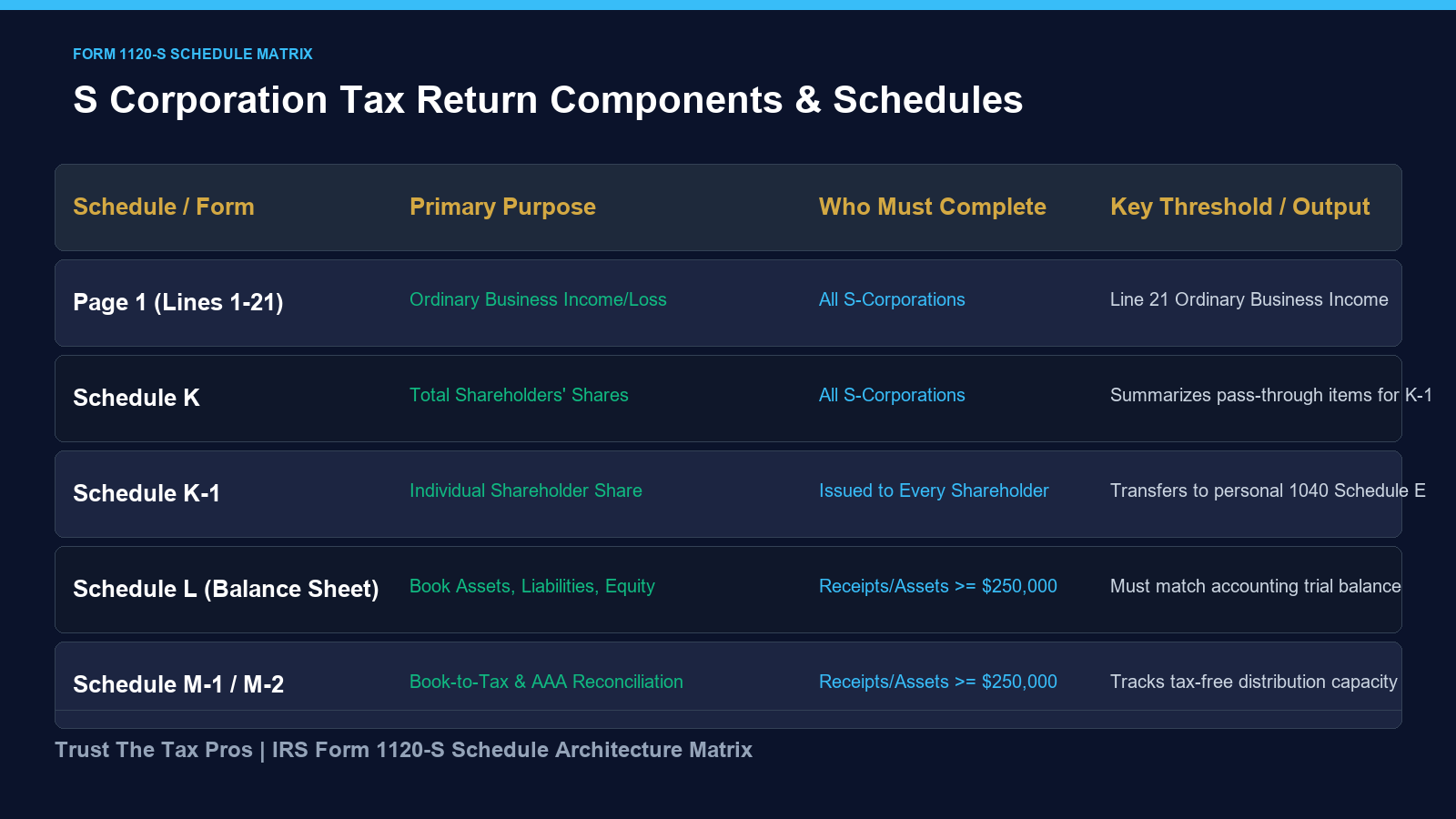
| Schedule / Section | Reporting Purpose | Filing Requirement | Key Output / Form |
|---|---|---|---|
| Page 1: Operating Income | Gross receipts minus operating costs | Mandatory for all S-Corps | Line 21 Ordinary Business Income |
| Schedule K | Total entity-wide pass-through items | Mandatory for all S-Corps | Transfers to Schedule K-1 |
| Schedule K-1 | Individual shareholder allocations | Issued to each shareholder | Personal Form 1040 Schedule E |
| Schedule L, M-1, M-2 | Balance sheet & AAA account tracking | Required if Receipts/Assets ≥ $250k | Reconciles book vs tax profit |
2. Line-by-Line Instructions for Page 1: Income and Deductions
Page 1 of Form 1120-S determines the ordinary income or loss generated by your business operations:
Income Section (Lines 1–6)
- Line 1a (Gross receipts or sales): Enter total revenue before returns and allowances. Deduct customer returns on Line 1b to reach net receipts on Line 1c.
- Line 2 (Cost of goods sold): Enter COGS calculated on Form 1125-A (inventories, direct materials, production labor).
- Line 4 & 5 (Net gain/loss & Other income): Enter ordinary gains from Form 4797 and miscellaneous business receipts (e.g. interest on trade accounts).
Deductions Section (Lines 7–20)
Shareholder-employees who perform services for the S-Corporation must receive reasonable W-2 compensation subject to FICA taxes before taking dividend distributions. Report officer wages on Line 7. If total receipts are $500,000 or more, you must also complete Form 1125-E (Compensation of Officers).
Warning: Failure to pay reasonable officer compensation is the #1 audit trigger for S-Corporations, leading to reclassification of distributions as wages plus severe payroll tax penalties.
- Line 8 (Salaries and wages): Non-officer employee W-2 gross payroll.
- Line 12 (Taxes and licenses): State employer payroll taxes, local franchise taxes, and business licenses (do not deduct federal income taxes).
- Line 14 (Depreciation): Regular MACRS depreciation from Form 4562. Note: Section 179 expense is NOT deducted on Line 14—it is reported separately on Schedule K.
- Line 19 (Other deductions): Itemized operating expenses such as legal fees, software subscriptions, insurance, and marketing (attach itemized statement).
- Line 21 (Ordinary business income/loss): Subtract Line 20 total deductions from Line 6 total income. This transfers directly to Schedule K Line 1.
For deadline timing and extensions, review our S-Corp tax deadline guide.
3. Step-by-Step Filing Roadmap: Preparing and Submitting Form 1120-S
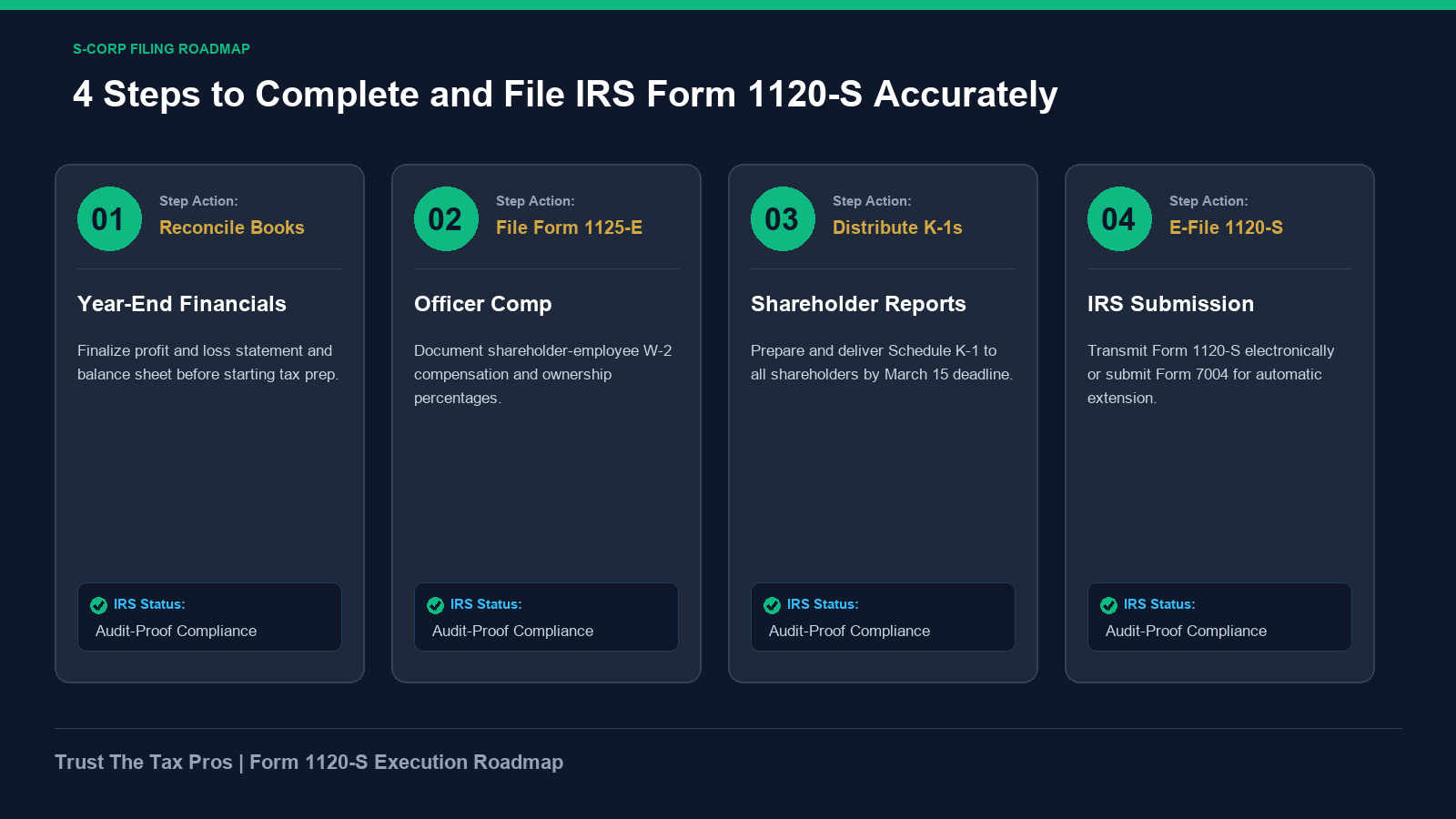
To avoid tax season bottlenecks, follow this 4-step execution sequence to prepare Form 1120-S and distribute Schedule K-1s to all shareholders.
4-Step Preparation Workflow
- Reconcile Trial Balance and Balance Sheet: Reconcile all bank, credit card, and loan accounts. Verify that ending balance sheet figures match your accounting software trial balance.
- Calculate Shareholder Basis: Maintain shareholder stock and debt basis schedules. Under IRS rules, shareholders cannot deduct losses exceeding their adjusted basis.
- Generate Schedule K-1s for Shareholders: Calculate each shareholder’s pro-rata percentage based on shares owned and days held during the year. Distribute copies to shareholders promptly so they can prepare their individual returns.
- E-File Before the March 15 Deadline: Submit Form 1120-S electronically or request an automatic 6-month extension to September 15 by filing Form 7004 before the March 15 cutoff.
If you need professional CPA preparation assistance, review our small business tax accountant guide.
Learn how to manage estimated tax obligations in our LLC quarterly estimated taxes guide.
Access official tax forms directly on the Internal Revenue Service official portal.
Frequently Asked Questions
#### When is Form 1120-S due for calendar year S-Corporations?
Form 1120-S is due on the 15th day of the 3rd month following the end of the tax year, which is March 15 for calendar year entities. An automatic 6-month extension can be requested using Form 7004, extending the filing deadline to September 15.
#### Do all S-Corps have to complete Schedule L (Balance Sheet)?
No. Small S-Corporations with total receipts of less than $250,000 AND total assets of less than $250,000 at the end of the tax year are exempt from completing Schedule L, Schedule M-1, and Schedule M-2.
#### Where does officer compensation go on Form 1120-S?
Officer compensation is reported on Page 1, Line 7. If total corporate receipts reach $500,000 or more, you must also complete and attach Form 1125-E (Compensation of Officers).
#### How does Schedule K-1 connect to personal tax returns?
The S-Corp generates a Schedule K-1 for each shareholder. Shareholders report their pro-rata share of ordinary business income or loss from Line 1 on Schedule E (Form 1040) of their personal income tax return.
Final Steps: Ensure Flawless S-Corporation Tax Compliance
Filing Form 1120-S with precision protects your S-Corporation tax status, avoids late filing penalties ($245+ per shareholder per month), and ensures seamless pass-through reporting for all owners. Keep your balance sheet reconciled, document officer compensation rigorously, and deliver Schedule K-1s ahead of individual filing deadlines.
Consult a licensed CPA or corporate tax specialist to review your Form 1120-S filing and maximize all available corporate tax write-offs.