Every tax season, millions of taxpayers face a fundamental decision: who should handle their annual filing? With tax codes expanding each year, choosing between a cpa vs tax preparer has a direct impact on your refund size, compliance standing, and wallet. While both professionals assist in preparing returns, their qualifications, legal authority, and fees differ dramatically.
Paying hundreds of dollars for a CPA to prepare a basic W-2 return is often an unnecessary expense. Conversely, relying on an unlicensed seasonal preparer to structure multi-state corporate distributions can trigger costly IRS audit notices. Let us examine the core distinctions between CPAs, Enrolled Agents, and tax preparers so you can choose the right expert for your specific financial situation.
- Licensing and Education: CPAs are state-licensed accounting professionals with rigorous degree and exam requirements. Tax preparers only require an IRS PTIN number.
- IRS Representation: CPAs and Enrolled Agents hold unlimited representation rights before the IRS. Non-credentialed preparers possess strictly limited audit defense rights.
- Complexity Match: Simple W-2 filers benefit from affordable tax preparers, while business owners, real estate investors, and high-earners require a CPA.
What Is a Certified Public Accountant (CPA)?
A Certified Public Accountant is a licensed accounting professional who has met state education, examination, and ethical requirements. Administered by state Boards of Accountancy under AICPA professional licensure standards, earning a CPA designation requires at least 150 semester hours of college education, passing the four-part Uniform CPA Examination, and completing verified professional experience.
CPAs are trained to look far beyond annual return submission. They analyze business balance sheets, construct multi-year tax strategies, handle corporate structuring, and provide formal financial auditing services. When evaluating local accounting talent, review our guide on finding a qualified small business CPA to understand how local credentials protect your business.
Under federal regulations, CPAs hold unlimited practice rights before the Internal Revenue Service. This means a CPA can communicate on your behalf, negotiate payment plans, contest auditor findings, and represent you during administrative appeals conferences, regardless of who originally prepared the tax return.

What Is a Tax Preparer?
A tax preparer is any individual who prepares federal tax returns for compensation. Under federal law, anyone can legally become a tax return preparer simply by obtaining a Preparer Tax Identification Number (PTIN) from the IRS. No college degree, accounting experience, or formal testing is required at the federal level.
According to IRS guidelines on choosing a tax professional, tax preparers fall into several distinct tiers of qualification:
- Non-Credentialed Preparers: Individuals who hold a PTIN but have completed no voluntary testing or continuing education. They typically input client records into commercial tax software.
- Annual Filing Season Program (AFSP) Participants: Non-credentialed preparers who voluntarily complete 18 hours of continuing education and pass a basic annual federal tax refresher course.
- State-Regulated Preparers: Preparers operating in states like California (CTEC registered), Oregon, Maryland, or New York, which mandate baseline state education and bonding requirements.
Tax preparers excel at routine, standardized filing. If your income consists solely of W-2 employment and standard investment statements, exploring affordable tax preparation options provides reliable compliance without the premium pricing of a licensed CPA.
Enter the Enrolled Agent (EA): The Tax Specialist
When comparing tax advisors, many consumers overlook a third vital category: the Enrolled Agent. An Enrolled Agent is a federally authorized tax practitioner empowered by the United States Department of the Treasury. Unlike CPAs, who are licensed at the state level, EAs earn their credential directly from the federal government.
To become an Enrolled Agent, candidates must pass the rigorous three-part Special Enrollment Examination (SEE) administered by the IRS, which tests exclusively on individual taxation, business taxation, and representation procedures. Alternatively, former IRS employees with at least five years of audit experience qualify automatically. The National Association of Enrolled Agents sets stringent continuing education rules for members.
Enrolled Agents hold the exact same unlimited representation rights before the IRS as CPAs and tax attorneys. Because their training focuses entirely on tax law rather than general corporate auditing or bookkeeping, an EA is often an exceptional, cost-effective alternative for complex tax filing and audit defense.
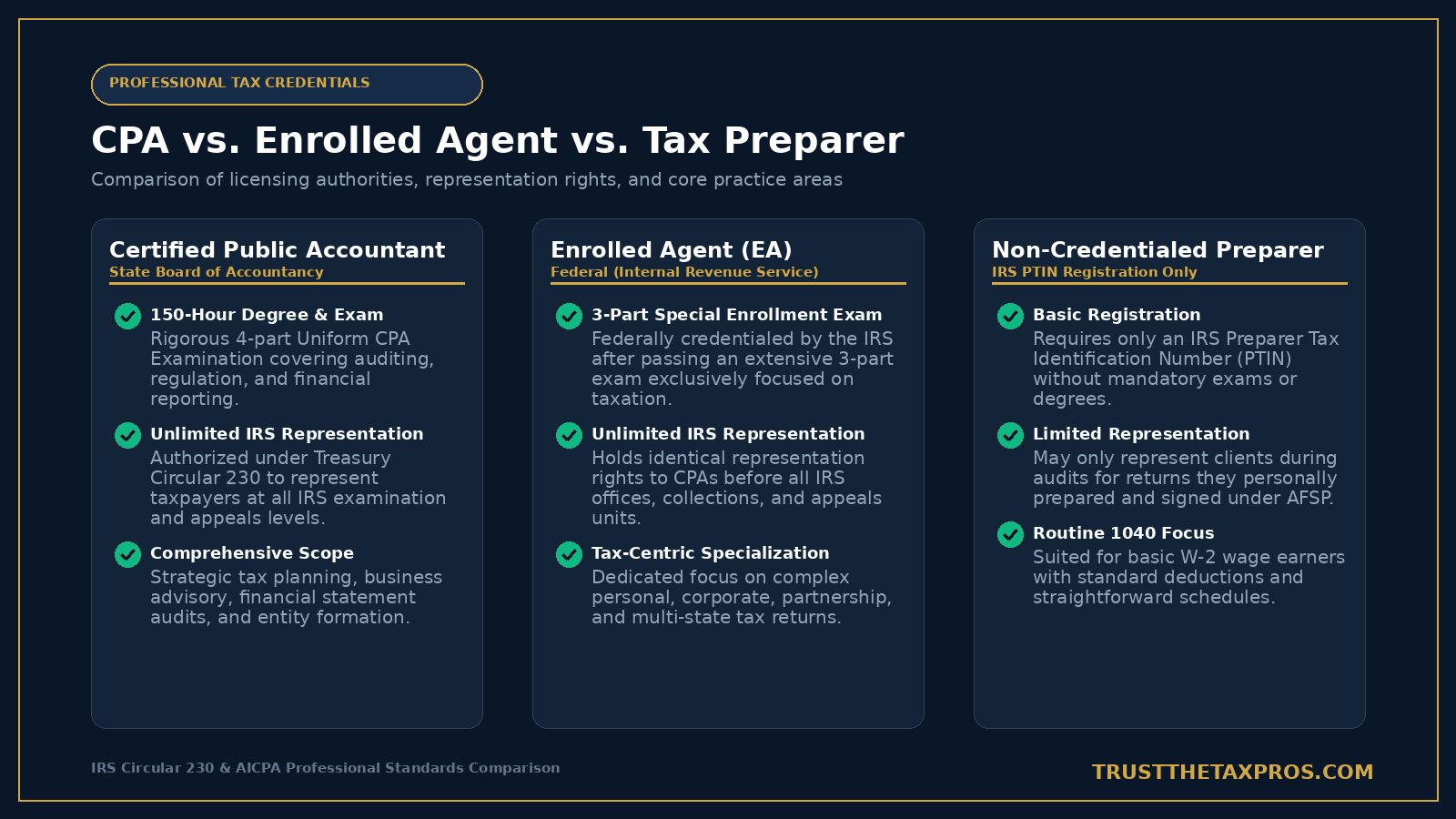
Key Differences: CPA vs. Tax Preparer Comparison
To see how these professional credentials compare across key functional categories, review the side-by-side analysis below.
| Comparison Metric | Certified Public Accountant (CPA) | Standard Tax Preparer (PTIN) |
|---|---|---|
| Licensing Authority | State Board of Accountancy | Federal PTIN Registration (Unlicensed) |
| Testing Requirements | 4-part Uniform CPA Exam (16 hours) | None required (unless state mandated) |
| IRS Representation Rights | Unlimited representation on all tax issues | Limited to returns they signed (if AFSP) |
| Continuing Education | 40 hours annually (including ethics) | None required (18 hrs if AFSP voluntary) |
| Average Individual Cost | $400 to $900+ per return | $150 to $350 per return |
Representation Rights: The Circular 230 Factor
The most critical practical difference between tax practitioners surfaces when an audit notice arrives in the mail. Under Treasury Department Circular 230, the IRS divides representatives into two distinct classes.
Attorneys, CPAs, and Enrolled Agents possess unlimited representation rights. They can represent clients on any tax matter before any IRS office, including customer service centers, revenue agents, revenue officers, and the Independent Office of Appeals. You can authorize a CPA using Form 2848 (Power of Attorney), allowing the CPA to handle the entire audit so you never have to speak directly with an IRS examiner. Reviewing our IRS audit representation guide explains how professional representation insulates taxpayers during audits.
In contrast, non-credentialed tax preparers possess limited representation rights. A preparer who participates in the voluntary Annual Filing Season Program can only represent you before customer service representatives and examination revenue agents for the specific tax return they personally prepared and signed. They cannot represent you on appeals, cannot handle collections, and cannot represent you if they did not sign the return. Non-credentialed preparers who do not participate in the AFSP have zero representation rights whatsoever.
- Refusal to Sign: By federal law, any paid preparer must sign the return and enter their valid PTIN number on Form 1040.
- Self-Prepared Label: Never accept a return marked “Self-Prepared” if you paid someone to complete it. Ghost preparers use this tactic to evade regulatory penalties.
- Refund-Based Fees: Legitimate professionals charge fixed fees or hourly rates. Preparers who charge a percentage of your refund violate ethical rules and inflate deductions illegally.
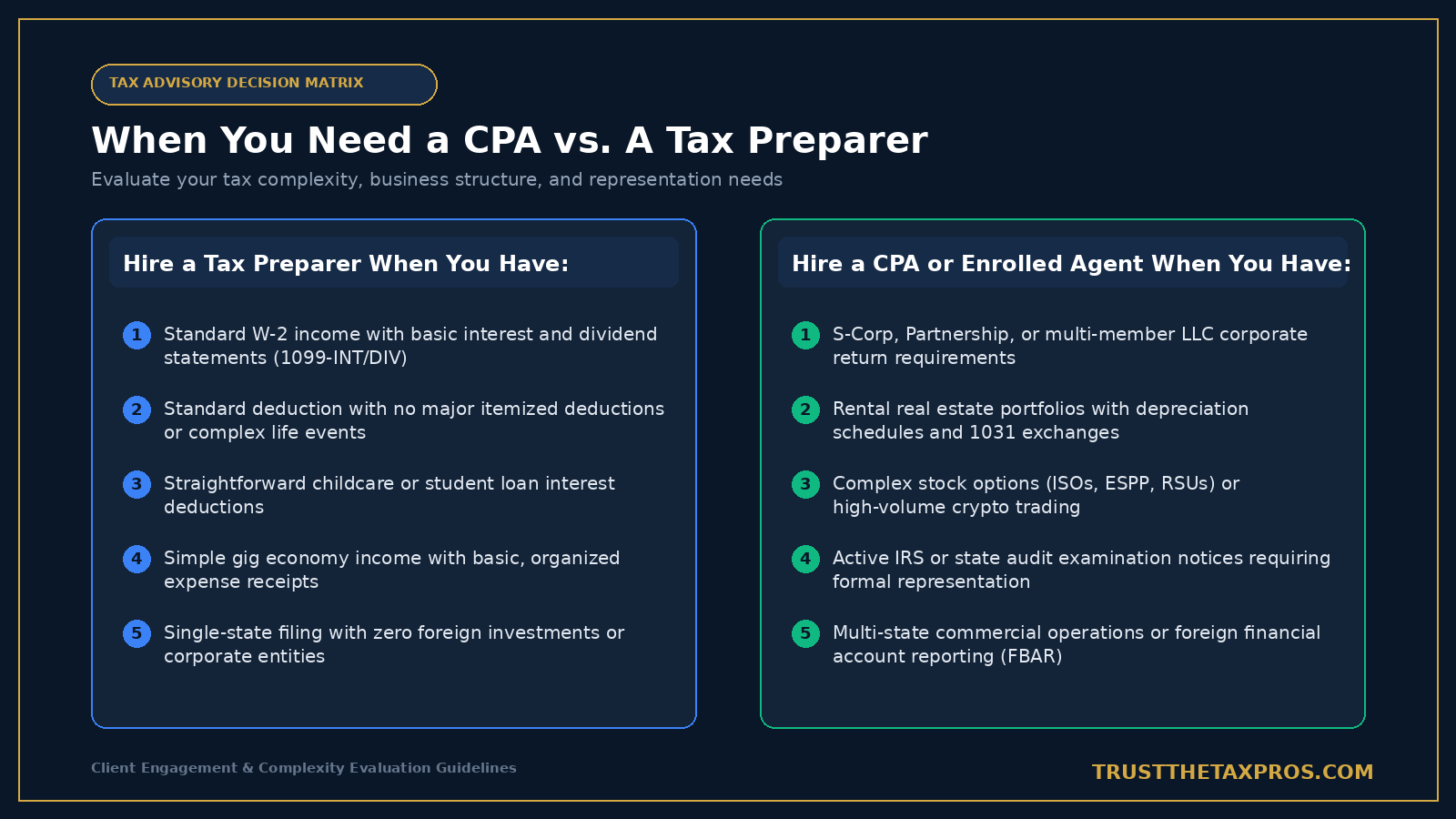
When You Can Use a Tax Preparer
Hiring a licensed CPA is not necessary for every taxpayer. If your personal financial profile is uncomplicated, paying for high-level corporate accounting is an inefficient use of funds. A qualified, credentialed tax preparer is an excellent choice under the following conditions:
- Standard Employment (Form W-2): Your income consists primarily of wages reported on one or two W-2 forms.
- Standard Deduction Filers: You take the standard deduction and have no significant medical expenses, charitable contributions, or state property tax write-offs to itemize.
- Basic Investment Reporting: You receive standard Form 1099-INT for interest or Form 1099-DIV for ordinary dividends without complex stock option vesting.
- Education & Child Credits: You are claiming straightforward child tax credits, dependent care credits, or the American Opportunity Tax Credit.
Taxpayers with these standard profiles can review our detailed individual tax filing guide to prepare their documents efficiently ahead of their tax appointment.
When You Truly Need a CPA
As your financial life grows, the consequences of a filing mistake expand exponentially. A CPA provides proactive tax structuring and strategic foresight that basic tax software cannot match. Retaining a CPA is highly recommended in these situations:
1. Business Owners and Corporate Entities
If you operate an LLC, S Corporation, or Partnership, your returns require balance sheet reconciliation, shareholder basis calculations, and depreciation schedules. Exploring our dedicated business tax services demonstrates how CPAs coordinate corporate returns (Form 1120-S, Form 1065) with personal Form 1040 filings to minimize payroll and self-employment taxes.
2. Rental Real Estate Portfolios
Real estate tax accounting involves complex rules, including depreciation recapture, Section 1031 like-kind exchanges, passive activity loss limitations under IRC Section 469, and Real Estate Professional Status (REPS). An error on your depreciation schedules can follow your property for decades and trigger significant tax upon sale.
3. Complex Executive Compensation
Holding Incentive Stock Options (ISOs), Restricted Stock Units (RSUs), or Employee Stock Purchase Plans (ESPP) introduces Alternative Minimum Tax (AMT) liabilities and dual-basis reporting. CPAs track adjusted cost basis to prevent double taxation when shares are liquidated.
4. Active Audits and Tax Disputes
If you have received an audit examination notice, intent-to-levy letter, or statutory notice of deficiency, you need a representative who can evaluate the auditor’s legal authority, research tax court precedents, and assert procedural rights.
How to Choose the Right Tax Professional
Regardless of choosing a CPA, an Enrolled Agent, or a professional tax preparer, protecting your financial data requires thorough screening. Follow these practical steps before handing over personal records:
- Verify Credentials: Look up the professional on the IRS Directory of Federal Tax Return Preparers. For CPAs, verify their active standing on your state Board of Accountancy website.
- Ask About Year-Round Availability: Many seasonal tax offices close on April 16. Ensure your tax professional maintains a permanent, year-round office so you can reach them if an IRS notice arrives in October.
- Inquire About Audit Representation: Ask explicitly if the practitioner provides audit representation and what their hourly rate is for examination defense.
- Review Their Security Practices: Ensure the firm uses encrypted client portals to exchange tax documents rather than unencrypted email attachments.
Frequently Asked Questions
What is the main difference between a CPA and a tax preparer?
A Certified Public Accountant (CPA) is a state-licensed financial professional who passed the rigorous Uniform CPA Examination, completed 150 college credit hours, and holds unlimited representation rights before the IRS. A non-credentialed tax preparer holds an IRS Preparer Tax Identification Number (PTIN) and focuses primarily on data entry and filing annual Form 1040 returns without formal licensing exams.
Can a tax preparer represent me if I get audited by the IRS?
Non-credentialed tax preparers hold limited representation rights. They can only represent clients before IRS revenue agents for returns they personally prepared and signed, provided they participate in the Annual Filing Season Program (AFSP). They cannot represent clients at administrative appeals conferences, negotiate collection matters, or litigate in court. CPAs and Enrolled Agents hold unlimited representation rights regardless of who prepared the return.
How much does a CPA cost compared to a tax preparer?
A basic individual tax return prepared by a retail tax preparer typically costs between $150 and $350. In contrast, an individual return prepared by a CPA generally ranges from $400 to $900. Corporate returns (Forms 1120-S, 1065) prepared by CPAs typically cost between $1,200 and $3,000 depending on entity complexity and bookkeeping condition.
When is it worth paying for a CPA instead of a preparer?
Hiring a CPA is worth the investment if you own a business, manage rental real estate, hold stock options (ISOs/RSUs), trade cryptocurrency actively, operate across multiple states, or need strategic tax planning to minimize future liabilities. For straightforward single W-2 wage earners taking the standard deduction, a standard tax preparer is sufficient.
Is an Enrolled Agent (EA) as qualified as a CPA for taxes?
For pure tax matters, yes. Enrolled Agents are federally licensed by the IRS after passing an intensive 3-part Special Enrollment Examination focused exclusively on individual, corporate, and partnership taxation. Like CPAs, EAs hold unlimited representation rights before the IRS. However, EAs do not provide financial statement audits or general management consulting.
How can I verify a tax preparer or CPA credential?
You can verify a tax professional’s active standing using the IRS Directory of Federal Tax Return Preparers with Credentials and Select Qualifications. For CPAs, you can also verify license status, disciplinary history, and active standing through your state Board of Accountancy or the national CPAverify database.