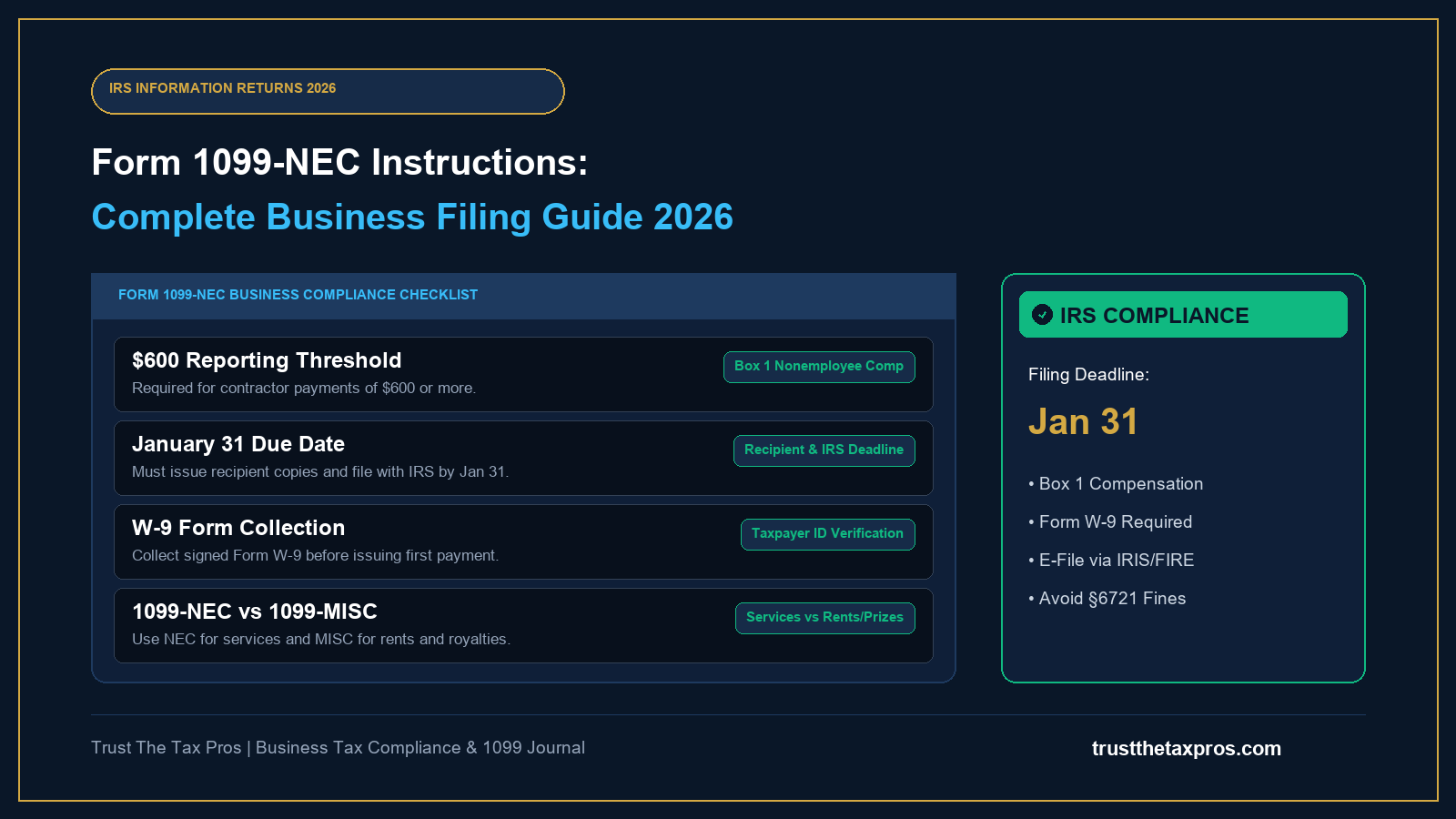
Businesses of all sizes rely on independent contractors, freelance specialists, consultants, and outside vendors to perform essential services. If your company pays unincorporated service providers during the tax year, complying with official Form 1099-NEC instructions for business is mandatory under federal tax law.
IRS Form 1099-NEC (Nonemployee Compensation) is dedicated solely to reporting payments made to independent workers. Failing to file Form 1099-NEC or missing the strict January 31 filing deadline can result in statutory penalties under Internal Revenue Code Section 6721. This guide provides comprehensive instructions on reporting thresholds, Form W-9 verification, Box 1 entries, and IRS electronic filing standards.
1. Who Must Receive Form 1099-NEC? (The $600 Threshold)
A business must file Form 1099-NEC if it made payments meeting all four of the following IRS statutory conditions:
- Payment for Services: You made payments for services in the course of your trade or business (personal payments like household repairs do not require a 1099).
- Nonemployee Status: You paid an individual who is not your W-2 employee (such as an independent contractor, freelance developer, or outside consultant).
- Cumulative Dollar Threshold: Total payments to that payee equaled or exceeded $600 during the calendar tax year.
- Unincorporated Payee: You made payments to an individual, partnership, sole proprietorship, single-member LLC, or legal service provider.
| Vendor / Payee Entity Type | Form 1099-NEC Required? | Statutory Dollar Threshold | Key Reporting Exception |
|---|---|---|---|
| Sole Proprietors & 1099 Freelancers | Yes (Mandatory) | $600+ per calendar year | Credit card payments reported on 1099-K |
| Attorneys & Legal Firms | Yes (Always) | $600+ per calendar year | Applies even if law firm is incorporated |
| C-Corporations & S-Corporations | No (Exempt) | N/A (Corporate Exemption) | Except legal services which require 1099 |
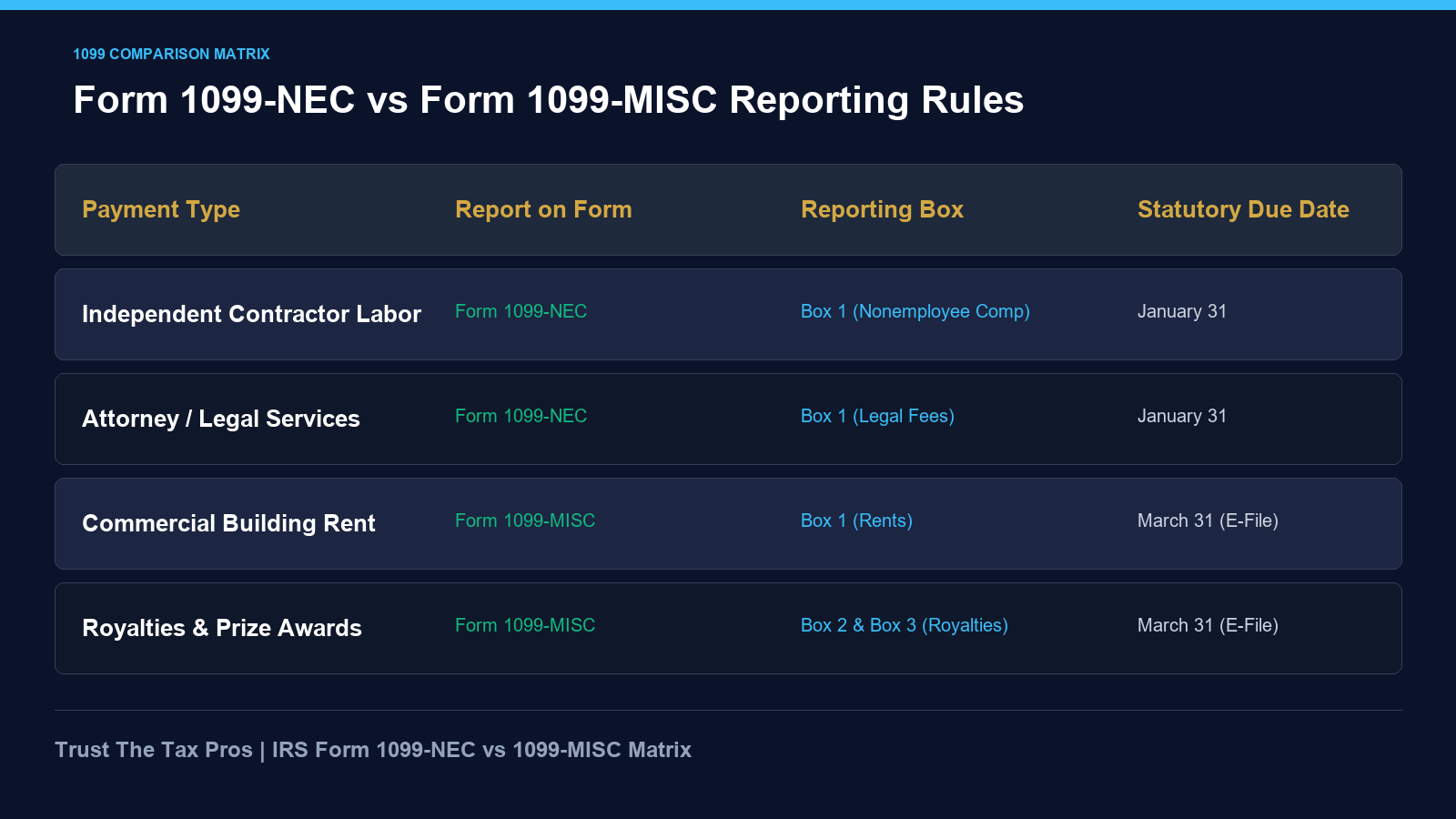
2. Form 1099-NEC vs Form 1099-MISC Key Differences
Understanding which form to file prevents misclassification and erroneous IRS filings:
- Form 1099-NEC (Box 1): Used exclusively for nonemployee service fees, professional fees, commissions, and independent contractor labor.
- Form 1099-MISC: Used for commercial real estate rent payments (Box 1), royalties (Box 2), prizes and awards (Box 3), medical and healthcare payments (Box 6), and gross legal settlement proceeds paid to attorneys (Box 10).
- Filing Deadlines: Form 1099-NEC has an accelerated statutory deadline of January 31, whereas Form 1099-MISC electronic returns are due March 31.
Never issue a payment to a new vendor or contractor without first obtaining a signed Form W-9. Form W-9 verifies the contractor’s legal name, federal tax classification (LLC, sole prop, corporation), and Taxpayer Identification Number (SSN or EIN), protecting your business from 24% mandatory backup withholding rules.
For self-employed tax deduction strategies, explore our 1099 tax calculator guide.
3. Step-by-Step Instructions to Complete and File Form 1099-NEC
Following a standard filing procedure ensures your business meets all IRS information return guidelines without incurring penalties.
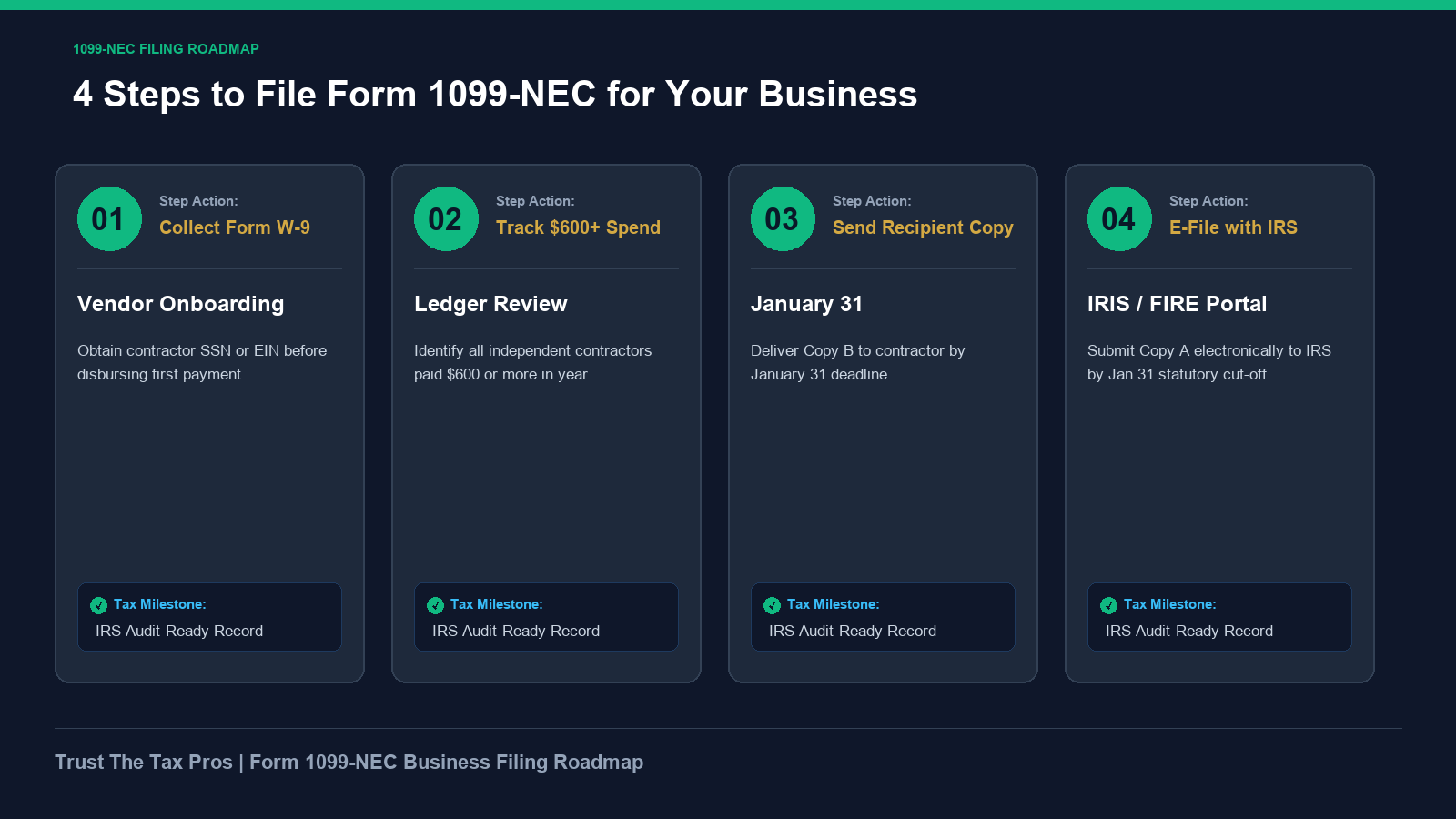
Filing Steps
- Payer & Recipient Information: Enter your business legal name, address, and EIN in the top payer box. Enter the contractor’s legal name, address, and SSN/EIN in the recipient boxes.
- Box 1 (Nonemployee Compensation): Enter total cumulative payments of $600 or more made for services rendered during the calendar year.
- Box 4 (Federal Income Tax Withheld): Enter any backup withholding withheld from payees who failed to provide a valid TIN.
- Send Recipient Copy B by January 31: Deliver Copy B to the contractor by mail or secure electronic delivery.
- E-File Copy A with the IRS by January 31: Businesses filing 10 or more information returns must e-file using the IRS Information Returns Intake System (IRIS) or FIRE portal.
Review first-year business entity rules in our first-year LLC tax filing guide.
Access official federal filing portals directly on the Internal Revenue Service official portal.
If you require CPA advisory support in Northern California, review advice from a Sacramento tax accountant.
Frequently Asked Questions
What is the deadline to file Form 1099-NEC?
The deadline to furnish Copy B to recipients and file Copy A with the IRS is January 31. If January 31 falls on a weekend, the deadline moves to the next business day.
Do I need to send a 1099-NEC to an LLC?
Yes, if the LLC is a single-member LLC (disregarded entity) or partnership. You do not need to issue a 1099-NEC to an LLC taxed as an S-Corporation or C-Corporation, except for legal fees.
What happens if I fail to file Form 1099-NEC on time?
The IRS assesses late filing penalties under IRC Section 6721 ranging from $60 per form (within 30 days) to $330 per form (after August 1). Penalties for intentional disregard exceed $660 per return with no maximum cap.
Do I report payments made via PayPal or credit card on Form 1099-NEC?
No. Payments made through third-party payment settlement entities (credit cards, PayPal, Stripe) are reported by the payment processor on Form 1099-K. Businesses should only report direct payments (checks, ACH, cash, wire transfers) on Form 1099-NEC.
Ensure Clean 1099 Business Compliance
Filing Form 1099-NEC accurately and on time protects your business from expensive IRS information return penalties. Collect Form W-9s from all new contractors, reconcile accounting ledgers before year-end, and submit electronic returns before January 31.
Consult a licensed CPA or tax professional to automate your 1099 vendor compliance and review year-end contractor reporting.