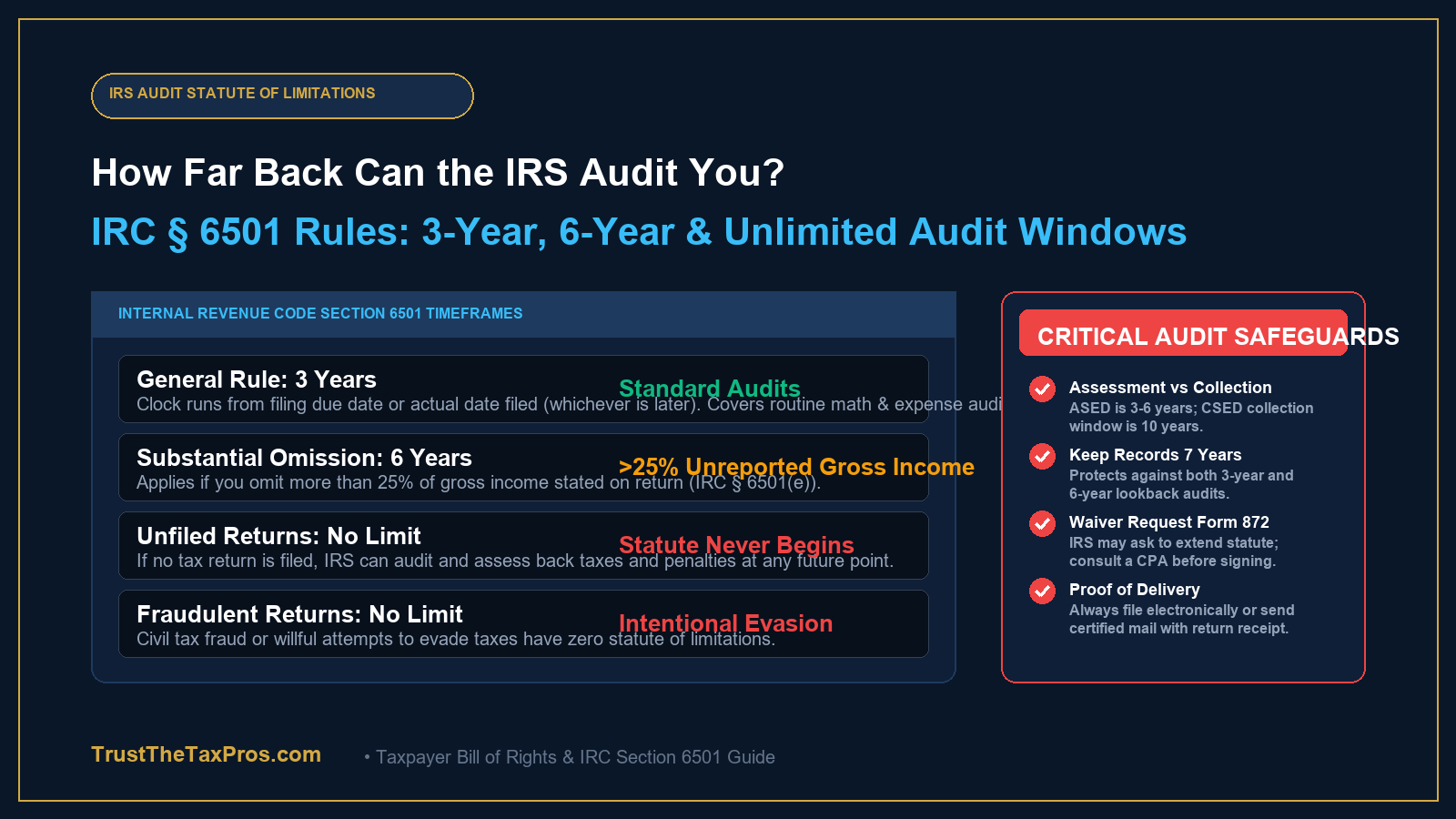
Few experiences cause more financial anxiety than receiving an examination notice from the Internal Revenue Service. If you are reviewing past filings, you are likely asking: how far back can the irs audit you?
The answer is not a single flat number. Federal tax law sets clear boundaries known as the Assessment Statute Expiration Date (ASED). Governed primarily by Internal Revenue Code (IRC) Section 6501, the timeframe depends on whether your return was filed on time, whether income was omitted, and whether intentional fraud occurred.
Understanding these strict statutory timelines helps taxpayers protect their rights, maintain appropriate records, and avoid unnecessary panic. Here is the complete breakdown of IRS lookback rules, legal triggers, and record retention guidelines.
The General 3-Year Rule: Standard Audit Window (IRC § 6501(a))
For the vast majority of individual and small business taxpayers, the IRS audit window is strictly limited to three years. Under Internal Revenue Code Section 6501 Assessment Limitations, the agency must assess any additional tax within 36 months.
The calculation of when that 3-year clock starts is critical. If you file your tax return on or before the standard April 15 deadline, the IRS treats the return as filed on April 15. The three-year window closes exactly three years from that statutory date.
If you file on an extension or submit your return late, the three-year clock starts on the actual calendar date the IRS receives your return. For example, if you filed your 2022 return on October 10, 2023, under an approved extension, the IRS has until October 10, 2026, to complete an audit examination.
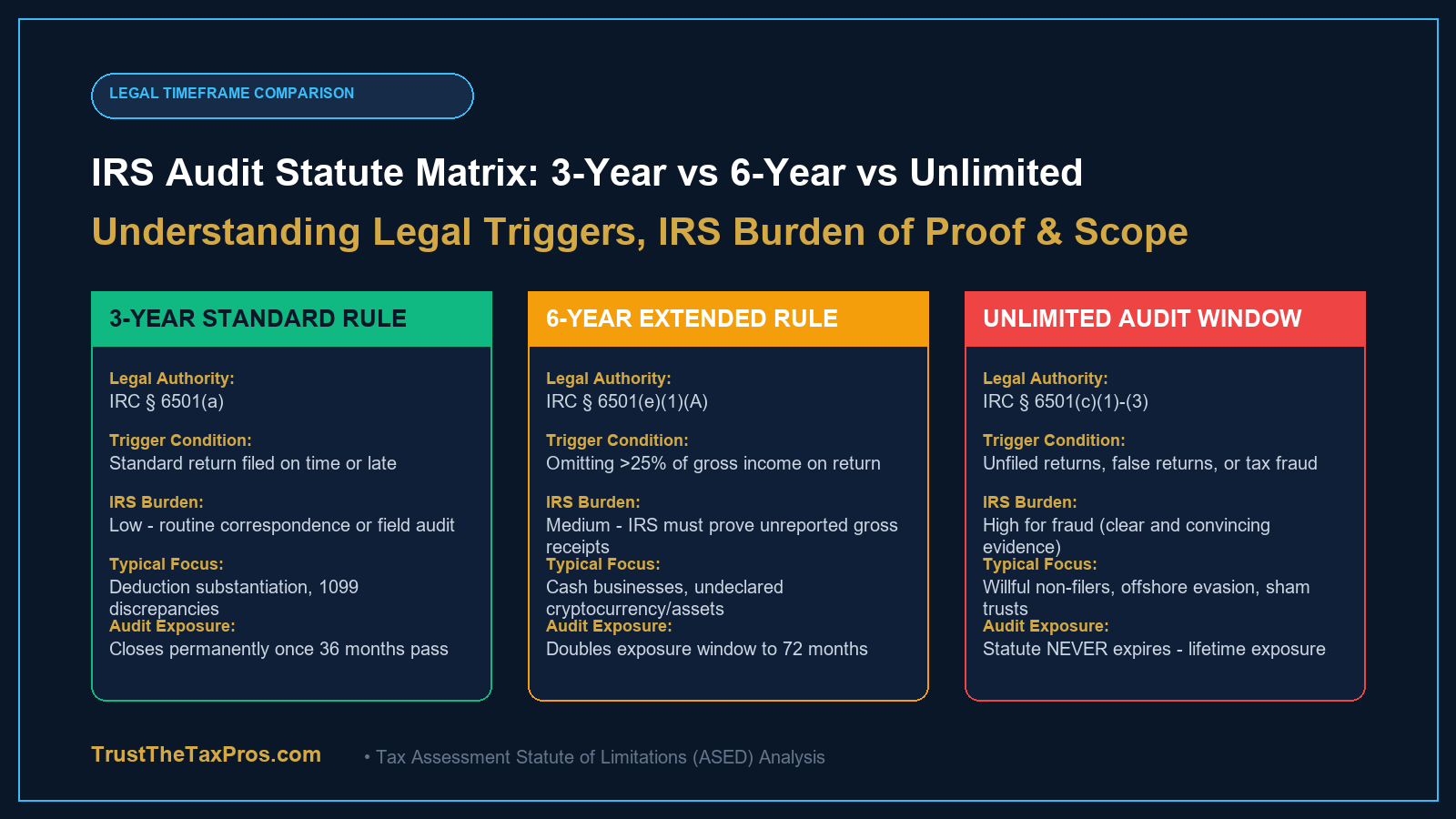
| Audit Category | Statutory Timeframe | Legal Trigger | Typical Examination Focus |
|---|---|---|---|
| Routine / Standard Return | 3 Years | Filing an honest, complete return | Receipt substantiation, 1099 math matching |
| Substantial Omission | 6 Years | Omitting >25% of gross income | Undeclared business revenue, foreign assets |
| Unfiled Tax Returns | No Time Limit | Failure to submit required tax return | Substitute for Return (SFR) assessment |
| Fraudulent Returns | No Time Limit | Willful intent to evade federal tax | Criminal investigation, 75% fraud penalty |
Most audits occur within two years of filing. The IRS prioritizes newer returns to ensure documentation is fresh and accessible. You can review practical prevention methods in our guide on IRS audit avoidance tips.
- Assessment Window (3 to 6 Years): This is the legal period in which the IRS must conduct an audit, verify deductions, and officially record a new tax assessment against you.
- Collection Window (10 Years): Once a tax liability is formally assessed, the IRS has 10 full years under IRC § 6502 to collect that balance through levies, liens, or wage garnishments.
The 6-Year Rule: Substantial Omission of Income (IRC § 6501(e))
The statute of limitations doubles to six years under specific conditions outlined in IRC § 6501(e). This extended timeframe applies whenever a taxpayer omits more than 25 percent of the gross income reported on their return.
Gross income omission calculations are based on gross receipts, not net taxable income. If your business reported $200,000 in gross revenue but failed to report an additional $55,000 in customer payments, you crossed the 25% threshold. That omission instantly exposes your entire tax return to a six-year examination window.
The 6-year rule also applies if you fail to disclose offshore financial assets. Under federal guidelines, omitting more than $5,000 of income attributable to specified foreign financial assets expands the audit window to 72 months.
When Does the IRS Have Unlimited Time to Audit You?
There are two primary scenarios where the statute of limitations never begins, giving the IRS lifetime authority to audit your accounts:
1. Failure to File a Tax Return
If you fail to file a tax return for a given tax year, the legal clock never starts ticking. The IRS can investigate, audit, and assess taxes on unfiled years decades later. In many instances, the agency files a Substitute for Return (SFR) under IRC § 6020(b), creating a tax assessment with zero deductions and maximum failure-to-file penalties. Review the financial consequences in our review of penalties for filing taxes late.
2. Filing a False or Fraudulent Return
Under IRC § 6501(c)(1), there is no statute of limitations on civil tax fraud or willful tax evasion. If the government demonstrates by clear and convincing evidence that a return was prepared with deliberate fraudulent intent, the IRS can audit and assess back taxes, interest, and a 75% civil fraud penalty at any future date.
Can the IRS Ask to Extend the Audit Deadline? (Form 872)
As an audit examination approaches the end of the 3-year statutory deadline, IRS revenue agents may ask you to sign Form 872 (Consent to Extend the Time to Assess Tax). This agreement legally extends the assessment window, giving the auditor additional months to complete their review.
Taxpayers often feel pressured to sign immediately. However, you are under no legal obligation to sign Form 872. If you decline to sign, the auditor must close the file and issue a formal Notice of Deficiency (90-day letter) based only on the evidence they have gathered.
Consult a CPA or tax attorney before signing any statutory extension waiver. In some cases, agreeing to a restricted extension that limits review to a single disputed deduction is preferable to granting an open-ended audit waiver. You can learn more about standard examination protocols directly through the official IRS Small Business Audit Examination Process.
Audit-Proof Record Retention: What to Keep and When to Shred
Maintaining proper records is your primary defense against audit assessments. The IRS places the burden of proof squarely on the taxpayer to substantiate deductions and credits claimed.
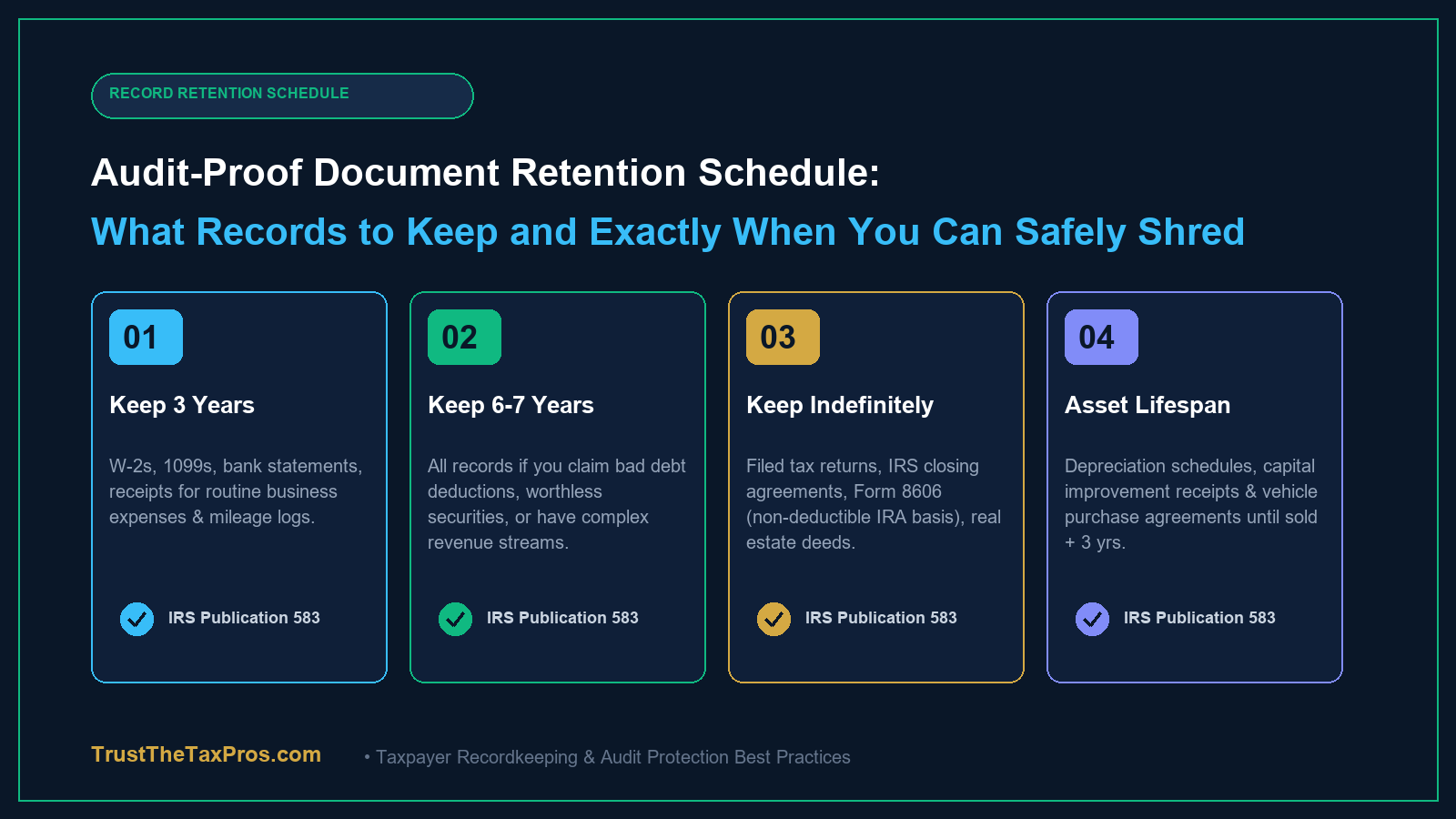
Follow these recordkeeping schedules aligned with the IRS Record Retention Guidelines and Publication 583:
- Keep for 3 Years: Form W-2s, 1099s, bank and credit card statements, mileage logs, and receipts for ordinary business expenses after filing.
- Keep for 6 to 7 Years: Records of gross receipts, contractor invoices, and documentation supporting bad debt write-offs or worthless security deductions.
- Keep for the Life of the Asset Plus 3 Years: Real estate settlement statements, capital improvement invoices, equipment purchase bills, and depreciation schedules.
- Keep Indefinitely: Copies of filed federal and state tax returns, proof of electronic filing confirmation, Form 8606 (tracking non-deductible IRA basis), and IRS closing agreements.
For individuals preparing annual returns, our step-by-step individual tax filing guide outlines how to organize documents properly before submitting your return.
Frequently Asked Questions
How far back can the IRS audit you for personal taxes?
For most individual taxpayers, the IRS can audit returns up to three years from the date filed or the original April 15 due date, whichever is later, under IRC Section 6501(a).
What triggers the 6-year IRS audit rule?
The 6-year audit window is triggered under IRC Section 6501(e) when a taxpayer omits more than 25 percent of gross income reported on their tax return, or fails to report more than $5,000 in foreign financial assets.
Can the IRS audit you after 10 years?
The IRS cannot initiate an assessment after 10 years on an honest return. However, if an assessment was legally made within the 3 or 6 year window, the IRS has 10 years under IRC Section 6502 to collect that tax debt. In cases of unfiled returns or tax fraud, there is no time limit.
Should I sign IRS Form 872 to extend the audit deadline?
Consult a licensed CPA or tax attorney before signing Form 872 (Consent to Extend the Time to Assess Tax). While refusing may cause the auditor to issue a statutory Notice of Deficiency based on incomplete figures, consenting gives the agency more time to examine other parts of your finances.