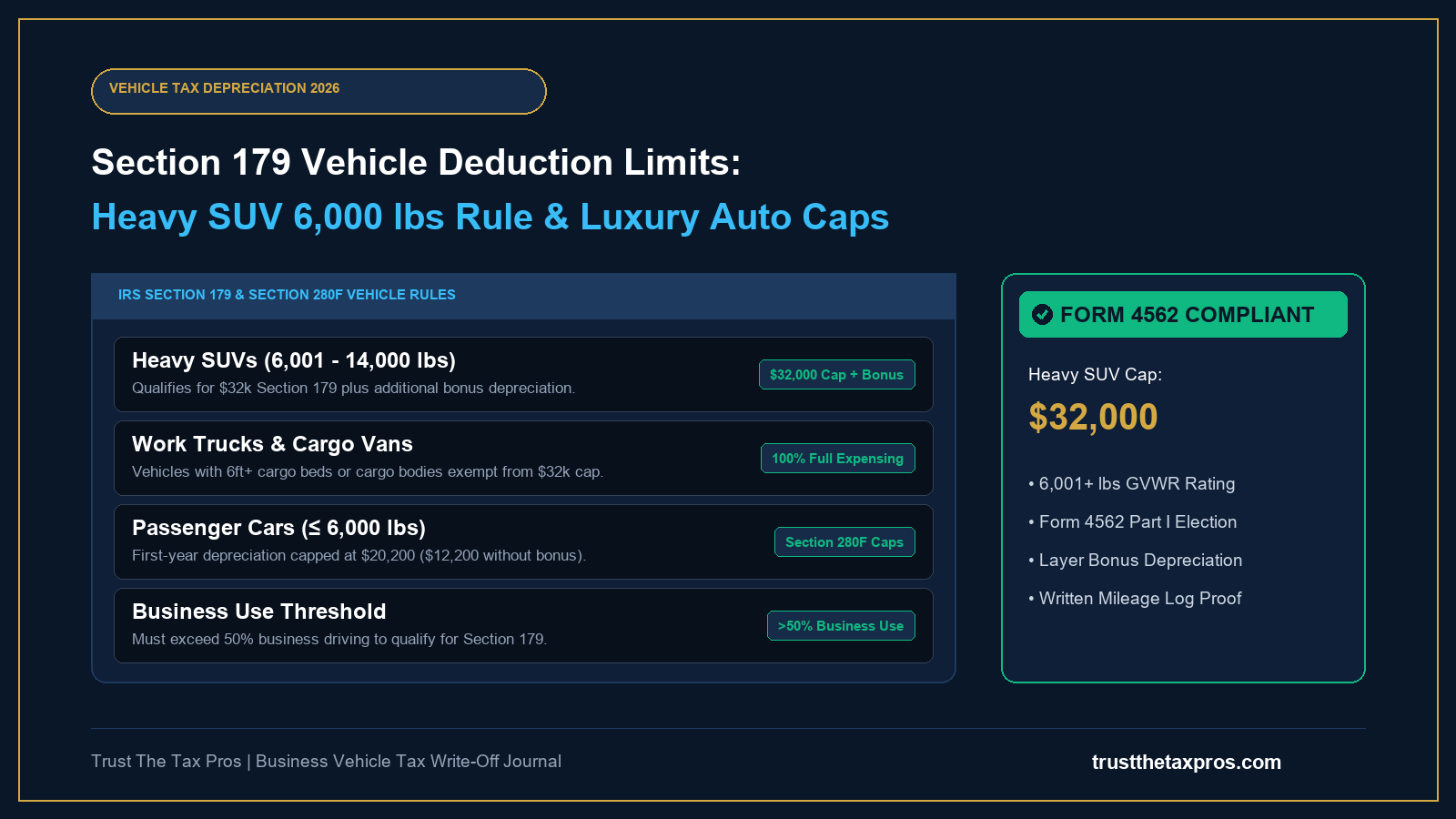
- Heavy SUVs (6,001–14,000 lbs GVWR): Qualify for an inflation-adjusted Section 179 expensing cap of $32,000 in the year placed in service, with remaining basis depreciable under bonus rules.
- Work Trucks & Cargo Vans (>6,000 lbs): Exempt from the $32,000 SUV limitation; businesses can write off up to 100% of the purchase price up to the annual aggregate Section 179 threshold.
- Passenger Cars (≤6,000 lbs): Restricted by IRS Section 280F luxury auto limits, capping total first-year depreciation at $20,200 ($12,200 without bonus depreciation).
- The >50% Business Use Test: To claim Section 179, qualified commercial mileage must exceed 50%. If usage slips below 50% in later years, depreciation recapture is triggered.
Purchasing a company vehicle represents one of the most powerful tax deduction opportunities available to self-employed individuals, LLC owners, and corporate executives. Under Internal Revenue Code (IRC) Section 179, business owners can accelerate depreciation deductions on qualifying equipment rather than writing off the purchase cost slowly over five to seven years.
However, the IRS tightly regulates vehicle deductions under the “listed property” statutory framework. Understanding the statutory Section 179 vehicle deduction limits requires analyzing vehicle gross weight classifications, qualified business usage percentages, and the interplay between Section 179 expensing and federal bonus depreciation.
Whether you are evaluating a heavy commercial SUV, a contractor pickup truck, or a standard passenger sedan, strict compliance with IRS rules is essential to defend deductions against audits. This guide breaks down the statutory rules, weight thresholds, luxury caps, and tax return filing mechanics for business vehicles.
Understanding Section 179 Vehicle Deduction Limits and Weight Thresholds
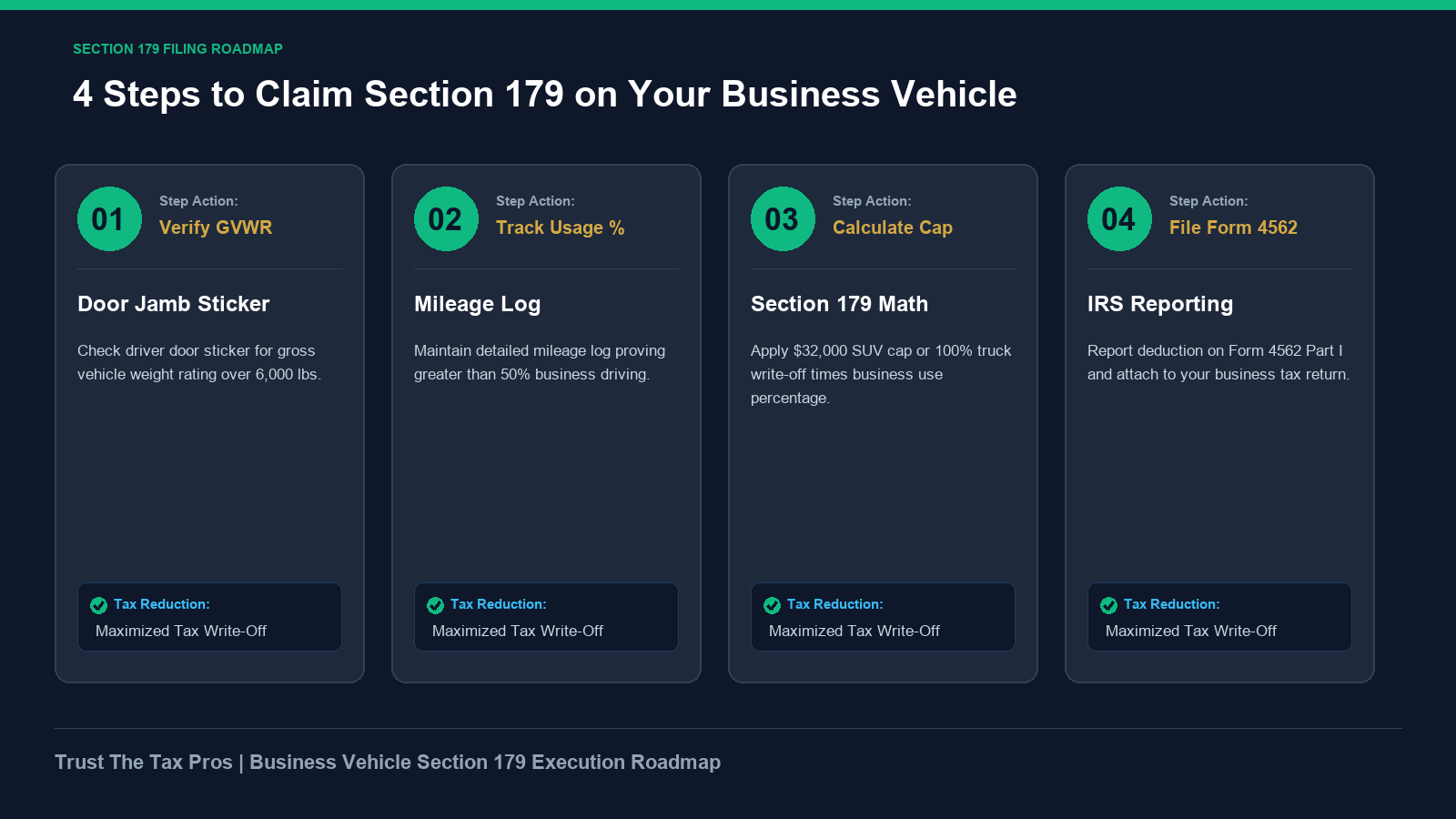
The core factor determining how much vehicle depreciation you can claim under Section 179 is the vehicle’s Gross Vehicle Weight Rating (GVWR). GVWR represents the maximum operating weight of the vehicle as specified by the manufacturer, including passenger weight, fluids, and cargo capacity. This weight is printed directly on the vehicle safety certification label inside the driver side door jamb.
The IRS separates business vehicles into two fundamental categories: light passenger automobiles weighing 6,000 pounds or less, and heavy vehicles with a GVWR exceeding 6,000 pounds. While light vehicles face severe statutory caps, heavy vehicles unlock substantial accelerated tax write-offs.
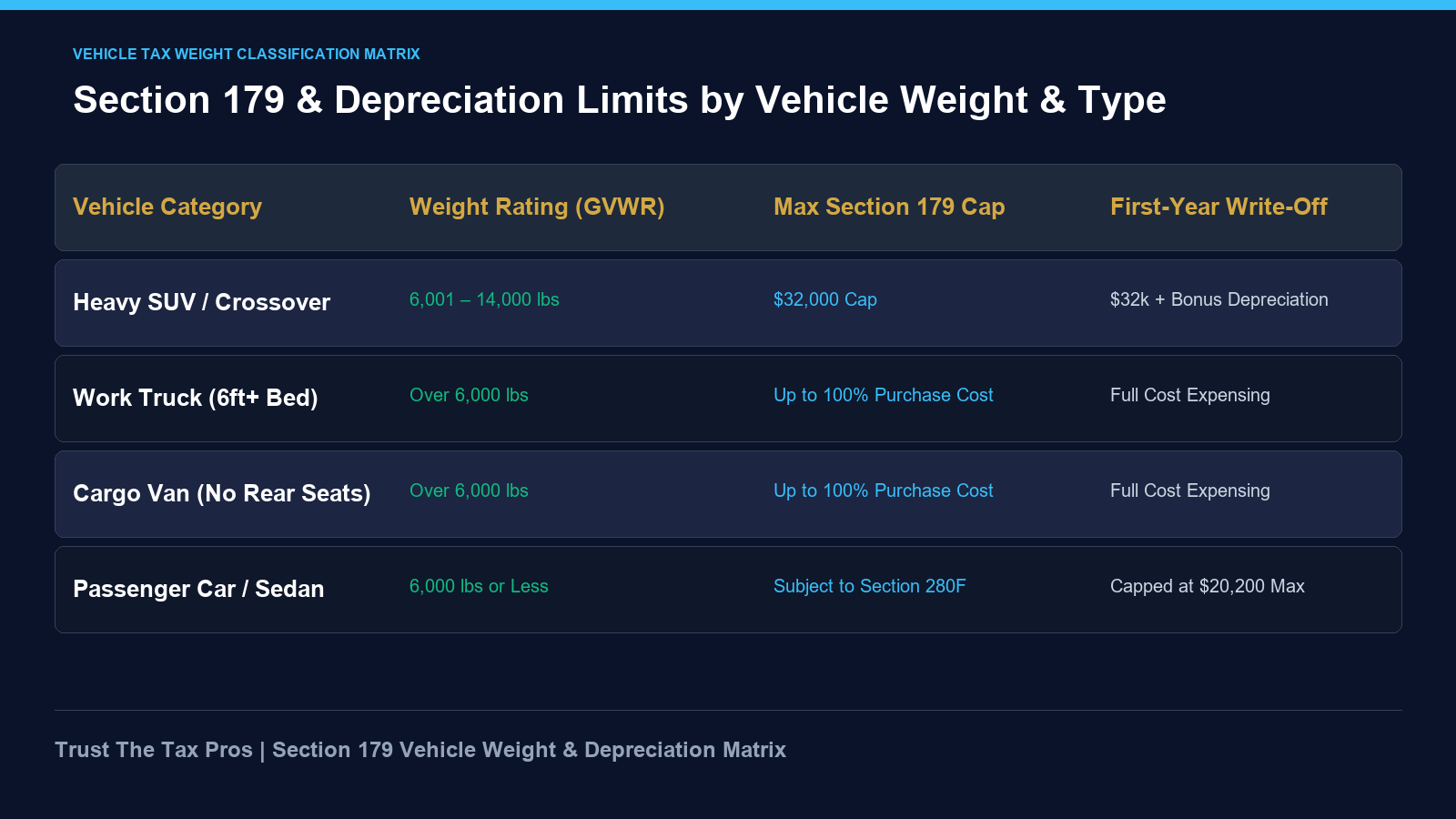
| Vehicle Type | GVWR Rating | Max Section 179 Cap | First-Year Deduction Potential |
|---|---|---|---|
| Heavy SUV / Crossover | 6,001 – 14,000 lbs | $32,000 | $32k + Bonus Depreciation |
| Commercial Work Truck (6ft+ Bed) | Over 6,000 lbs | 100% of Purchase Price | Full Expensing up to $2.5M+ cap |
| Cargo Van (No Rear Passenger Seats) | Over 6,000 lbs | 100% of Purchase Price | Full Expensing up to $2.5M+ cap |
| Light Passenger Auto / Sedan | 6,000 lbs or Less | Subject to § 280F Limits | $20,200 Max First-Year Write-Off |
When selecting a business vehicle, cross-referencing manufacturer specifications against published IRS guidelines in IRS Publication 946 (How To Depreciate Property) protects your company from invalid depreciation deductions.
The 6,000-Pound Heavy SUV Rule: Section 179 Cap Mechanics
Often referred to as the “Heavy SUV Loophole,” Section 179 allows business owners who acquire sport utility vehicles with a manufacturer GVWR above 6,000 pounds but not exceeding 14,000 pounds to deduct a substantial upfront portion of the purchase cost. For tax years beginning in 2026, the statutory Section 179 limit for these heavy passenger vehicles is indexed to $32,000.
To illustrate how this works, consider a small business consultant who purchases an eligible heavy SUV (such as a BMW X5, Porsche Cayenne, or Chevy Tahoe) for $80,000 and uses it 100% for business. The business first deducts the statutory $32,000 Section 179 expense. The remaining depreciable tax basis of $48,000 ($80,000 minus $32,000) is then eligible for federal bonus depreciation and regular MACRS recovery.
For entrepreneurs operating as pass-through entities, review our detailed guide on bookkeeping for single member LLC to ensure owner vehicle contributions and asset entries are tracked cleanly on the company balance sheet.
- Strict 50% Threshold: Under IRC § 280F(b), if business use of a vehicle is 50% or less, Section 179 expensing and bonus depreciation are completely disallowed.
- Prorated Deductions: If your vehicle is used 80% for business, your maximum Section 179 cap is prorated accordingly (e.g., $32,000 × 80% = $25,600 allowable deduction).
- Depreciation Recapture Risk: If business use falls below 51% during any of the subsequent five recovery years, you must recapture the accelerated tax savings as ordinary income.
Work Trucks and Cargo Vans: Exemptions from the $32,000 Limitation
Congress recognized that genuine commercial vehicles should not be restricted by passenger SUV limits. As a result, the tax code explicitly exempts certain utility and commercial vehicles from the $32,000 Section 179 limitation, allowing businesses to expense up to 100% of the acquisition cost.
To qualify for this complete 100% expensing exemption, the vehicle must have a GVWR over 6,000 pounds and satisfy one of the following architectural criteria:
- Full-Size Cargo Bed: Pickup trucks with a cargo bed of at least six feet in interior length that is not readily accessible from the passenger compartment.
- Cargo Van Architecture: Vans with a fully enclosed driver compartment, seating solely for the driver and first-row passenger, and no rear body seating.
- Passenger Seating Capacity: Commercial passenger shuttles or vans designed to seat more than nine passengers behind the driver seat.
For construction firms, plumbing contractors, and field service providers, utilizing full-size work trucks allows for complete tax deductions in the year of acquisition. When maintaining records, compare accelerated depreciation with standard vehicle write-offs using our Schedule C vehicle mileage deduction guide.
Section 280F Luxury Automobile Depreciation Limits for Passenger Cars
When purchasing or leasing a passenger vehicle rated at 6,000 pounds GVWR or less, businesses are restricted by IRC Section 280F “luxury automobile” caps. Despite the word “luxury,” this rule applies to almost every standard passenger car, sedan, and compact crossover sold in the United States today.
Under Section 280F, annual first-year depreciation deductions are capped at statutory dollar amounts, regardless of the purchase price. For vehicles placed in service in 2026, the first-year depreciation limit is $20,200 when federal bonus depreciation is elected, and $12,200 if bonus depreciation is opted out of.
Because depreciation on a $55,000 passenger vehicle would take over a decade to fully recover under Section 280F limits, many small business owners prefer opting for standard mileage deductions or choosing a qualifying vehicle with a GVWR over 6,000 pounds. Discover how IRS auditors evaluate vehicle expenses in our IRS audit avoidance tips.
How to Report Vehicle Depreciation on IRS Form 4562
To claim Section 179 expensing or MACRS depreciation on any business vehicle, you must complete and file IRS Form 4562 (Depreciation and Amortization). Because vehicles represent listed property, compliance requires completing multiple sections of the form.
- Part I (Election To Expense Certain Property Under Section 179): Enter your tentative Section 179 deduction on Line 6, subject to business income limitations on Line 11.
- Part V, Section A (Listed Property Depreciation): List the vehicle description, date placed in service, business use percentage, cost basis, and selected depreciation convention.
- Part V, Section B (Information on Use of Vehicles): Answer required compliance questions verifying whether another vehicle is available for personal use and whether contemporaneous written evidence supports the business percentage.
For corporate entities filing federal returns, see our walkthrough on Form 1120-S instructions for S-Corps to align vehicle balance sheet assets with shareholder distributions.
Frequently Asked Questions About Section 179 Vehicle Deductions
What is the Section 179 vehicle deduction limit for heavy SUVs?
For passenger-type vehicles and heavy SUVs with a Gross Vehicle Weight Rating between 6,001 and 14,000 pounds, the first-year Section 179 expense deduction is capped at $32,000. Any remaining vehicle cost basis can be depreciated using federal bonus depreciation and regular MACRS schedules.
Can I deduct 100% of a vehicle under Section 179 if I use it for personal errands?
No. You can only deduct the percentage of the vehicle cost that directly corresponds to documented business use. Furthermore, if your business use percentage is 50% or less, Section 179 expensing is completely disallowed by the IRS.
Do leased vehicles qualify for Section 179 expensing?
No. Leased vehicles cannot be depreciated under Section 179 because the business does not hold ownership title. Instead, lease payments are deductible as ongoing operating expenses on Schedule C or corporate returns, subject to IRS lease inclusion table adjustments.
Where do I find the gross vehicle weight rating of my car?
The GVWR is printed on the Federal Motor Vehicle Safety Standard certification label permanently affixed to the driver side door jamb or pillar. Do not confuse curb weight with GVWR; the IRS only recognizes the manufacturer GVWR rating.
What happens if my business has a net tax loss during the year?
Section 179 deductions cannot exceed your aggregate net trade or business taxable income. If claiming Section 179 would create or increase a business loss, the disallowed portion is carried forward indefinitely to future tax years under IRC § 179(b)(3).