
Public accounting firms across the country face a persistent structural crisis: an acute shortage of qualified accountants colliding with unprecedented regulatory complexity. According to the American Institute of CPAs (AICPA), more than 300,000 accountants left the profession over the past decade, leaving managing partners stretched thin during the grueling ten-week spring filing compression. To protect staff from burnout, protect firm margins, and accept lucrative new business, forward-thinking practices rely increasingly on tax preparation outsourcing as a core operating model.
Adopting an outsourced delivery model is no longer merely an emergency measure for handling overflow volume. When implemented with disciplined protocols, outsourcing transforms a traditional accounting practice into an agile, scalable enterprise. It liberates senior managers and partners from low-margin data entry, enabling them to focus on high-value client advisory services. However, delegating tax returns to third-party professionals introduces serious legal, regulatory, and technical obligations that practitioners must handle with precision.
The Economic Drivers: Why Modern CPA Practices Outsource Tax Preparation
The traditional model of hiring local entry-level staff accountants to key in W-2s, 1099s, and brokerage statements has become economically unsustainable for many independent firms. The combination of rising domestic salary expectations, elevated health benefit costs, and extreme seasonal attrition creates severe margin compression.
Key Operational Benefits of Tax Preparation Outsourcing
- Instant Capacity Scaling: Scale processing bandwidth up by 40% to 100% between January and April without adding permanent year-round overhead.
- Labor Arbitrage and Margin Expansion: Reduce raw return preparation labor costs by 50% to 70%, boosting practice profitability.
- Elimination of Partner Burnout: Remove 70-hour workweeks for internal staff, improving retention of senior talent.
- Shift to Advisory Revenue: Free internal professionals to deliver fractional CFO consulting, estate planning, and strategic tax mitigation.
- Overnight Turnaround Cycles: Leverage international time zone differences to achieve continuous 24-hour return processing.
Firms expanding their service offerings should review our guide on building a profitable tax preparation business to see how capacity planning directly impacts client retention and firm valuation.
Onshore vs Offshore Tax Outsourcing Models
Firm leadership must choose between two primary structural models: domestic onshore contractors or international offshore teams. Each path presents distinct cost profiles, operational considerations, and compliance thresholds.
| Comparison Metric | Onshore Outsourcing | Offshore Outsourcing |
|---|---|---|
| Talent Location | United States domestic personnel | India, Philippines, Latin America |
| Average Hourly Cost | $45 to $85+ per hour | $18 to $35 per hour |
| Time Zone Alignment | Real-time domestic business hours | Opposite or staggered time zones (overnight processing) |
| Client Friction | Minimal client hesitation | Requires clear communication on data safeguards |
| Section 7216 Requirements | Standard third-party disclosure consent | Mandatory specialized offshore disclosure language |
| Best Application | Complex corporate filings, specialized state issues | High-volume Form 1040s, standard 1120-S and 1065s |
Regulatory Compliance: Mastering IRS Section 7216
The single greatest regulatory hurdle in tax preparation outsourcing is compliance with Internal Revenue Code Section 7216. Enacted to safeguard taxpayer privacy, Section 7216 is a criminal statute. Under 26 U.S. Code Section 7216, any tax return preparer who knowingly or recklessly discloses or uses tax return information for any purpose other than preparing a return is guilty of a federal misdemeanor, punishable by a fine of up to $1,000, up to one year imprisonment, or both, for each violation.
In addition to criminal liability, civil penalties under Internal Revenue Code Section 6713 assess $250 per unauthorized disclosure, up to an annual maximum of $10,000. For accounting firms handling thousands of taxpayer records, non-compliance represents severe operational and reputational exposure.
Requirements of Treasury Regulation Section 301.7216-3
According to the official IRS Section 7216 Information Center, practitioners may disclose tax return information to third-party service providers only after obtaining formal, written, affirmative consent from the taxpayer. The rules require strict protocol adherence:
- Timing: Consent must be obtained before any tax return information is transmitted, shared, or made accessible to the service provider. Retroactive consents are legally invalid.
- Standalone Document: The consent form cannot be buried inside standard engagement letters or fine print. It must be provided as a distinct, standalone document or separate electronic acknowledgment.
- Specific Disclosures: The document must identify the specific third-party provider, the precise categories of data to be shared, and the exact purpose of the disclosure.
- Form 1040 Exact Formatting: For individual tax returns in the Form 1040 series, the disclosure must follow the exact statutory wording, font size, and layout prescribed under Revenue Procedure 2013-14.
- Offshore Notice: If client data will be accessed by or transmitted to personnel located outside the United States, the disclosure must explicitly state that taxpayer information will be disclosed to a service provider located outside the U.S., naming the specific foreign countries involved.
If a client refuses to execute the Section 7216 consent, the firm must prepare the return entirely in-house without third-party involvement. Maintaining strict audit logs of executed consents protects the practice during regulatory reviews.
The FTC Safeguards Rule and Firm Data Security Standards
Federal oversight extends beyond the IRS. Under the Federal Trade Commission’s amended Standards for Safeguarding Customer Information, CPA firms and tax preparation businesses are classified as non-banking financial institutions. Under the FTC Safeguards Rule, practices must maintain rigorous technical and procedural defenses.
When selecting an outsourcing partner, the managing CPA remains fully accountable for third-party security failures. Your firm’s Written Information Security Plan (WISP) must mandate that external vendors satisfy the following requirements:
1. Virtual Desktop Infrastructure (VDI) Environments
Never permit third-party preparers to download raw client files, W-2s, or PDF tax documents to local desktop hard drives. Secure outsourcing arrangements utilize secure VDI environments (such as Citrix or Microsoft Azure Virtual Desktop). Remote workers view screen renderings and operate cloud tax software without the ability to print, copy, screenshot, or store data locally.
2. SOC 2 Type II and ISO 27001 Certifications
Legitimate tax outsourcing providers undergo rigorous annual independent audits. Demand and review the vendor’s SOC 2 Type II report, which verifies operational controls governing security, availability, processing integrity, and confidentiality. ISO 27001 certification further demonstrates enterprise-grade information security management.
3. Data Encryption Standards
All client data must be protected using 256-bit Advanced Encryption Standard (AES) encryption at rest, alongside TLS 1.3 encryption protocols during all network transmissions. Enforce mandatory multi-factor authentication (MFA) across all administrative and preparer access points.
Practitioners must also protect their operations from unforeseen claims. Explore our detailed analysis on tax preparer errors and omissions insurance to confirm your policy covers subcontractor and outsourced operations.

Designing a Three-Tier Quality Control Workflow
Outsourcing tax preparation does not mean outsourcing professional responsibility. Under Treasury Department Circular 230 and AICPA Code of Professional Conduct Rule 1.300.040, the signing tax professional retains full responsibility for the accuracy of every return submitted to the IRS. Delegating data processing requires establishing a structured three-tier review workflow.
Tier 1: Initial Processing and Data Entry (Outsourced Team)
The outsourced team receives digital source documents through a secure portal. They input source figures, match prior-year depreciation schedules, enter K-1 items, cross-reference trial balances, and clear initial software diagnostic warnings. The outsourced team prepares an organized electronic workpaper binder with standardized tick marks and hyperlinked references.
Tier 2: In-House Senior Review (Firm Manager / Senior Accountant)
An experienced internal senior reviewer inspects the draft return against client source documentation. This stage focuses on contextual tax strategy: verifying multi-state allocation rules, evaluating passive loss limitations, reviewing Section 179 elections, and checking for missing deductions that an external processor might overlook. The internal reviewer provides structured feedback through electronic review notes.
Tier 3: Partner Final Sign-Off and Client Delivery (Signing CPA)
The firm partner conducts a high-level strategic review, verifies client billing, discusses complex positions with the business owner, and secures the signed Form 8879 (e-file authorization). The partner signs the return as the authorized paid preparer, maintaining the trusted advisory relationship with the client.
For independent business owners seeking clarity on fundamental tax compliance, share our plain-English guide on small business taxes for beginners to help them organize records before tax season begins.
Selecting the Right Outsourcing Partner: Firm Due Diligence Checklist
Before executing an outsourcing agreement, practice leaders should conduct thorough vendor vetting. Use this practical evaluation checklist during provider interviews:
- Professional Qualifications: Does the vendor employ credentialed professionals (such as U.S. CPAs, Enrolled Agents, or chartered accountants with documented U.S. tax training)?
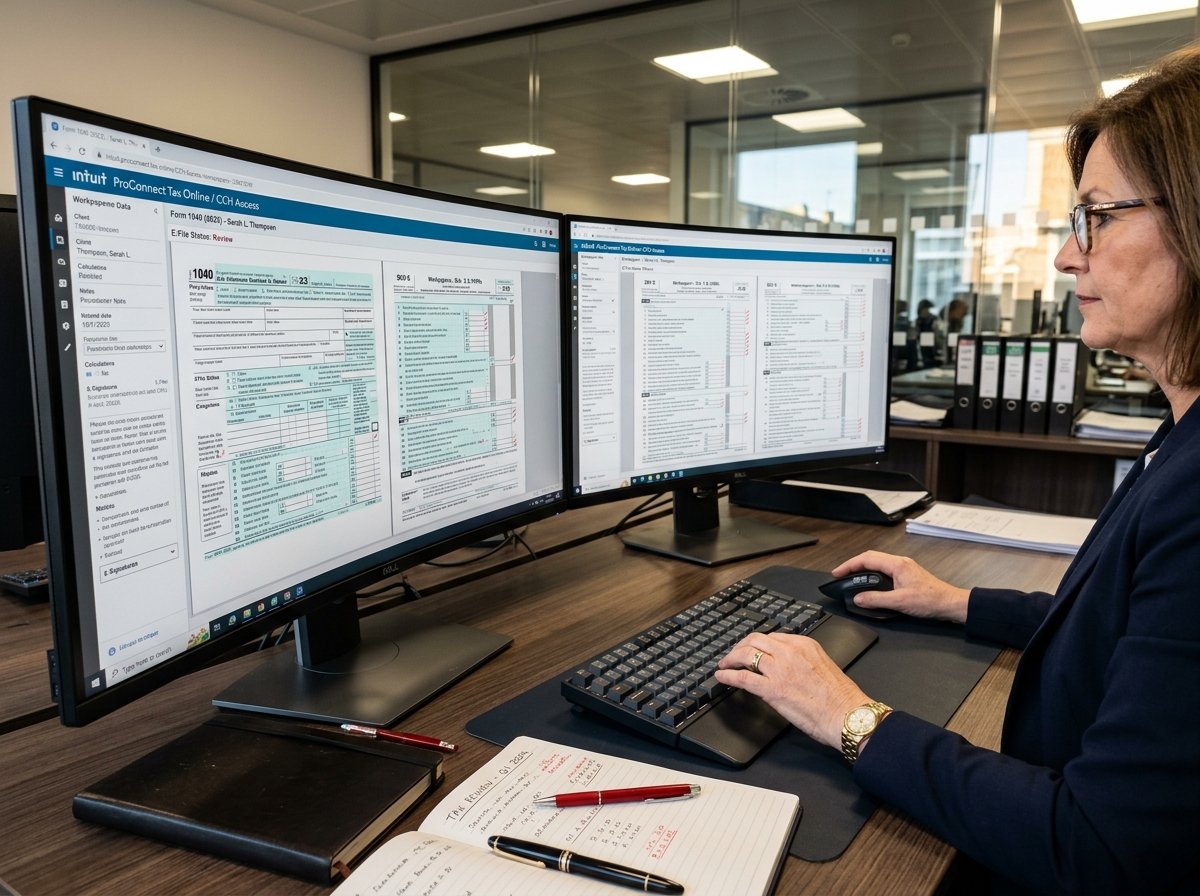
- Software Proficiency: Does the team demonstrate deep expertise in your existing production software (such as UltraTax CS, CCH Axcess, ProConnect, or Drake)?
- Contractual Guarantees: Does the service level agreement (SLA) define exact turnaround windows (such as 48 to 72 hours for standard returns) and specify error remediation policies?
- Data Sovereignty and Access Controls: Does the vendor allow work to be performed directly on your hosted servers, ensuring client data never leaves your firm’s encrypted perimeter?
- Clear Pricing Structure: Does the provider offer transparent fee options (such as fixed per-return pricing or dedicated full-time equivalent staffing) with zero hidden maintenance fees?
Integrating Outsourcing into Your Firm’s Long-Term Strategy
Tax preparation outsourcing is not an all-or-nothing proposition. The most successful accounting practices initiate outsourcing gradually. Begin by routing fifty to one hundred standardized individual returns (Form 1040) or basic single-member LLC filings through the outsourced channel during the first season.
As your internal team becomes proficient at managing outsourced workpapers and standardized review queues, you can expand the scope to include complex S Corporations, partnerships, and multi-state filings. By liberating your professionals from routine mechanical processing, your firm can build high-margin advisory services, eliminate tax season burnout, and achieve sustainable long-term growth.
To review licensing standards, ethical obligations, and credential differences among tax professionals, examine our practical guide on CPA credentials versus standard tax preparers.
Frequently Asked Questions
Does outsourcing tax preparation violate IRS client confidentiality rules?
No, provided your firm adheres strictly to Internal Revenue Code Section 7216. You must obtain informed, affirmative written consent from the client before sharing any tax return information with outside vendors or offshore personnel.
What is the penalty for violating IRS Section 7216 disclosure rules?
Under 26 U.S. Code Section 7216, unauthorized disclosure of tax return information is a federal criminal misdemeanor punishable by fines up to $1,000 and up to one year imprisonment per violation, alongside civil penalties under Section 6713.
What is the primary difference between onshore and offshore tax outsourcing?
Onshore outsourcing uses United States based contractors and domestic legal jurisdiction, offering direct real-time communication at higher hourly rates ($45 to $85+ per hour). Offshore outsourcing utilizes international professional teams (such as in India or the Philippines) at significant cost savings ($18 to $35 per hour) with overnight turnaround, but demands rigorous Section 7216 offshore disclosures and international security audits.
Who signs the tax return when preparation work is outsourced?
The signing CPA or Enrolled Agent at your firm signs the tax return as the paid preparer. Outsourcing assists with data entry, workpaper organization, and initial drafting, but the licensed practitioner maintains full legal and professional responsibility for the return’s accuracy.
How does the FTC Safeguards Rule affect tax preparation outsourcing?
The FTC Safeguards Rule requires tax professionals to maintain a Written Information Security Plan (WISP) and mandate that all third-party service providers implement multi-factor authentication, end-to-end data encryption, and strict access controls.
What software platforms support secure outsourced tax workflows?
Leading secure platforms include Intuit ProConnect, Thomson Reuters UltraTax CS, Wolters Kluwer CCH Axcess, and Drake Software hosted on secure virtual desktop infrastructure (VDI) environments that prevent local data downloads.