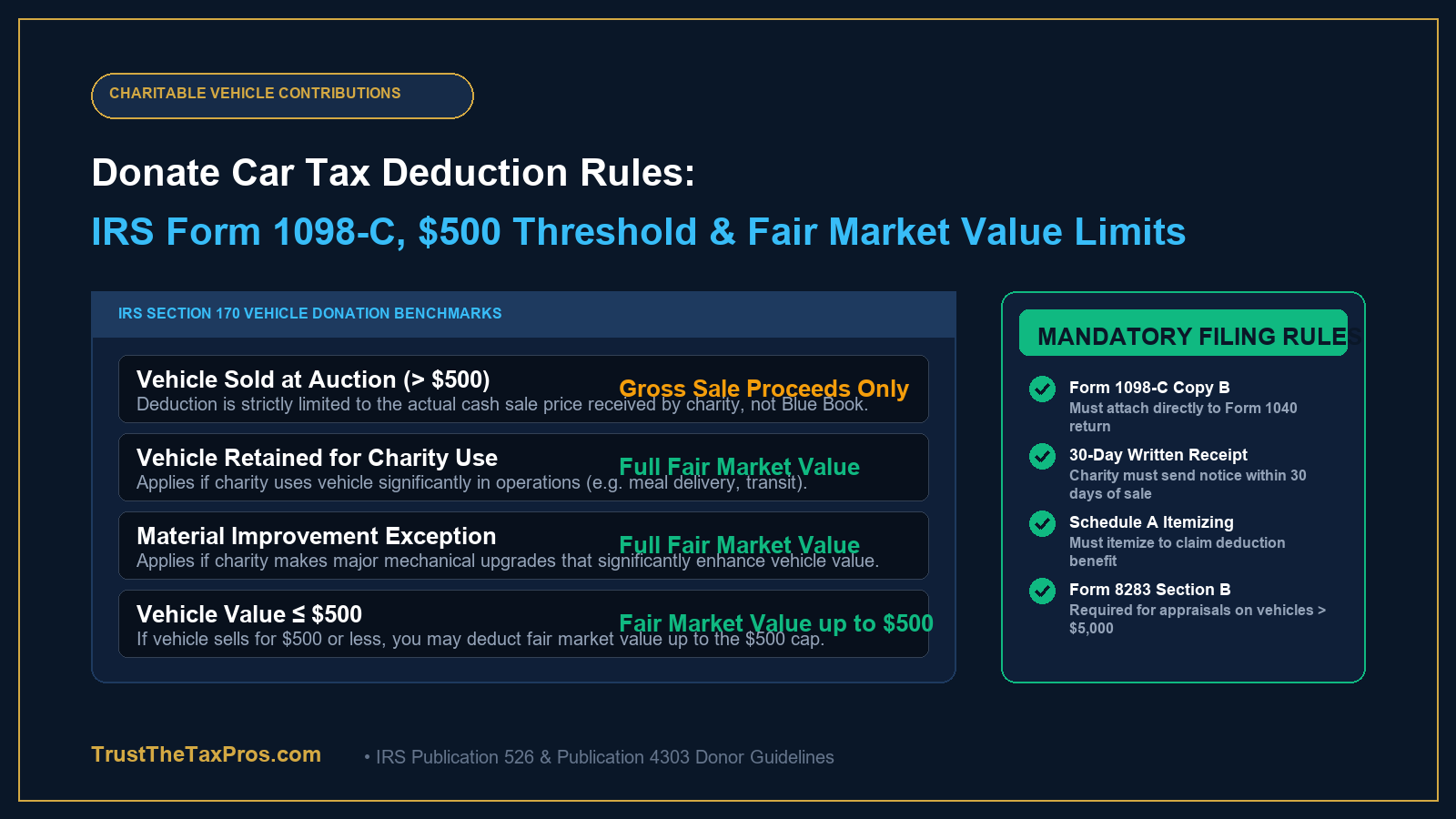
Donating an unwanted vehicle to a charitable organization is a generous way to support a worthy cause while reducing your federal taxable income. Before handing over your keys, you must understand how the donate car tax deduction actually works under federal tax law.
Many vehicle owners assume they can look up the private-party Kelley Blue Book value and deduct that entire figure on their tax return. The Internal Revenue Service reformed vehicle donation regulations to eliminate inflated write-offs. Today, the tax code ties your deduction directly to what the charity actually does with your car.
This comprehensive compliance guide breaks down the critical $500 valuation threshold, IRS Form 1098-C reporting requirements, fair market value exceptions, and Schedule A itemizing rules so you can claim your tax benefit without audit risk.
The General Rule: Gross Sales Proceeds vs Fair Market Value
Charitable contributions of motor vehicles are governed by IRC Section 170 Charitable Contributions and Gifts and detailed in IRS Publication 526 Charitable Contributions. The law establishes two main paths for determining your write-off.
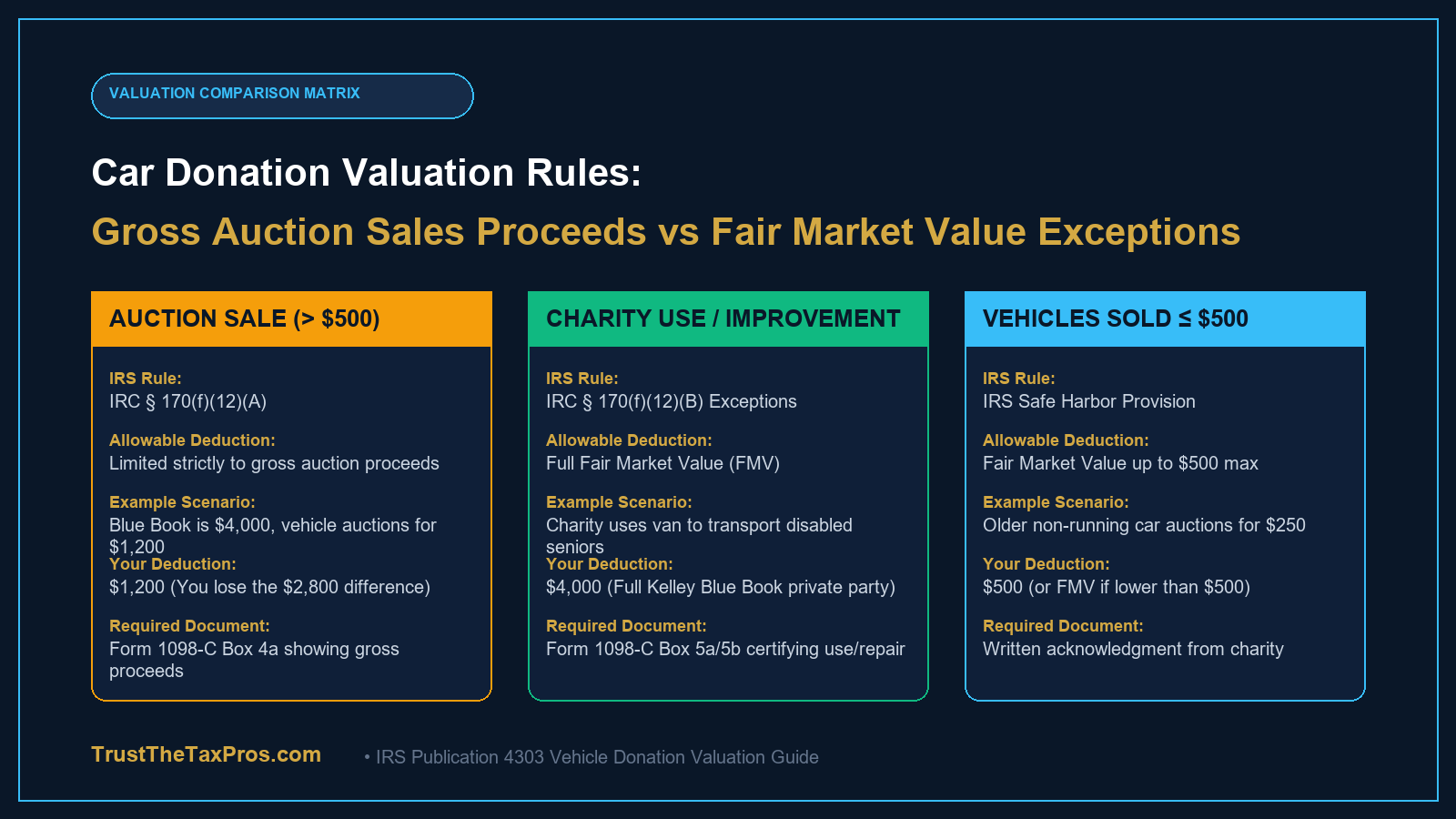
If the charity sells your vehicle at auction and the gross proceeds exceed $500, your deduction is limited strictly to the actual gross sales price. Even if your car had a retail or private-party market value of $4,000, your tax deduction is capped at $1,200 if the charity sells it for $1,200 at a wholesale auto auction.
If the vehicle sells for $500 or less, the IRS safe harbor rule applies. You can deduct the fair market value of the car up to a maximum cap of $500, or the actual gross sales proceeds, whichever is greater.
Charity Action |
Maximum Allowable Deduction |
Required Tax Documentation |
IRS Code Authority |
|---|---|---|---|
| Sold at Auction (> $500) | Gross Sales Proceeds Only | Form 1098-C Box 4a | IRC § 170(f)(12)(A) |
| Retained for Significant Use | Full Fair Market Value (FMV) | Form 1098-C Box 5a | IRC § 170(f)(12)(B)(i) |
| Materially Improved by Charity | Full Fair Market Value (FMV) | Form 1098-C Box 5b | IRC § 170(f)(12)(B)(ii) |
| Vehicle Sold for ≤ $500 | Fair Market Value Up to $500 | Written Charity Receipt | IRS Safe Harbor Rule |
Understanding these rules ensures you set realistic tax expectations. For broader filing preparation strategies, consult our comprehensive guide on individual tax filing for taxpayers.
- Significant Intervening Use: The charity intends to use the car extensively to deliver meals, transport patients, or run emergency shelters on a regular basis.
- Material Improvement: The charity makes major mechanical upgrades (such as rebuilding an engine or transmission) that significantly increase its value before sale. Routine cleaning or paint touch-ups do not qualify.
- Discounted Sale to a Needy Individual: The organization transfers the vehicle to an individual in financial distress at a nominal price to help them secure employment or essential transportation.
IRS Form 1098-C: The Mandatory Tax Document
You cannot legally claim a vehicle donation deduction over $500 without official certification from the receiving organization. This proof arrives via IRS Form 1098-C (Contributions of Motor Vehicles, Boats, and Airplanes).
Federal law requires the charity to provide Copy B of Form 1098-C to you within 30 days of the vehicle sale date. If the charity retains the vehicle for organizational use, they must provide the form within 30 days of the donation. Review official agency guidelines at IRS Form 1098-C Guidelines.
Form 1098-C contains vital details including your Social Security Number, the Vehicle Identification Number (VIN), the date of contribution, and the exact gross sales proceeds in Box 4a. You must attach Copy B of Form 1098-C directly to your Form 1040 federal return. Failing to attach this form will cause the IRS to reject your deduction automatically.
Step-by-Step Roadmap: How to Donate a Car and Claim the Write-Off
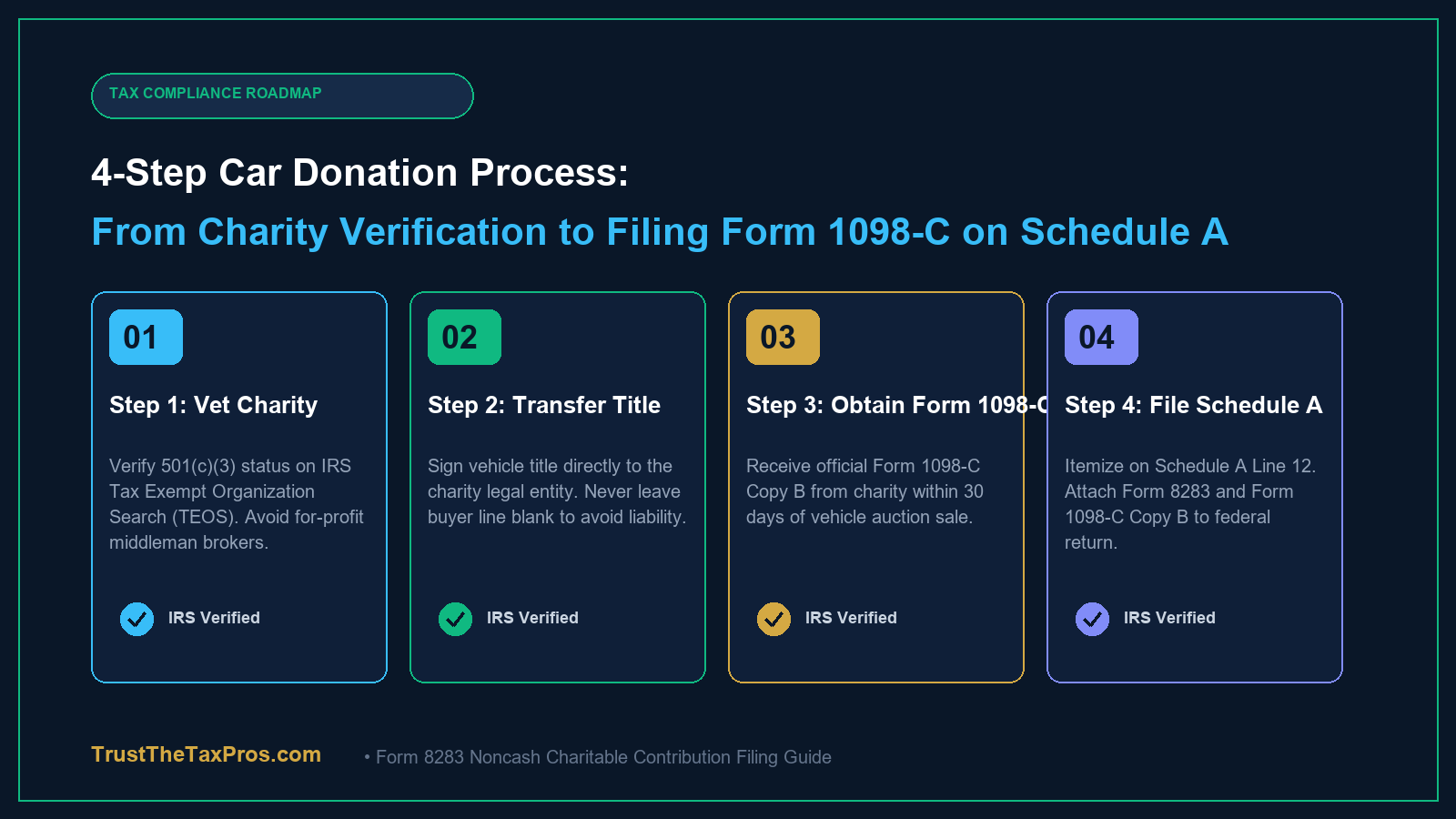
To avoid tax complications or lingering vehicle ownership liability, follow this structured four-stage donation protocol:
1. Verify 501(c)(3) Tax-Exempt Status
Only contributions to qualified 501(c)(3) public charities are tax deductible. Contributions to civic leagues, political groups, foreign entities, or individuals are strictly non-deductible. Always check the IRS Tax Exempt Organization Search (TEOS) online database to verify active tax-exempt standing before surrendering your vehicle.
2. Transfer the Vehicle Title Properly
Never sign over a vehicle title leaving the buyer field blank. Unscrupulous middleman towing companies often resell vehicles without registering the title, leaving the donor legally responsible for future parking tickets, impound fees, or traffic violations. Sign the title directly over to the legal name of the charity and notify your state department of motor vehicles immediately.
3. Obtain Form 1098-C and Written Receipts
Request an immediate temporary receipt at the time of vehicle pickup documenting the date, donor name, and VIN. Once the charity auctions the vehicle, ensure they mail Copy B of Form 1098-C to you within 30 days. Contact the organization promptly if you do not receive this form by December.
4. File Schedule A and Form 8283
Report the charitable contribution on Schedule A (Form 1040). If your total noncash deduction exceeds $500, you must also complete IRS Form 8283 (Noncash Charitable Contributions), Section A. If you claim a deduction exceeding $5,000 based on fair market value, you must complete Section B and obtain a formal written appraisal from an independent certified appraiser.
The Itemized Deduction Trap: Standard Deduction vs Schedule A
Many donors donate vehicles expecting an automatic reduction in their tax bill, only to discover at filing time that the donation provides zero tax benefit. This occurs because charitable donations can only be claimed if you itemize your deductions on Schedule A.
Following tax code changes, the Standard Deduction is substantial. For single taxpayers, the standard deduction is $15,000, while married couples filing jointly receive $30,000. If your combined mortgage interest, state and local taxes, and charitable gifts do not exceed your standard deduction, itemizing makes no financial sense.
Review standard deduction thresholds across state and federal returns in our guide on the California standard deduction for married filing jointly.
Common IRS Red Flags When Claiming Car Donations
Vehicle donations have historically attracted heightened IRS scrutiny due to past valuation abuses. Protect your return by avoiding these common audit triggers:
- Deducting Blue Book Value for an Auctioned Car: Claiming $4,500 on Schedule A when Form 1098-C shows the charity received $950 at auction triggers an immediate automated adjustment notice.
- Missing Form 1098-C Copy B: E-filing a return claiming a vehicle deduction over $500 without transmitting Form 1098-C (or mailing Form 8453 with the paper copy attached) leads to automatic deduction disallowance.
- Donating to Non-Qualifying Middlemen: Many radio and TV vehicle donation advertisements are run by commercial private brokers who keep 80% to 90% of the vehicle proceeds. Confirm that the actual recipient is a registered 501(c)(3) entity.
- Skipping Appraisals on High-Value Vehicles: Claiming more than $5,000 for a classic or specialty vehicle under a fair market value exception without a qualified appraisal violates IRS regulations.
If you receive an inquiry from an auditor regarding your charitable deductions, review our practical IRS audit avoidance tips and understand potential penalties for late filing.
Frequently Asked Questions
How much can I write off for donating my car to charity?
If the charity sells your vehicle at auction for more than $500, your tax deduction is limited strictly to the gross sales proceeds received by the organization. If the car sells for $500 or less, you can deduct the fair market value up to $500.
Can I use Kelley Blue Book to determine my car donation tax deduction?
Generally, no. You cannot use Kelley Blue Book or Edmunds private-party values if the charity sells your vehicle at auction for more than $500. You can only use published pricing guides if an exception applies, such as the charity keeping the car for significant operational use.
What IRS tax forms are required to claim a vehicle donation?
You must obtain IRS Form 1098-C from the charity within 30 days of the sale and attach Copy B to your return. If your total noncash deduction exceeds $500, you must also complete IRS Form 8283 and file Schedule A to itemize deductions.
Do I get a tax deduction if I take the Standard Deduction?
No. Charitable donations of vehicles are noncash contributions claimed on Schedule A. If you take the Standard Deduction instead of itemizing, your car donation will not reduce your federal income tax liability.
When is an independent appraisal required for a donated car?
An independent certified appraisal is legally required if you claim a deduction exceeding $5,000 and qualify to use Fair Market Value rather than auction sale proceeds. The appraisal must be completed within 60 days before the donation date.