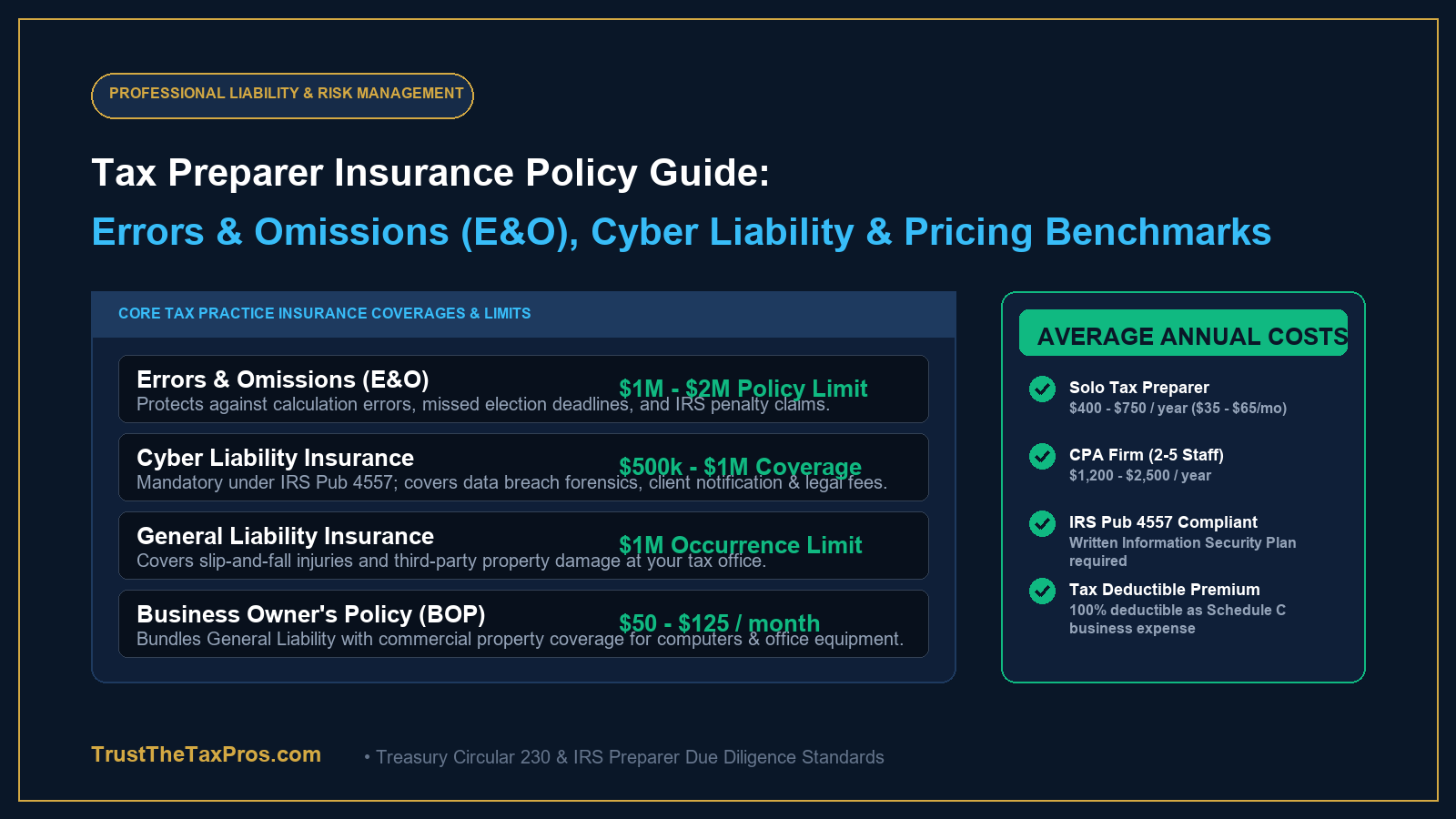
Operating a modern accounting or tax advisory practice involves significant professional responsibility. Whether you prepare individual returns or advise corporate clients, specialized tax preparer insurance is essential protection against costly client lawsuits, data breaches, and regulatory fines.
A single transposed digit, an overlooked tax election deadline, or a sophisticated email phishing attack can expose your practice to devastating financial liabilities. Disgruntled clients facing IRS accuracy penalties frequently sue their paid tax preparer to recover interest, penalties, and accounting fees.
This comprehensive practice management guide examines core coverage types, breaks down average policy costs, explains mandatory data protection mandates under IRS Publication 4557, and compares leading professional liability insurance providers.
The Three Vital Insurance Coverages Every Tax Preparer Needs
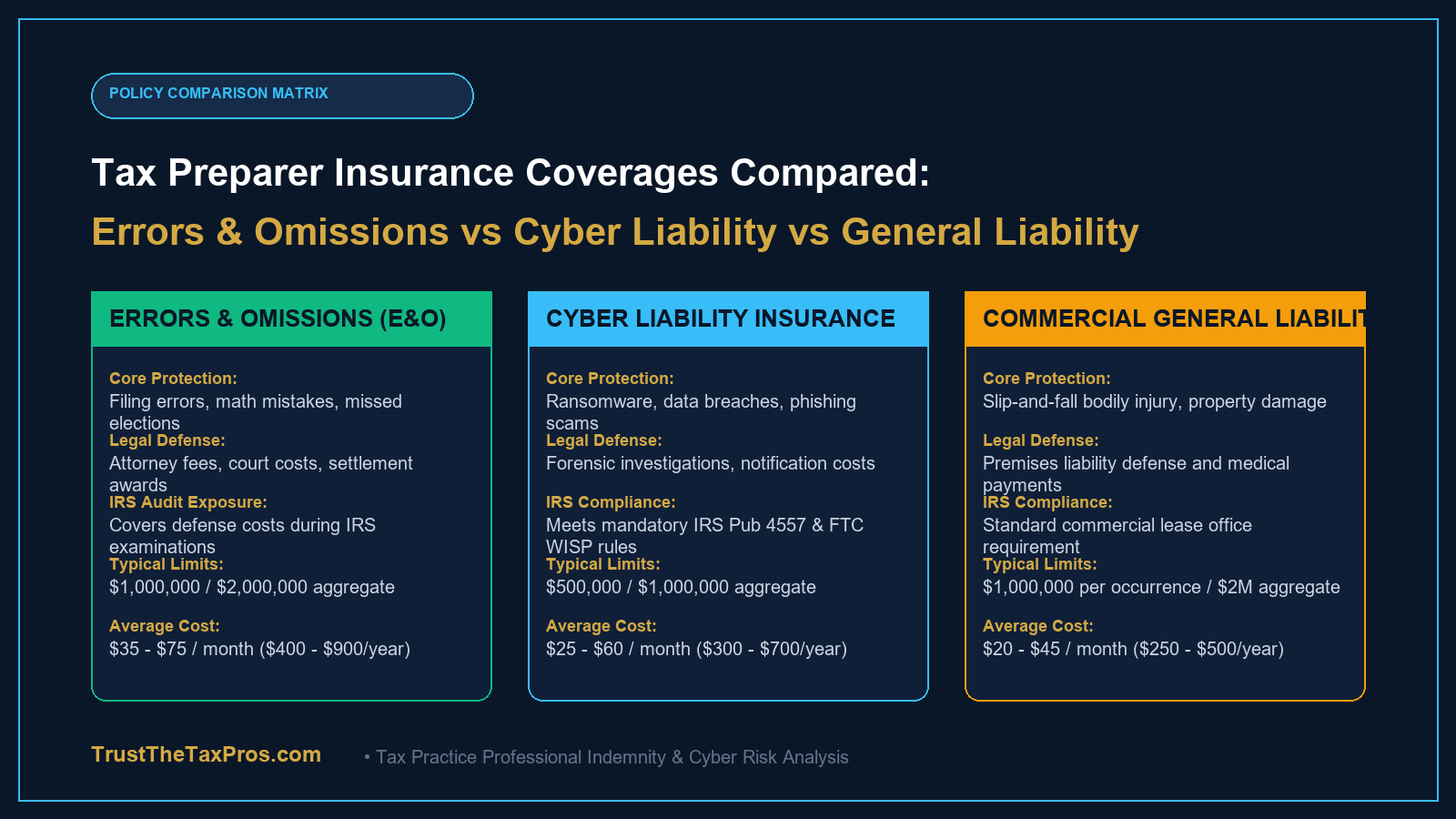
A generic commercial policy does not shield tax professionals from practice-specific risks. To safeguard your business completely, you must assemble three complementary insurance policies:
1. Errors and Omissions (E&O) Insurance
Also known as Professional Liability Insurance, E&O coverage is the cornerstone of tax practice risk management. It defends you against claims alleging negligence, calculation errors, missed tax deadlines, or incorrect tax advice. If a client sues you because an erroneous deduction triggered an IRS examination, E&O pays your legal defense fees, expert witness costs, and court judgments.
2. Cyber Liability and Data Breach Insurance
Tax preparers store some of the most sensitive data in the economy: client names, Social Security Numbers, bank routing details, and wage transcripts. Federal guidelines detailed in IRS Publication 4557 Safeguarding Taxpayer Data require practitioners to protect taxpayer data rigorously. Cyber liability covers forensic data recovery, mandatory client notifications, credit monitoring services, and regulatory legal defense following a cyber attack.
3. Commercial General Liability (CGL) Insurance
General liability protects against non-professional physical risks occurring at your place of business. It covers third-party bodily injuries (such as a client slipping on ice outside your office) and physical property damage. Most commercial office landlords require proof of at least $1,000,000 in general liability before executing a commercial lease.
| Policy Type | Core Protection Scope | Standard Coverage Limit | Average Annual Cost |
|---|---|---|---|
| Errors & Omissions (E&O) | Filing mistakes, calculation errors, missed elections | $1,000,000 / $2,000,000 | $400 – $900 / year |
| Cyber Liability | Data breaches, ransomware, phishing, extortion | $500,000 / $1,000,000 | $300 – $700 / year |
| Commercial General Liability | Slip-and-fall bodily injury, property damage | $1,000,000 per occurrence | $250 – $500 / year |
Bundling General Liability with commercial property coverage through a Business Owner’s Policy (BOP) often yields premium discounts of 15% to 25%. You can learn more about general accounting fee standards in our guide to small business CPA selection.
- Federal Legal Requirement: Under the Federal Trade Commission Gramm-Leach-Bliley Act Safeguards Rule, all professional tax preparers must create and maintain a written data security plan.
- PTIN Renewal Verification: The IRS requires tax professionals to confirm that they have an active WISP in place when renewing their annual Preparer Tax Identification Number (PTIN). Failure to maintain a plan can result in suspension of electronic filing credentials.
How Much Does Tax Preparer Insurance Cost?
Insurance premiums vary according to firm size, annual gross billings, complexity of services, and past claims history. Typical pricing tiers include:
Solo practitioners preparing between 100 and 300 personal Form 1040 returns annually can expect to pay $400 to $750 per year for a $1,000,000 E&O policy. Adding dedicated cyber coverage increases the annual investment by $300 to $500.
Small accounting firms with two to five preparers handling complex business returns (Form 1120-S and Form 1065) typically pay $1,200 to $2,500 annually. Premiums reflect the increased financial exposure associated with corporate tax planning and payroll management.
All insurance premiums paid to protect your business are 100% tax deductible as ordinary operating expenses. If operating as an LLC or sole proprietorship, report these expenses on Line 15 of Schedule C. Review corporate formation tax requirements in our walkthrough on filing business taxes for an LLC.
Step-by-Step Roadmap: How to Protect Your Tax Practice
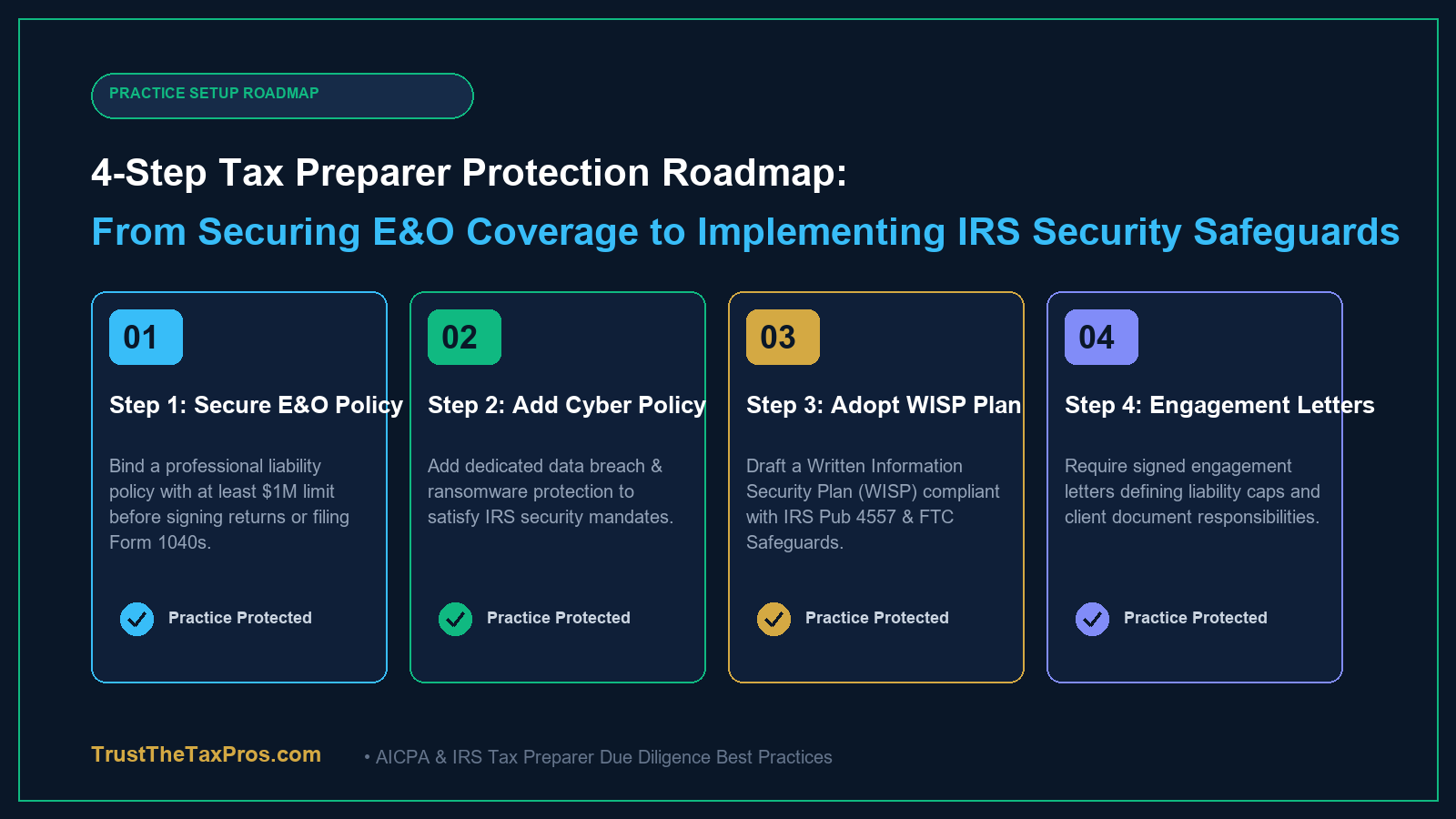
Establishing robust risk protection requires practical administrative safeguards alongside your insurance policies:
1. Secure a Comprehensive E&O Policy
Purchase a professional liability policy prior to accepting paid tax clients. Ensure your policy includes coverage for IRS audit defense costs, subpoena expenses, and disciplinary proceedings before state accountancy boards. Review established industry programs through the AICPA Member Professional Liability Insurance Programs.
2. Require Signed Engagement Letters for Every Client
Never start tax work without a signed engagement letter. This binding contract defines the exact scope of services, specifies deadlines for client document submissions, outlines limitation of liability clauses, and confirms that client-provided records are assumed accurate.
3. Implement Multi-Factor Authentication and Encryption
Protect all client portals and tax software using multi-factor authentication (MFA). Mandate full-disk encryption on all practice laptops and encrypt all sensitive PDF tax documents transmitted via email to comply with federal security mandates.
4. Establish Clear Document Retention Policies
Maintain digital copies of all signed client e-file authorizations (Form 8879) and source documentation for at least three to seven years. For statutory guidelines on audit exposure, consult our breakdown on IRS audit representation rights and review statutory rules on penalties for filing taxes late.
Top Insurance Providers for Tax Professionals
When selecting an insurance carrier, choose an underwriter with specialized experience in accounting malpractice defense:
- Hiscox: Renowned for tailored small business insurance, offering fast online quoting, affordable standalone E&O policies, and seamless monthly billing for solo tax preparers.
- BiBERK (A Berkshire Hathaway Company): Delivers cost-effective direct-to-consumer coverage with excellent financial stability ratings and straightforward policy terms.
- The Hartford: A leading commercial insurer offering robust Business Owner’s Policies, specialized data breach riders, and dedicated claims specialists.
- Travelers: Excellent choice for growing regional CPA firms requiring higher policy limits ($2M to $5M) and sophisticated employment practices liability coverage.
Frequently Asked Questions
Is tax preparer insurance legally required by the IRS?
The IRS does not mandate Errors and Omissions insurance to obtain a PTIN or EFIN. However, federal law under the FTC Safeguards Rule and IRS Publication 4557 requires tax preparers to implement strict data security measures, making Cyber Liability insurance an essential operational safeguard.
How much does Errors and Omissions insurance cost for a tax preparer?
A standard $1,000,000 Errors and Omissions (E&O) policy for a solo tax preparer typically costs between $35 and $75 per month ($400 to $900 per year). Pricing depends on annual client return volume, services offered (bookkeeping vs audits), and past claims history.
Does tax preparer insurance cover IRS penalties assessed against clients?
Most comprehensive E&O policies cover client penalties and interest resulting from preparer error, such as a missed filing deadline or inaccurate calculation. However, insurance will never pay the underlying tax liability that the client rightfully owed.
What is the difference between E&O and Cyber Liability insurance?
Errors and Omissions insurance protects against professional mistakes in tax calculations, advice, and filing elections. Cyber Liability insurance protects against data breaches, ransomware attacks, stolen client Social Security Numbers, and forensic investigation costs.
Are tax preparer insurance premiums tax deductible?
Yes. Professional liability insurance premiums, E&O coverage, and cyber policies are 100 percent tax deductible as ordinary and necessary business expenses on Schedule C (Line 15) for sole proprietors or on corporate entity tax returns.