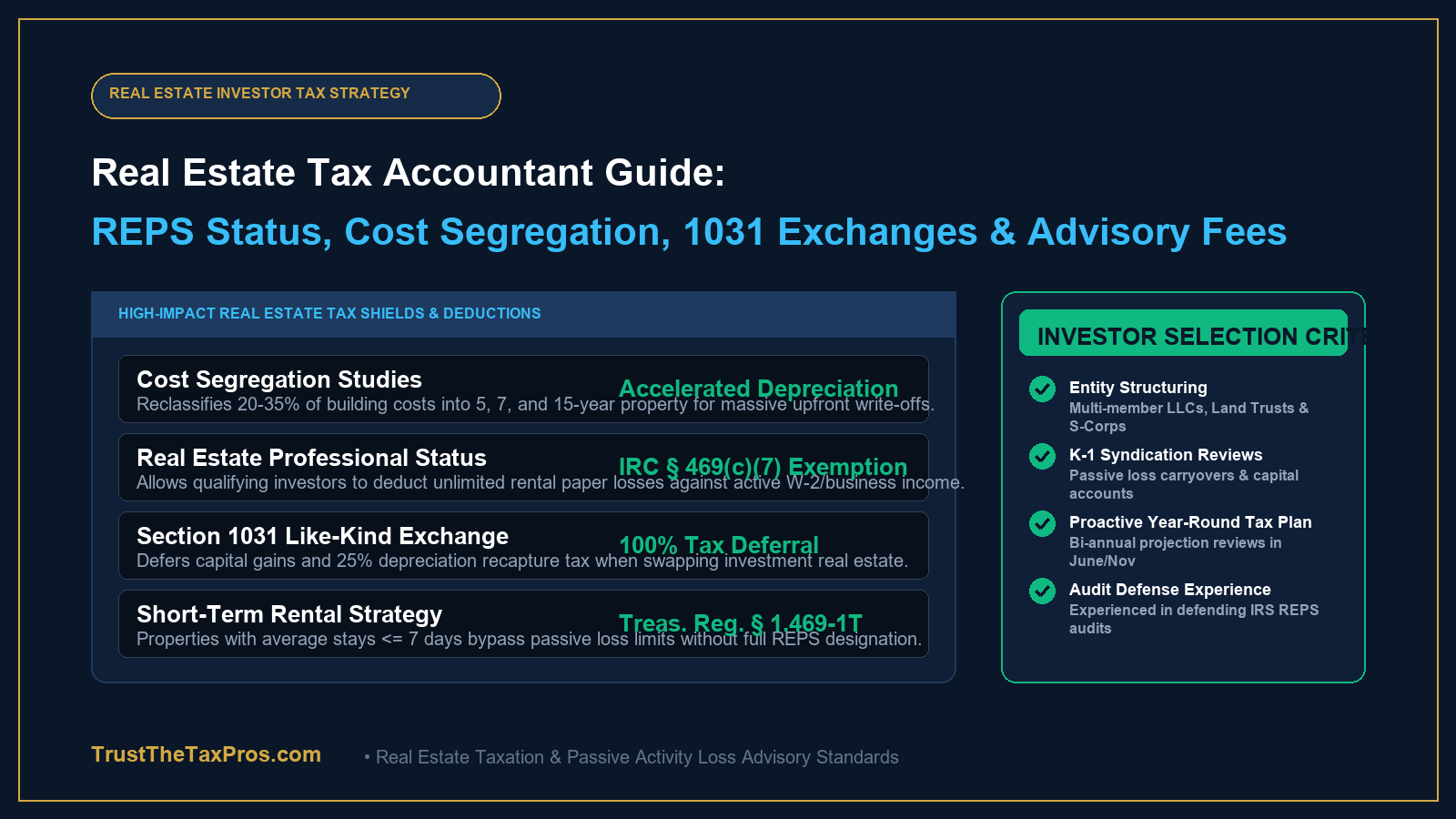
Investing in real estate is one of the most reliable wealth-building vehicles in America, but maximizing your returns requires sophisticated tax planning. Retaining a dedicated real estate tax accountant ensures you capitalize on depreciation incentives, passive loss exemptions, and capital gains deferral strategies.
General tax preparers typically view rental properties through a backward-looking lens, simply reporting rent checks and deducting basic mortgage interest. In contrast, an experienced real estate CPA acts as a strategic wealth advisor, structuring properties to shelter six-figure incomes from federal and state tax liabilities.
This comprehensive investor guide breaks down why specialized real estate accounting matters, details high-leverage tax shields like Cost Segregation and Real Estate Professional Status (REPS), and outlines key interview questions to evaluate candidate CPAs.
Why General Accountants Fail Real Estate Investors
Real estate taxation is governed by a distinct subset of the Internal Revenue Code with strict judicial precedents. Working with a neighborhood tax preparer who primarily files retail W-2 returns often results in costly oversights:
First, generalists routinely fail to make the statutory IRC Section 469(c)(7)(A) grouping election. Without this formal election statement attached to your return, the IRS treats each individual rental property as a separate activity. That oversight prevents you from aggregating your hours across multiple properties to meet federal material participation standards.
Second, inexperienced preparers default to standard 27.5-year straight-line depreciation for residential properties or 39-year depreciation for commercial buildings. They overlook the immense tax savings unlocked by accelerated personal property carve-outs. You can explore broader firm selection benchmarks in our guide to small business CPA selection.
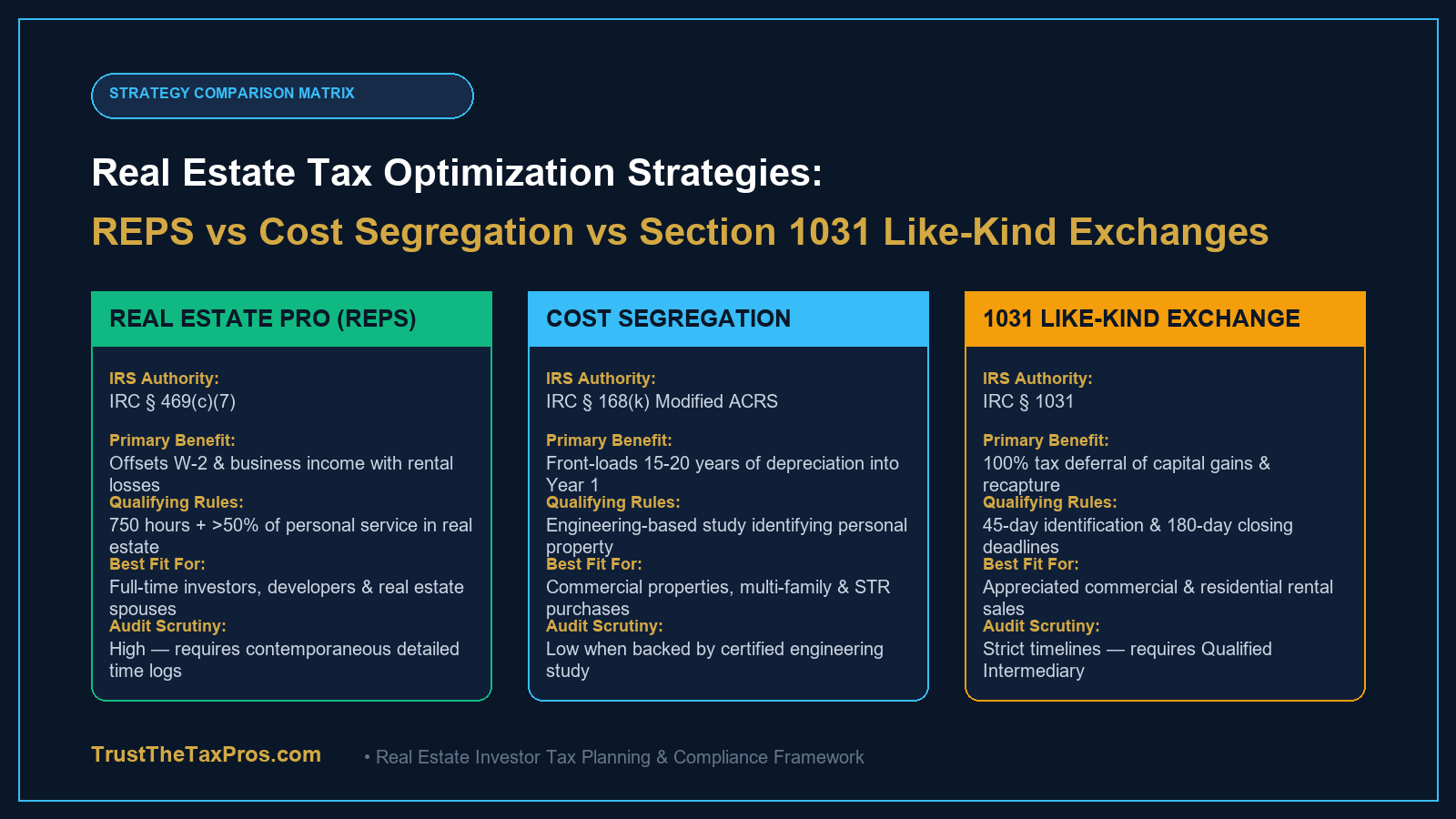
| Tax Strategy | Governing Tax Authority | Primary Financial Benefit | Target Investor Profile |
|---|---|---|---|
| Real Estate Pro (REPS) | IRC § 469(c)(7) | Offsets W-2 and business income with rental paper losses | Full-time investors, developers, and real estate spouses |
| Cost Segregation | IRC § 168(k) (MACRS) | Accelerates 20% to 35% of building basis into Year 1 write-offs | Commercial, multi-family, and short-term rental acquisitions |
| Section 1031 Exchange | IRC § 1031 | Defers 100% of capital gains and 25% depreciation recapture | Investors selling highly appreciated real property assets |
| Short-Term Rental Loophole | Treas. Reg. § 1.469-1T(e)(3)(ii)(A) | Non-passive treatment without full REPS designation | High W-2 earners managing Airbnb and VRBO properties |
A specialized CPA understands the technical requirements outlined in IRC Section 469 Passive Activity Losses. They construct documentation that protects your write-offs during federal examinations.
- Prong 1 (More Than Half of Personal Services): More than 50% of the total working hours you perform across all trades during the tax year must be in real property trades or businesses in which you materially participate. W-2 employees working 2,000 hours in tech or finance cannot qualify unless they own at least 5% of their employer.
- Prong 2 (The 750-Hour Threshold): You must perform more than 750 hours of documented service in real property trades or businesses during the calendar year. Detailed contemporaneous time logs are mandatory.
Cost Segregation: Unlocking Accelerated Depreciation
Cost segregation is one of the most powerful tax reduction tools available to property owners. Under standard IRS guidelines, residential buildings depreciate over 27.5 years, yielding roughly 3.6% in deductions annually.
A cost segregation study utilizes engineering and architectural analysis to dismantle property costs into shorter recovery periods:
- 5-Year Property: Decorative lighting, dedicated electrical outlets, carpeting, removable cabinetry, and appliances.
- 15-Year Land Improvements: Parking lots, concrete sidewalks, outdoor landscaping, fencing, retaining walls, and exterior signage.
- Bonus Depreciation Integration: Components classified under 20 years qualify for first-year bonus depreciation under Section 168(k), generating immediate six-figure write-offs in the year of acquisition.
When combined with REPS status or short-term rental management, cost segregation creates substantial non-cash paper losses that can offset ordinary income. You can also review equipment expensing rules in our guide on Section 179 vehicle deductions.
Section 1031 Like-Kind Exchanges: Tax-Free Capital Reinvestment
Selling an appreciated property triggers capital gains tax (up to 20%), net investment income tax (3.8%), state income taxes, and a 25% depreciation recapture tax on previously claimed write-offs. A Section 1031 Like-Kind Exchange allows investors to defer all taxes by reinvesting sale proceeds into new investment property.
A real estate CPA coordinates with a Qualified Intermediary (QI) to ensure strict adherence to federal deadlines:
- 45-Day Identification Window: You must formally identify up to three potential replacement properties in writing within 45 calendar days of closing your sale. This deadline cannot be extended for any reason.
- 180-Day Purchase Deadline: You must close on the replacement property within 180 calendar days of the relinquished property sale date.
- Equal or Greater Value Rule: To achieve 100% tax deferral, the replacement property must have an equal or greater purchase price, and all net equity must be rolled over to avoid taxable “boot.”
Industry policy insights are maintained by organizations such as the National Association of Realtors Federal Tax Policy Guidance.
The Short-Term Rental (STR) Tax Strategy
For high-income W-2 earners who cannot meet the 750-hour REPS threshold, the Short-Term Rental rule offers an exceptional tax shelter. Governed by Treasury Regulation § 1.469-1T(e)(3)(ii)(A), rental properties with an average guest stay of seven days or less are legally classified as businesses rather than passive rental activities.
If you materially participate in the operation of the short-term rental (for example, by performing at least 100 hours of service and more than any other individual), the activity becomes active. Pairing this strategy with an aggressive cost segregation study allows you to deduct substantial depreciation losses directly against your W-2 wages in Year 1.
To establish safe entity structures for short-term rentals, read our complete guide to filing business taxes for an LLC.
Questions to Ask Before Hiring a Real Estate Tax CPA
Interview candidate accountants with targeted questions to assess their practical experience:
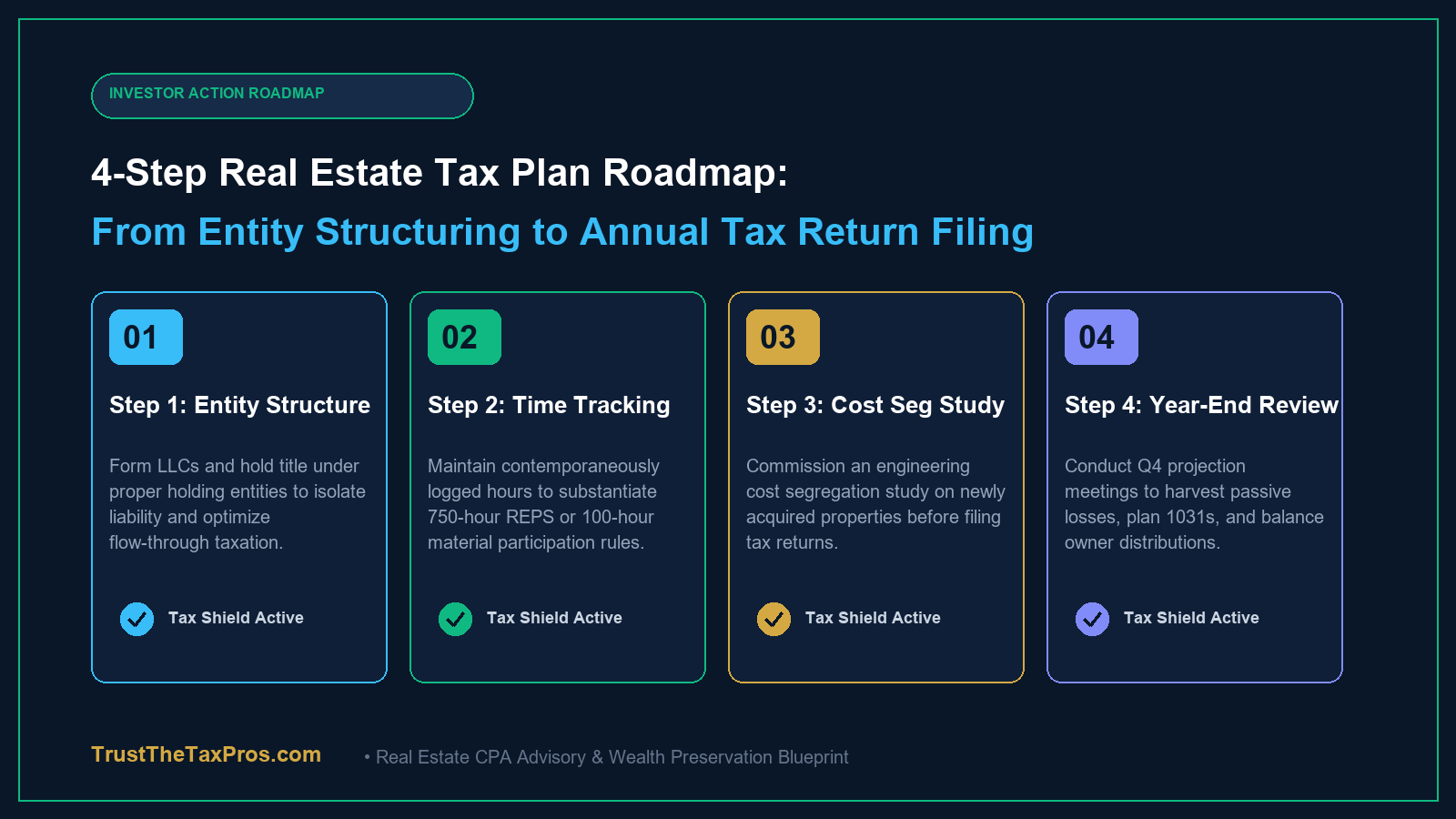
- “Do you personally invest in real estate?” CPAs who own rental properties understand operational nuances, repair classifications, and property management systems firsthand.
- “How many of your clients claim REPS status or cost segregation?” If a CPA has never filed an IRC Section 469(c)(7)(A) grouping election or defended a cost segregation study, they are not equipped for active investors.
- “How do you prepare clients for IRS real estate audits?” The IRS maintains specialized training manuals detailed in the IRS Real Estate Audit Technique Guides. Your CPA must know exactly how auditors scrutinize travel logs and participation hours.
- “Do you conduct mid-year and Q4 tax planning reviews?” Real estate tax strategy happens before year-end closings, not during tax season. Proactive CPAs mandate planning meetings in June and November.
Learn more about audit protection strategies by reviewing our essential IRS audit avoidance tips.
Frequently Asked Questions
Why do real estate investors need a specialized tax accountant?
Real estate taxation involves unique Internal Revenue Code sections such as Section 469 passive activity limits, Section 1031 like-kind exchanges, and cost segregation depreciation. A general tax preparer often misses advanced grouping elections and accelerated write-offs, costing investors tens of thousands in unnecessary taxes.
What is Real Estate Professional Status (REPS)?
Real Estate Professional Status is an IRS tax designation under IRC Section 469(c)(7). It allows qualifying taxpayers who spend more than 750 hours and more than half their working time in real estate trades to deduct rental property losses against their active W-2 and business income without limit.
What is a cost segregation study and how does it save taxes?
A cost segregation study is an engineering review that separates non-structural components of a property (such as specialty flooring, lighting, landscaping, and parking lots) from the 27.5 or 39-year building structure. These items are reclassified into 5, 7, or 15-year recovery periods, allowing massive bonus depreciation deductions in Year 1.
How does the short-term rental tax loophole work?
Under Treasury Regulation Section 1.469-1T, a rental property with an average guest stay of seven days or less is not classified as a rental activity. If the owner materially participates for at least 100 hours, tax losses generated through depreciation can offset non-passive W-2 or business income without requiring full REPS status.
How much does a real estate CPA cost?
Real estate CPAs typically charge between $1,500 and $4,500 annually for comprehensive tax filing and quarterly advisory services. Complex portfolios involving multi-tier LLCs, syndication K-1s, and ongoing Section 1031 advisory range from $3,500 to $8,000+ per year.