Operating a commercial business in Florida provides tremendous economic advantages, including the absence of a personal state income tax. However, the state makes up for this revenue through vigilant enforcement of sales and use tax laws. Completing your florida sales tax filing accurately and on time is essential to avoid automatic statutory penalties and preserve your business license.
Every registered business holding a Florida Certificate of Registration must file periodic returns using Form DR-15. Even if you collected zero tax during a quiet month, the Florida Department of Revenue requires a formal filing. Let us walk through the filing steps, county discretionary surtax calculations, timely collection allowances, and common compliance pitfalls.
- State Tax Rate: Florida levies a baseline 6.0% state sales tax on taxable goods and services.
- County Surtax: Counties add local discretionary surtaxes ranging from 0.5% to 1.5% with a $5,000 single-item cap.
- Filing Deadline: Returns and payments are due on the 1st and considered late after the 20th day of the following month.
Understanding Florida Sales Tax Rates and County Surtax
Florida levies a baseline state sales tax rate of 6.0% on the sale, rental, or repair of most tangible personal property, admissions, and certain taxable services. Commercial leases also face state sales tax under specific statutory provisions. Business owners establishing local operations can review our foundational guide on filing business taxes for LLCs to align state tax filings with federal entity registrations.
In addition to the state tax rate, individual counties impose a local discretionary sales surtax under Florida Statutes Chapter 212. Most counties set their surtax rate between 0.5% and 1.5%. For instance, Miami-Dade County adds a 1.0% surtax, making the total effective sales tax rate 7.0%. Hillsborough County adds 1.5%, bringing the total rate to 7.5%.
Businesses should note that sales tax collected from customers is held in trust for the state. Sole proprietors and pass-through entities can consult IRS state and local sales tax guidance to ensure proper reconciliation on federal schedules.
A critical rule unique to Florida is the $5,000 single-item surtax limitation. When you sell a single item of tangible personal property, the county discretionary surtax applies only to the first $5,000 of purchase price. The 6% state tax applies to the entire amount, but the county surtax ceases calculating past $5,000. For example, if you sell a piece of commercial equipment for $12,000 in a county with a 1% surtax, the customer pays 6% on the full $12,000 ($720) plus 1% on only the first $5,000 ($50), totaling $770 in sales tax.

Form DR-15 vs. Form DR-15EZ: Which Form Applies?
The Florida Department of Revenue (FDOR) provides two primary return forms for reporting sales and use tax. Knowing which form your business requires depends on operational complexity.
Form DR-15: Standard Sales and Use Tax Return
Form DR-15 is the standard return utilized by most retail businesses, contractors, commercial landlords, and multi-location companies. It contains detailed schedules for gross sales, exempt sales, taxable sales, discretionary surtax calculations, and local options. If your business operates in multiple counties or collects use tax on out-of-state purchases, Form DR-15 is mandatory.
Form DR-15EZ: Simplified Sales and Use Tax Return
Form DR-15EZ is a streamlined version created for smaller retail operations that conduct business in a single county, collect tax only on standard transactions, and claim no complex exemptions. While convenient, the majority of electronic filers use the online e-Services portal, which mirrors Form DR-15 dynamically.
| Reporting Frequency | Annual Tax Liability Threshold | Filing & Payment Deadlines |
|---|---|---|
| Monthly Filing | Over $1,000 per calendar year | Due the 1st; late after the 20th of following month |
| Quarterly Filing | $501 to $1,000 per calendar year | Due the 1st; late after the 20th following quarter end |
| Semi-Annual Filing | $101 to $500 per calendar year | Due the 1st; late after the 20th of July and January |
| Annual Filing | $100 or less per calendar year | Due the 1st; late after the 20th of January |
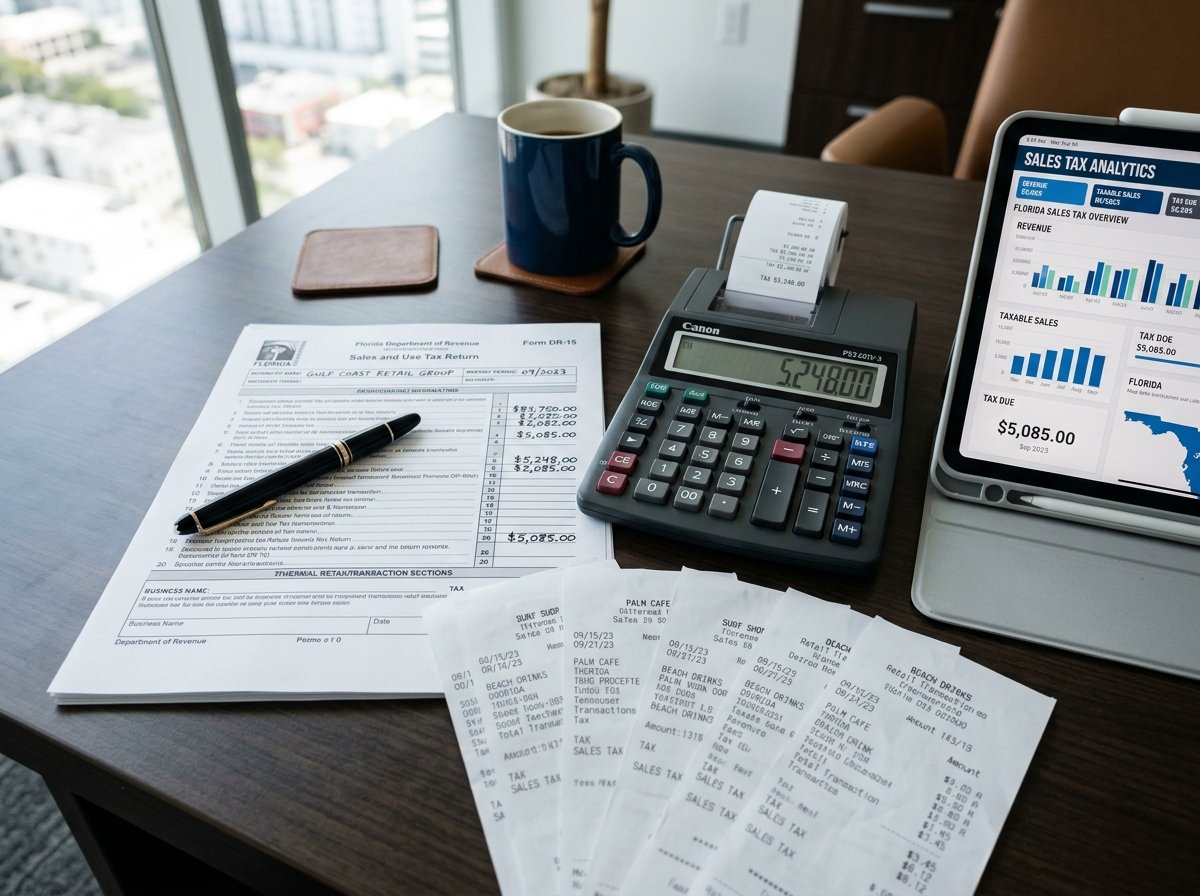
Step-by-Step Guide to Filing Online via Florida e-Services
The state of Florida strongly encourages electronic filing and mandates it for businesses that paid $20,000 or more in sales tax during the prior state fiscal year. Even for smaller dealers, online filing is the only method to claim the state collection allowance. You can access the official portal through the Florida Department of Revenue sales tax portal.
Step 1: Gather Sales and Exemption Records
Before logging into your account, pull gross sales receipts for the reporting period. Separate your revenue into three distinct categories: gross sales, exempt sales (such as groceries, prescription medications, or sales to non-profits with valid exemption certificates), and taxable sales. Maintaining clean accounting records through organized bookkeeping for LLCs prevents reporting errors.
Step 2: Log In to the Florida e-Services Portal
Navigate to the FDOR e-Services website using your assigned User ID and password. Select “File and Pay Taxes” and choose “Sales and Use Tax (DR-15).” Verify your business partner number and contract object number match your physical registration certificate.
Step 3: Enter Gross and Taxable Sales
Enter your Gross Sales in Line 1. Enter exempt sales in Line 2. The portal will automatically subtract Line 2 from Line 1 to establish Line 3 (Taxable Sales). Enter your state sales tax collected in Line 4.
Step 4: Compute Discretionary Sales Surtax
In Line 15, report the taxable amount subject to county surtax. Remember to exclude the portion of single-item sales exceeding $5,000. Select your specific county from the drop-down menu, and the system applies the local surtax percentage to calculate Line 15d.
Step 5: Apply the Collection Allowance
If you are filing on or before the 20th of the month, the portal automatically calculates your collection allowance on Line 16. Registered dealers receive a credit equal to 2.5% of the first $1,200 of tax due, with a statutory maximum deduction of $30. While modest, this allowance provides a free $360 annual deduction for consistent monthly filers.
Step 6: Submit Electronic Payment
Review the calculated total tax due on Line 20. Authorize an electronic funds transfer (e-check/ACH debit) or submit payment via credit card (which incurs a third-party convenience fee). Save your electronic filing confirmation number and print the summary return for your corporate tax records.
- Zero Sales Mandate: If your business had zero taxable sales during the assigned period, you must still log in and file a return reporting $0.
- Automatic $50 Penalty: Failing to submit a return results in an automatic $50 late filing assessment, even when zero tax is owed.
- License Revocation: Chronic non-filing of zero returns leads to administrative revocation of your sales tax certificate.

Remote Sellers and Economic Nexus Rules in Florida
Florida legislation transformed sales tax requirements for out-of-state retailers and online merchants through Senate Bill 50. Out-of-state businesses that previously shipped goods into Florida without collecting sales tax now face clear statutory thresholds under Florida Statutes Title XIV Chapter 212.
Any remote seller or marketplace facilitator that makes more than $100,000 in taxable remote sales of tangible personal property delivered into Florida during the previous calendar year establishes economic nexus. Once you cross this $100,000 threshold, you must register with the Florida Department of Revenue, collect applicable state and county surtaxes based on destination delivery addresses, and remit payments electronically on Form DR-15.
Marketplace facilitators (such as Amazon, eBay, or Etsy) are legally required to collect and remit Florida sales tax on behalf of third-party marketplace sellers. However, if your business sells through its own e-commerce website alongside marketplaces, you must monitor your independent sales volume separately. Partnering with a dedicated small business tax accountant helps remote businesses automate nexus tracking and prevent surprise back-tax liabilities.
Penalties, Late Fees, and Audit Avoidance
The Florida Department of Revenue enforces strict collection penalties. Missing the monthly 20th deadline immediately voids your collection allowance and triggers statutory fines. Understanding state enforcement policies in our guide on tax penalties and interest reveals how administrative additions compound over time.
Florida imposes a 10% penalty on any unpaid tax balance, subject to a statutory minimum fee of $50. If taxes remain unpaid, floating interest accrues daily under a statutory rate updated twice yearly. For severe or fraudulent underreporting, the state assesses a mandatory 50% penalty and can initiate criminal proceedings for theft of state funds.
To avoid audit triggers, businesses should observe four operational best practices:
- Keep Resale Certificates on File: If you sell goods tax-free to other businesses for resale, obtain and verify a signed Annual Resale Certificate (Form DR-13) before completing the transaction.
- Reconcile Point-of-Sale Data Monthly: Ensure your merchant processor reports align with Form DR-15 lines. The state cross-references 1099-K filings from payment processors against reported sales.
- Track County Destination Rates: When delivering goods to customers across county lines, apply the destination county’s discretionary surtax rate rather than your home business location.
- Automate Payment Reminders: Set recurring calendar alerts for the 15th of every month to ensure ACH debit payments clear before the 20th deadline.
For growing enterprises seeking complete regulatory compliance, exploring our specialized business tax services provides full-spectrum support across local, state, and federal tax jurisdictions.
Frequently Asked Questions
When is Florida sales tax due each month?
Florida sales tax returns and payments are due on the 1st day of the month following the reporting collection period. Returns and payments become legally late after 11:59 PM Eastern Time on the 20th day of that month. If the 20th falls on a weekend or state holiday, filings remain timely on the next business day.
Do I have to file a Florida sales tax return if I had zero sales?
Yes. If your business holds an active Florida Sales and Use Tax Certificate of Registration (Form DR-11), you must submit a zero-tax return on Form DR-15 for every assigned reporting period. Failing to file a zero return triggers an automatic minimum $50 late penalty.
What is the Florida collection allowance?
The Florida Department of Revenue offers a collection allowance to registered dealers who file and pay electronically on time. The allowance equals 2.5% of the first $1,200 of tax due, with a maximum benefit of $30 per reporting period. If your payment or filing is even one day late, the entire allowance is forfeited.
How does the $5,000 single-item county surtax cap work in Florida?
Florida local discretionary sales surtax applies only to the first $5,000 of purchase price on a single item of tangible personal property. The standard 6% state sales tax applies to the full purchase amount, but any county surtax (ranging from 0.5% to 1.5%) stops calculating once the $5,000 threshold is reached.
What is the Florida economic nexus threshold for remote sellers?
Under Florida Senate Bill 50, out-of-state remote sellers and marketplace facilitators who generate more than $100,000 in taxable remote retail sales delivered into Florida during the previous calendar year must register with the Florida Department of Revenue and collect sales tax.
What is the penalty for filing Florida sales tax late?
Late returns incur a penalty of 10% of any unpaid tax due, with a statutory minimum penalty of $50 even if no tax was collected. In addition, floating statutory interest accrues daily on unpaid tax balances until satisfied.