Every dollar you earn in business requires hard work, but failing to track and claim your legitimate write-offs means surrendering your hard-earned profits directly to the IRS. For sole proprietors, independent contractors, and LLC founders, utilizing a structured small business tax deductions checklist pdf reference transforms annual tax preparation from an overwhelming scramble into a clear, predictable profit-saving exercise.
Every allowable deduction you record directly lowers your net profit on Schedule C. Because pass-through business owners pay both federal income tax (10% to 37%) and self-employment tax (15.3%), a single missed $1,000 deduction can cost you upwards of $350 to $450 in needless tax payments. This practical, CPA-reviewed checklist breaks down every major deduction category, maps expenses directly to IRS tax forms, and explains the recordkeeping rules required to audit-proof your business.
The Statutory Foundation: Ordinary and Necessary Expenses
Before categorizing receipts, every business owner must understand the legal benchmark governing all business write-offs. Under Internal Revenue Code Section 162, you may deduct all ordinary and necessary expenses paid or incurred during the taxable year in carrying on any trade or business.
- Ordinary: An expense that is customary and accepted in your specific field, trade, or profession.
- Necessary: An expense that is helpful, appropriate, and beneficial to the operation and growth of your business. The expense does not need to be indispensable to qualify.
According to IRS Publication 334 (Tax Guide for Small Business), personal living expenses are strictly non-deductible. When an expenditure serves both personal and business purposes (such as a cell phone or personal vehicle), you may only deduct the verified business-use percentage.
To grasp how business structures influence how these deductions are reported, review our foundational guide on small business taxes for beginners.
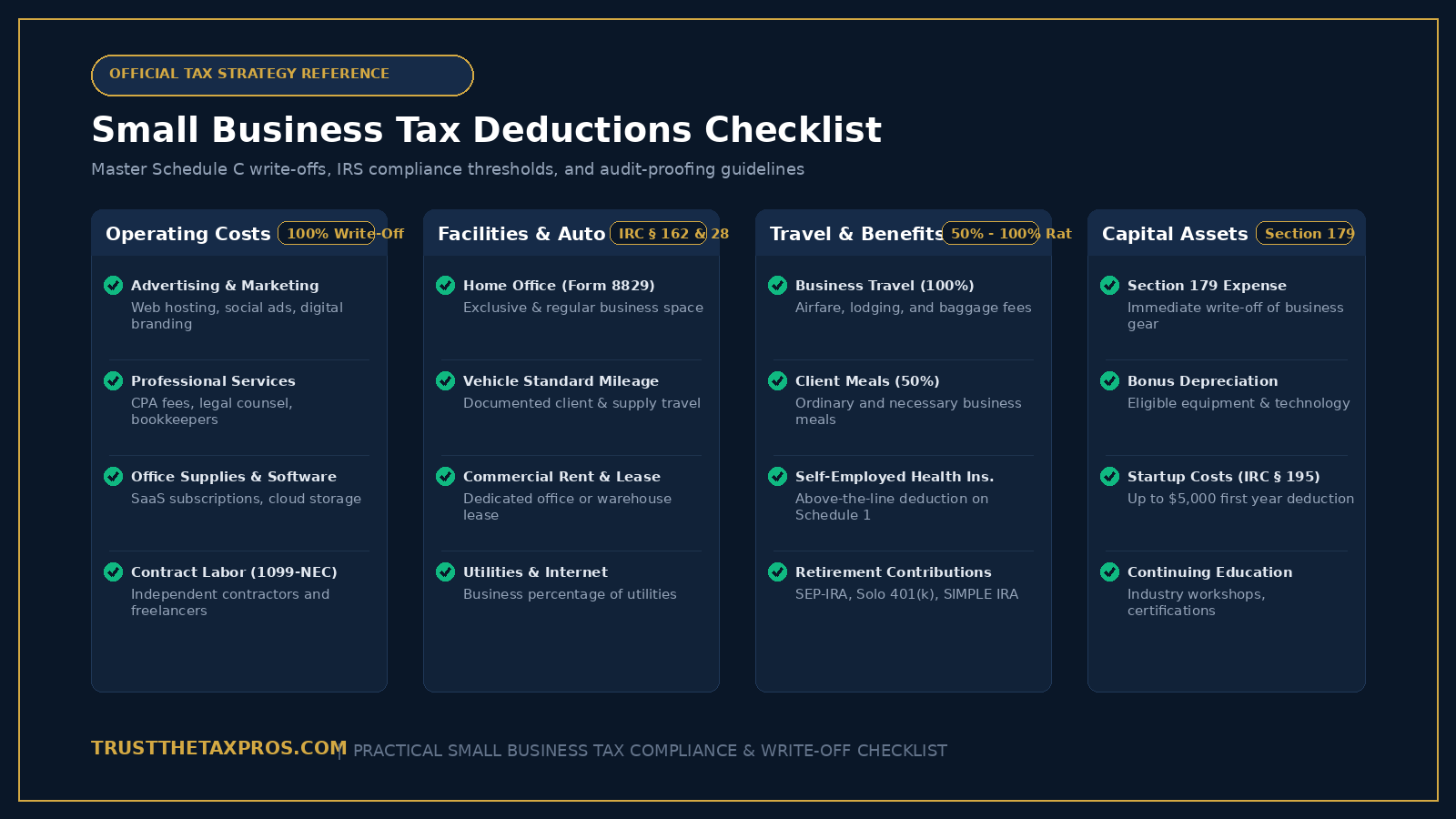
Master Small Business Tax Deductions Checklist
Use this organized, category-by-category checklist to audit your financial records, accounting software, and bank statements before preparing your annual return.
1. General Operating & Administrative Expenses
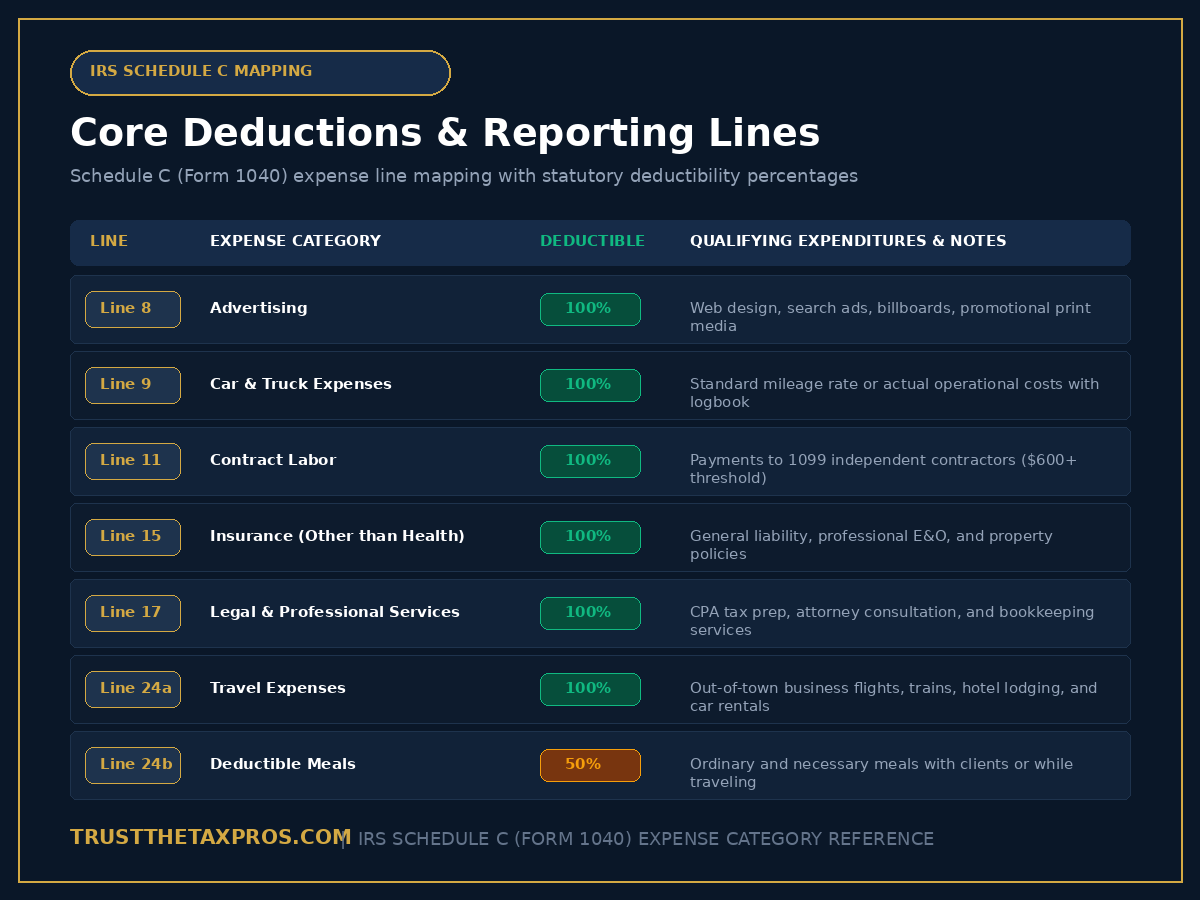
- Advertising & Marketing (Line 8): Website hosting, domain registration, social media advertising, business cards, email marketing platforms, and print media.
- Office Expenses & Postage (Line 18): General office stationery, printer paper, shipping fees, courier costs, and post office box rentals.
- Software & Cloud Subscriptions (Line 18 or 27a): Accounting software (QuickBooks, Xero), CRM platforms, cloud storage (Google Workspace, Dropbox), and cybersecurity tools.
- Bank & Merchant Processing Fees (Line 27a): Monthly business checking maintenance fees, wire transfer charges, Stripe/Square payment processing fees, and merchant discount rates.
- Dues & Subscriptions (Line 27a): Professional association memberships, trade journals, business magazines, and chamber of commerce dues.
2. Professional Services & Contract Labor
- Legal & Accounting Fees (Line 17): Fees paid to CPAs, tax attorneys, registered agents, bookkeepers, and trademark attorneys.
- Contract Labor (Line 11): Payments made to independent freelancers, virtual assistants, and subcontractors. Remember that you must issue Form 1099-NEC to any unincorporated contractor paid $600 or more during the calendar year.
- Consulting Fees (Line 17): Business coaching, management consultants, and specialized technical advisors.
3. Facilities, Utilities, and Home Office
If you maintain commercial space or work from a dedicated home workspace, substantial facility deductions apply:
- Commercial Rent & Lease (Line 20b): Monthly lease payments for retail storefronts, corporate office space, or storage warehouses.
- Repairs & Routine Maintenance (Line 21): Regular upkeep, painting, cleaning services, and minor repairs that keep property in efficient working condition without adding capital value.
- Commercial Utilities (Line 25): Electricity, water, natural gas, trash collection, and heating services for commercial facilities.
- Home Office Deduction (Line 30): For owners working from home, calculating this deduction on Form 8829 allows you to write off a percentage of your rent/mortgage interest, utilities, and homeowners insurance. For step-by-step calculation guidelines, read our complete breakdown on IRS Form 8829 home office instructions.
- Business Communications: The documented business percentage of your personal mobile phone and home internet service.
4. Vehicle and Transportation Deductions
Business vehicle travel represents one of the largest write-offs for self-employed individuals, but strict rules govern auto claims under IRS Publication 463 (Travel, Gift, and Car Expenses).
- Standard Mileage Rate: Deducting the IRS statutory per-mile rate for every business mile driven for client meetings, supply runs, and job sites. Commuting between your personal residence and a primary workplace is never deductible.
- Actual Vehicle Expense Method: Tracking total annual gas, oil changes, insurance, registration fees, lease payments, and depreciation, multiplied by your business-use percentage.
- Parking Fees & Highway Tolls (Line 9): 100% deductible when incurred during business-related travel, regardless of whether you use the standard mileage or actual expense method.
To evaluate which calculation method yields the largest tax savings for your vehicle, consult our detailed analysis on Schedule C vehicle mileage deduction strategies.
5. Travel and Business Meals
Travel and meals are subject to heightened IRS examination. Knowing the exact deductibility caps is essential:
- Business Travel (Line 24a – 100% Deductible): Airfare, passenger train tickets, ride-shares, rental cars, hotel lodging, and baggage fees incurred while away from your tax home overnight for business purposes.
- Business Meals (Line 24b – 50% Deductible): Food and beverages purchased during business travel or meals with clients, partners, and prospects where bona fide business is actively discussed. The expense must not be lavish or extravagant under the circumstances.
- Client Entertainment (0% Deductible): Under current federal law, client entertainment expenses (such as sports tickets, golf rounds, or theater tickets) are completely non-deductible, even if business discussions take place.
6. Insurance, Taxes, and Financial Charges
- Commercial Insurance (Line 15): General liability insurance, professional errors and omissions (E&O), commercial property insurance, and cyber liability policies.
- Business Loan & Credit Card Interest (Line 16b): Interest paid on business lines of credit, commercial mortgages, and dedicated business credit cards. Principal loan payments are not deductible.
- State & Local Business Taxes (Line 23): State franchise taxes, annual LLC filing fees, municipal business licenses, personal property taxes on business equipment, and employer payroll taxes.
- Bad Debts (Line 10): Uncollectible accounts receivable, but only if you operate under the accrual accounting method and previously included that uncollected amount in gross revenue. Cash-basis businesses cannot deduct bad debts.
7. Capital Equipment, Depreciation, and Startup Write-Offs
- Section 179 Immediate Expensing: Writing off 100% of the cost of qualifying machinery, heavy equipment, computers, servers, and business vehicles purchased and placed into service during the tax year.
- De Minimis Safe Harbor Election: Electing to deduct tangible personal property purchases costing $2,500 or less per invoice (or $5,000 with applicable financial statements) as immediate expenses rather than capitalizing them.
- Startup Expenditures (IRC § 195): Deducting up to $5,000 in qualifying preliminary expenses incurred before launching your business (such as initial advertising, permits, and professional setup fees), amortizing remaining balances over 15 years.
- Continuing Education & Seminars: Registration fees, books, and courses that maintain or improve skills required in your current business. Courses that qualify you for a new trade or profession are not deductible.

Above-the-Line Deductions on Form 1040 (Schedule 1)
Not all small business tax deductions live on Schedule C. Several of the most valuable write-offs available to entrepreneurs are claimed as adjustments to income on Schedule 1 of Form 1040. These deductions reduce your Adjusted Gross Income (AGI) directly:
1. Self-Employed Health Insurance Deduction
If you operated at a net profit and were not eligible to participate in a subsidized health plan maintained by an employer (including a spouse’s employer), you can deduct 100% of health, dental, and qualified long-term care insurance premiums paid for yourself, your spouse, and your dependents.
2. Retirement Plan Contributions
Contributions made to small business retirement plans (such as a SEP-IRA, Solo 401(k), or SIMPLE IRA) shelter substantial income from current-year taxation while compounding tax-deferred.
3. Deduction for One-Half of Self-Employment Tax
Every sole proprietor and single-member LLC owner automatically deducts 50% of their calculated self-employment tax on Schedule 1, neutralizing the employer half of FICA taxes.
When planning your annual cash flow and tax reserves, review our strategic analysis on quarterly estimated taxes for LLCs to avoid underpayment penalties throughout the year.
Audit-Proofing Your Deductions: Four Recordkeeping Rules
Claiming aggressive write-offs without contemporaneous proof creates severe exposure during an IRS examination. If an auditor disallows an undocumented expense, you face back taxes, accrued interest, and a mandatory 20% accuracy-related penalty under Internal Revenue Code Section 6662. Follow these four non-negotiable rules:
- Maintain Absolute Account Separation: Run all business income and expenses exclusively through dedicated business bank and credit card accounts. Mixing personal groceries and business expenses is the primary red flag auditors look for.
- Keep Contemporaneous Mileage Logs: Under Section 274(d), mileage estimates made at tax time will be rejected in an audit. Use GPS-enabled mobile mileage tracking apps to document the date, distance, destination, and business purpose of every trip in real time.
- Archive Digital Receipts: Thermal paper receipts fade completely within six to twelve months. Photograph or scan all receipts and attach them to corresponding transactions inside your cloud accounting software.
- Retain Records for Three to Seven Years: Under IRS Publication 583, you must retain all tax documents, invoices, bank statements, and receipts for at least three full years from the date of filing, and up to seven years for claims involving asset losses or bad debts.
Frequently Asked Questions
What qualifies an expense as tax deductible for a small business?
Under Internal Revenue Code Section 162, a business expense must be both ordinary (common and accepted in your specific industry) and necessary (helpful and appropriate for your trade or business).
How does claiming deductions reduce my total tax bill?
Every allowable business deduction reduces your net taxable profit on Schedule C. For sole proprietors and single-member LLCs, lower net profit reduces both your self-employment tax (15.3%) and your personal federal and state income tax liabilities.
Can I deduct client entertainment expenses?
No. Under the Tax Cuts and Jobs Act, client entertainment expenses (such as sporting events, golf outings, or theater tickets) are 100% non-deductible. However, ordinary business meals with clients or while traveling remain 50% deductible.
What documentation do I need to substantiate business mileage?
Under Internal Revenue Code Section 274(d), you must maintain a contemporaneous mileage log documenting the date of each trip, starting and ending odometer readings, total business miles driven, destination, and the specific business purpose.
How long should small business owners keep expense receipts?
Under IRS Publication 583, you must retain all receipts, invoices, canceled checks, and bank statements for at least three full years from the date you filed the return, and up to seven years for claims related to property loss or bad debts.
Can I claim both the standard mileage rate and actual vehicle expenses?
No. You must choose either the standard mileage rate or the actual expense method for each vehicle during a given tax year. If you choose the standard mileage rate in the first year the vehicle is in service, you preserve the option to switch to actual expenses in later years.