
Every year, millions of taxpayers ask an essential financial question before handing over their financial documents: what is a reasonable tax preparation cost? Whether you are filing a simple Form 1040, managing multiple freelance income streams, or overseeing an expanding corporation, professional tax fees often feel unpredictable. Prices range from under one hundred dollars for automated software to several thousand dollars for specialized CPA advisory services.
Understanding how accounting professionals establish their rates eliminates billing surprises. Transparent pricing depends directly on your filing complexity, the number of required schedules, and how cleanly your records are organized. This practical guide breaks down national fee benchmarks by return type, examines hourly versus flat-rate billing structures, outlines federal fee regulations, and shares proven ways to reduce your annual tax preparation bill.
National Averages: What Does Tax Preparation Cost in 2026?
According to biennial fee surveys published by the National Society of Accountants (NSA) and national CPA practice management studies, the cost of tax preparation correlates strongly with the specific schedules attached to your return.
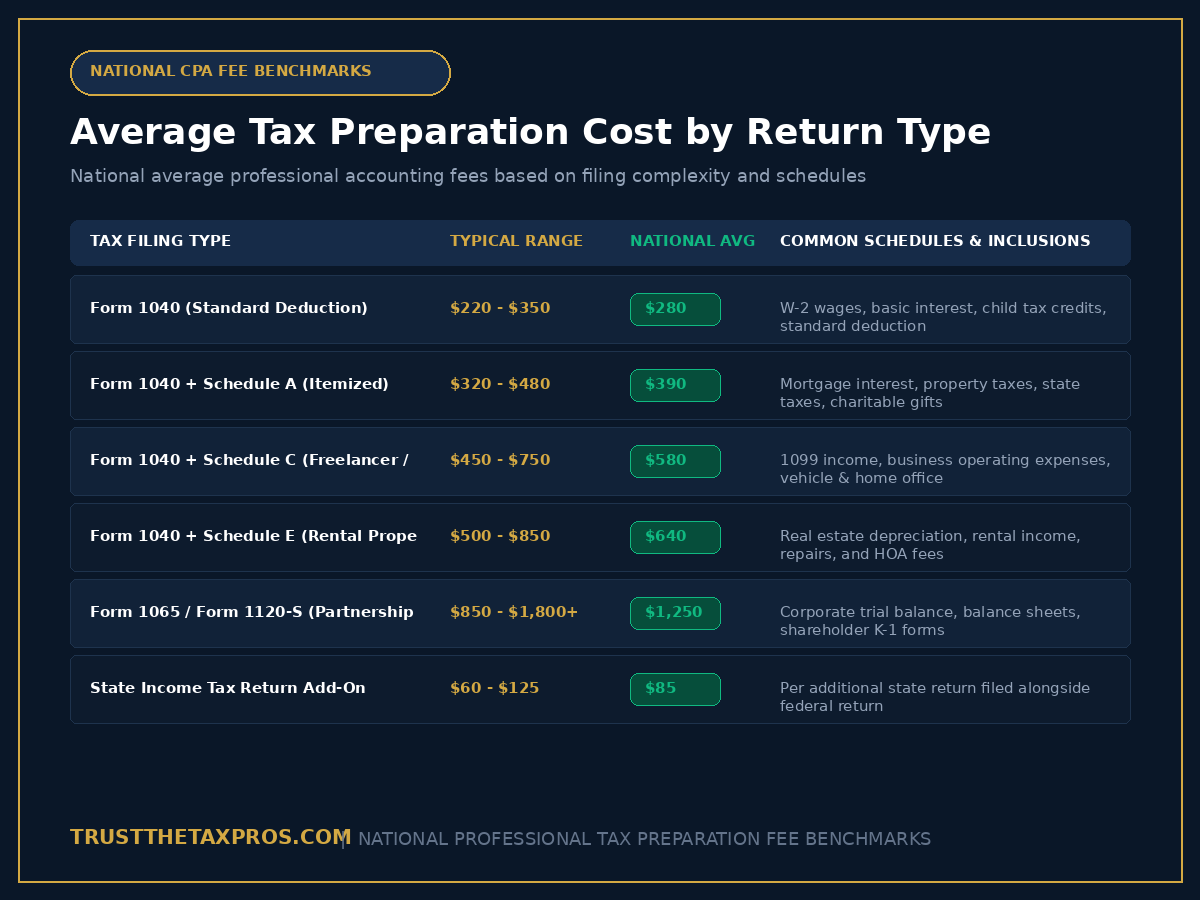
While regional geographic adjustments exist (with major metropolitan areas commanding 15% to 30% higher rates than rural markets), the following national fee ranges represent realistic benchmarks across independent accounting practices:
| Tax Return Filing Type | Typical Fee Range | National Average | What Is Included |
|---|---|---|---|
| Form 1040 (Standard Deduction) | $220 to $350 | $280 | W-2 income, retirement distributions, basic child tax credits, and one state return |
| Form 1040 + Schedule A (Itemized) | $320 to $480 | $390 | Mortgage interest, property taxes, charitable contributions, and medical deductions |
| Form 1040 + Schedule C (Sole Prop/1099) | $450 to $750 | $580 | 1099-NEC revenue, categorized expenses, home office deduction, and vehicle mileage |
| Form 1040 + Schedule E (Rental Real Estate) | $500 to $850 | $640 | Rental property income, depreciation schedules, operating expenses, and HOA fees |
| Form 1065 / 1120-S (Partnership / S-Corp) | $850 to $1,800+ | $1,250 | Corporate income, balance sheets (Schedule L), partner/shareholder K-1 forms |
| Additional State Return Add-On | $60 to $125 | $85 | Per additional state return filed alongside the federal filing |
For independent contractors and small business founders, review our detailed guide on small business taxes for beginners to see how filing complexity alters both your tax liability and your preparation fees.
Accountant Billing Models: How CPAs Charge for Services
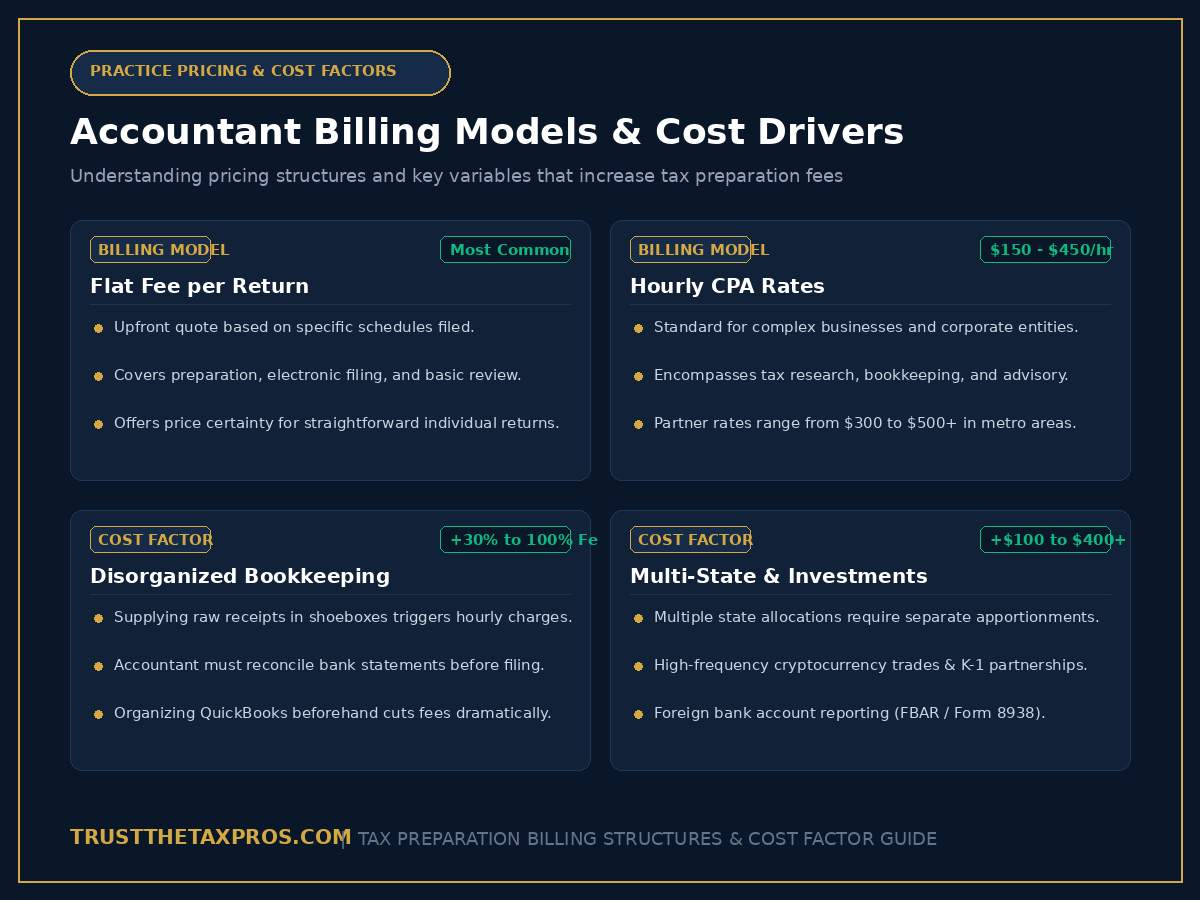
Unlike retail tax chains that charge an a la carte menu fee for every form generated, professional accounting firms structure their fees under three common pricing models:
1. Flat-Fee Pricing per Return
Flat-fee billing is the most transparent and popular structure for individual filers. The CPA assesses your tax documents during an initial intake review and quotes a guaranteed flat price. This fee includes data entry, electronic filing, and a post-filing consultation to review the results. Flat fees provide budget certainty, provided you deliver complete records without subsequent mid-season additions.
2. Hourly Billing
Hourly billing is standard for complex small businesses, multi-state corporate entities, and clients requiring ongoing advisory support. Average CPA hourly rates nationwide fall into distinct tiers:
- Staff Accountants / Bookkeepers: $85 to $150 per hour (routine data input and ledger reconciliation).
- Senior Managers / Enrolled Agents: $175 to $300 per hour (workpaper review, multi-tier allocations, tax planning).
- Partners / Managing CPAs: $300 to $500+ per hour (complex corporate transactions, executive consultation, IRS representation).
3. Form-Based / Menu Pricing
Common among commercial retail storefronts (such as H&R Block or Jackson Hewitt), menu pricing charges a baseline fee for Form 1040, then attaches incremental surcharges for every additional schedule. While advertising low starting rates, a taxpayer with two 1099s, a student loan deduction, and child care credits often finds their final retail invoice exceeding an independent CPA fee.
To understand the difference in training, representation rights, and value between various tax professionals, consult our detailed comparison on choosing between a CPA and a general tax preparer.
The Hidden Cost Drivers: What Makes Your Tax Bill Increase?
When clients complain that their tax preparation fee was higher than expected, the cause almost always traces back to specific operational complications. The following factors consistently drive fees upward:
1. Disorganized Records (The ‘Shoebox’ Surcharge)
Accountants are paid to perform tax preparation and strategic analysis, not manual administrative sorting. Delivering a physical box of crumpled paper receipts or an unorganized spreadsheet forces the CPA to spend billable hours reconciling bank statements. This preliminary bookkeeping work adds 30% to 100% to your invoice.
2. Cryptocurrency and High-Volume Trading
Under IRS regulations, every digital currency exchange, sale, or staking reward is a taxable event requiring capital gains reporting on Form 8949. If you execute hundreds of decentralized transactions without generating an aggregated CSV report through software like CoinLedger or Koinly, your CPA must manually verify cost bases, adding substantial billable time.
3. Multi-State Apportionment and Remote Work
Working remotely across multiple state lines or operating a business that generates revenue in multiple jurisdictions triggers multi-state apportionment rules. Filing separate non-resident returns requires calculating income allocation ratios, adding $75 to $150 per state.
4. Rental Real Estate and Schedule K-1s
Holding interests in real estate syndications, private partnerships, or S Corporations means waiting for Schedule K-1 forms. K-1s involve complicated basis limitations, passive activity loss rules, and capital account reconciliations that require senior-level review.
5. Last-Minute Rush Filings
Submitting records during the final two weeks before the April 15 deadline creates extreme operational friction. Many firms assess a 20% to 50% expedited processing surcharge for returns delivered after April 1.
Accounting firms balancing heavy seasonal volumes can explore our strategic guide on tax preparation outsourcing for CPA firms to understand how modern practices manage capacity without inflating client fees.
IRS Regulations on Tax Preparation Fees: Circular 230 Rules
The IRS actively regulates how authorized tax professionals charge for their services. Under Treasury Department Circular 230, codified under 31 CFR Section 10.27, strict legal standards protect consumers from predatory fee arrangements.
Federal Consumer Protections Under Circular 230
- Ban on Contingent Fees for Original Returns: A tax practitioner is strictly prohibited from charging a fee based on a percentage of your refund or a percentage of taxes saved on an original tax return. Any preparer who claims they charge “10% of whatever refund we get you” is violating federal regulations.
- Exceptions for Amended Returns & Audits: Contingent fees are legally permitted only in narrow contexts, such as representing a taxpayer during an IRS examination or filing an amended return challenging an assessed deficiency.
- Prohibition on Unconscionable Fees: Practitioners may not charge unconscionable fees that bear no reasonable relationship to the complexity of the services rendered.
Free and Low-Cost Alternatives: When Should You DIY?
Not every taxpayer needs to hire an independent CPA. If your financial life is straightforward, several low-cost and free alternatives exist:
- IRS Free File & Direct File: Under the IRS Free File program, taxpayers with an Adjusted Gross Income below statutory thresholds (typically around $79,000) can file their federal returns online for free using commercial partner software or the IRS Direct File pilot.
- VITA and TCE Programs: The Volunteer Income Tax Assistance (VITA) and Tax Counseling for the Elderly (TCE) programs provide free, IRS-certified tax preparation for low-to-moderate-income families, elderly individuals, and persons with disabilities.
- Commercial DIY Software: Platforms like FreeTaxUSA, TurboTax, and H&R Block Online allow taxpayers with basic W-2 income and standard deductions to file independently for $0 to $100.
However, when you purchase a rental home, launch a side business, receive equity compensation (RSUs/stock options), or face an audit notice, professional tax advice quickly pays for itself. A qualified CPA routinely uncovers deductions, depreciation strategies, and entity tax credits that far exceed their preparation fee.
Actionable Steps to Lower Your Tax Preparation Bill
If you want to hire a premier tax accountant without overpaying, follow this disciplined preparation strategy:
- Deliver Reconciled Digital Books: If you are self-employed, reconcile all business accounts before sending your records. Use our downloadable small business tax deductions checklist PDF to organize every expense line item ahead of time.
- Submit Records in a Single Complete Package: Drip-feeding documents over six weeks causes the preparer to reopen your file multiple times, adding administrative charges. Wait until you have 100% of your 1099s, W-2s, and K-1s before submitting.
- Engage Early in February: Contact your tax professional in January or February. Firms frequently offer early-bird discounts to smooth out their seasonal workload before the March rush.
- Request an Upfront Engagement Letter: Never begin work without a signed engagement letter that explicitly defines the scope of work, fee structure, and billing policies for out-of-scope research.
Frequently Asked Questions
What is the average tax preparation cost for an individual return?
According to national accounting fee benchmarks, a standard individual Form 1040 with state return costs between $220 and $350. If you itemize deductions on Schedule A, fees average $320 to $480. Adding self-employment schedules (Schedule C) increases the average fee to $450 to $750.
Why do CPA fees vary so widely compared to retail tax chains?
CPAs are licensed fiduciary professionals with deep expertise in strategic tax planning, audit defense, and entity structuring. Retail franchises often utilize seasonal data entry staff and employ a la carte pricing menus that charge separately for every form, frequently equaling or exceeding independent CPA rates.
Can a tax preparer charge a fee based on the size of my refund?
No. Under Treasury Department Circular 230 (31 CFR Section 10.27), licensed tax practitioners are strictly barred from charging contingent fees based on the percentage of a refund on an original tax return.
What factors cause an accountant to increase your tax preparation bill?
The primary cost drivers include disorganized records requiring preliminary bookkeeping, cryptocurrency transaction reconciliation, multi-state income apportionments, rental property schedules, and late filing during peak compression windows.
How can I lower my professional tax preparation cost?
You can significantly lower your bill by delivering organized digital summaries, reconciling bank and credit card accounts in advance, submitting documents early in February, and providing complete Form 1099 and K-1 documents in a single package.
Are tax preparation fees tax deductible?
For individual W-2 employees, tax preparation fees are non-deductible following the Tax Cuts and Jobs Act. However, self-employed individuals, LLCs, and corporate business owners can deduct the portion of accounting fees related to business schedules directly on Schedule C, Form 1065, or Form 1120-S.