Few professional fields offer the stability, upward mobility, and recession-resistant demand found in public and corporate taxation. Whether you are an undergraduate evaluating business majors, a recent graduate entering public practice, or an experienced practitioner aiming for partnership, understanding the realistic tax accountant salary trajectory is crucial for strategic career planning. In an era marked by historic accounting talent shortages, tax professionals command exceptional market leverage and compensation premiums.
According to federal labor statistics and national accounting salary reports, compensation in the tax sector scales rapidly with professional credentials and years of practice. While an entry-level associate begins with a solid base salary, earning a Certified Public Accountant (CPA) license or Enrolled Agent (EA) credential unlocks substantial earning acceleration. This guide breaks down compensation across every career tier, contrasts public accounting with corporate tax departments, examines high-paying specialty niches, and outlines the fastest routes to maximizing your earnings.
National Salary Benchmarks: From Staff Associate to Firm Partner
Under the latest data from the U.S. Bureau of Labor Statistics Occupational Outlook Handbook, the median annual wage for accountants and auditors stands at $83,680, with top earners in the 90th percentile exceeding $140,000 in base compensation alone. However, specialized tax professionals often outpace general financial accountants due to the technical complexity of statutory compliance.
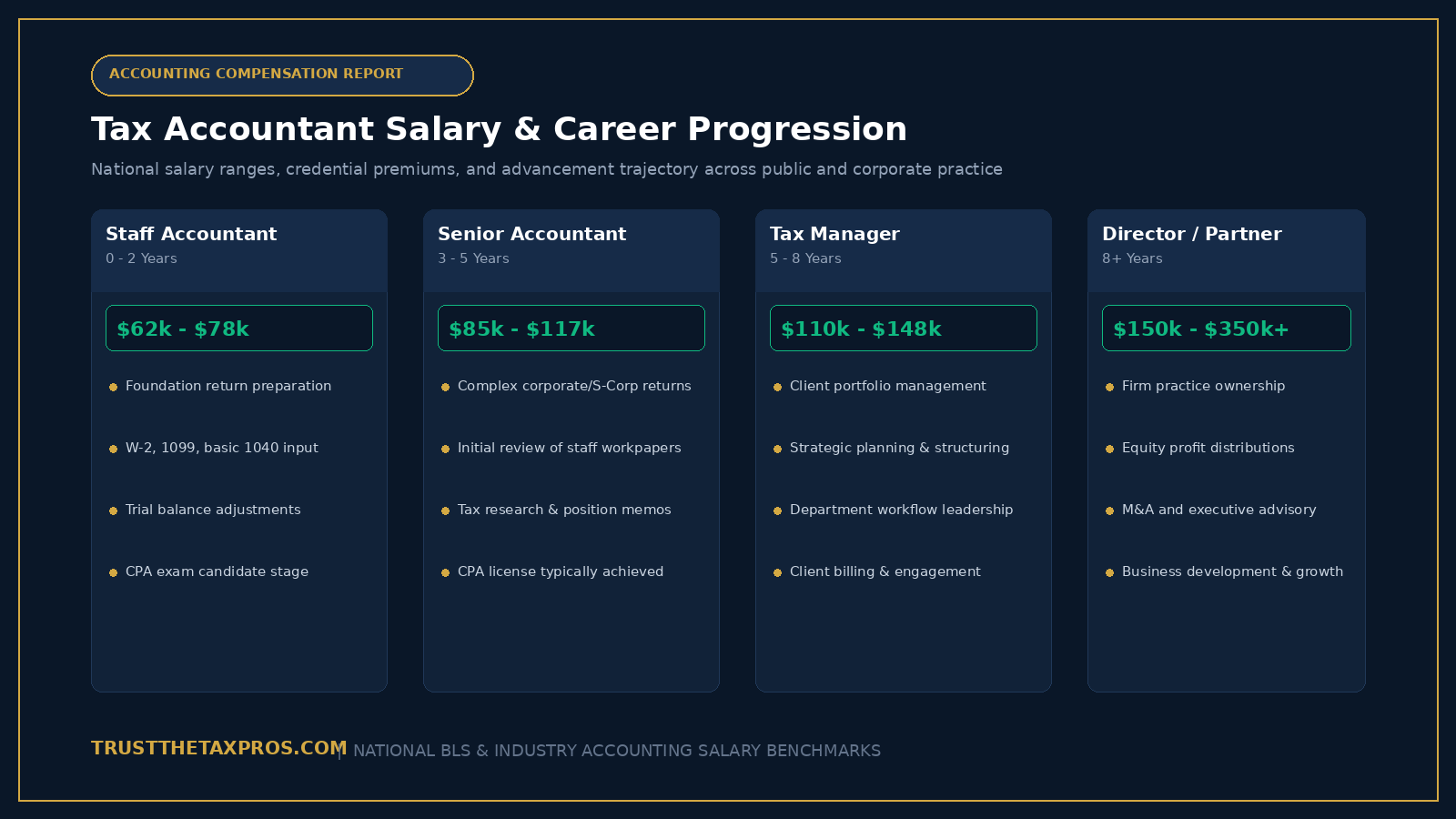
Drawing on national industry studies and compensation guides, the tax accounting career ladder features clear compensation bands:
1. Entry-Level Tax Associate (0 to 2 Years)
National Salary Range: $62,000 to $78,000 (Average: $68,000)
Entry-level tax staff focus on the mechanical foundations of compliance. Responsibilities include keying in W-2s, 1099s, and basic Form 1040 schedules, assembling electronic workpaper files, and reconciling preliminary trial balances. In major metropolitan markets, competitive entry packages frequently exceed $75,000, often paired with $5,000 CPA exam passing bonuses.
2. Senior Tax Associate (3 to 5 Years)
National Salary Range: $85,000 to $117,000 (Average: $96,000)
Senior associates represent the operational engine of accounting firms. At this stage, professionals prepare complex multi-state corporate (Form 1120-S) and partnership (Form 1065) returns, write tax research memos, and conduct first-round reviews of junior staff workpapers. Earning a CPA license is typically mandatory for promotion past this tier.
3. Tax Manager (5 to 8 Years)
National Salary Range: $110,000 to $148,000 (Average: $128,000)
Managers transition from direct preparation to client relationship management, staff supervision, and high-level tax advisory. Managers oversee tax season workflow queues, conduct client intake reviews, and design strategic tax plans. Annual performance bonuses at this level range from 10% to 20% of base salary.
4. Senior Tax Manager / Director (8+ Years)
National Salary Range: $139,500 to $213,250+ (Average: $165,000)
Directors in public firms and corporate tax directors in private industry manage large departments, oversee global tax provisioning (ASC 740), and lead IRS dispute negotiations. In corporate environments, directors often receive substantial stock grants, bringing total realized compensation well above $225,000.
5. Public Firm Equity Partner (10+ Years)
National Compensation Range: $250,000 to $650,000+
Equity partners in independent CPA practices and national accounting firms share directly in net practice profits. While salary draws vary, top-performing equity partners at regional and national practices routinely earn $350,000 to $700,000+ through annual equity distributions and billing realization.
For independent practitioners considering building their own firm, examine our strategic analysis on how to launch and grow a profitable tax practice.
Public Accounting vs. Corporate In-House: Compensation Comparison
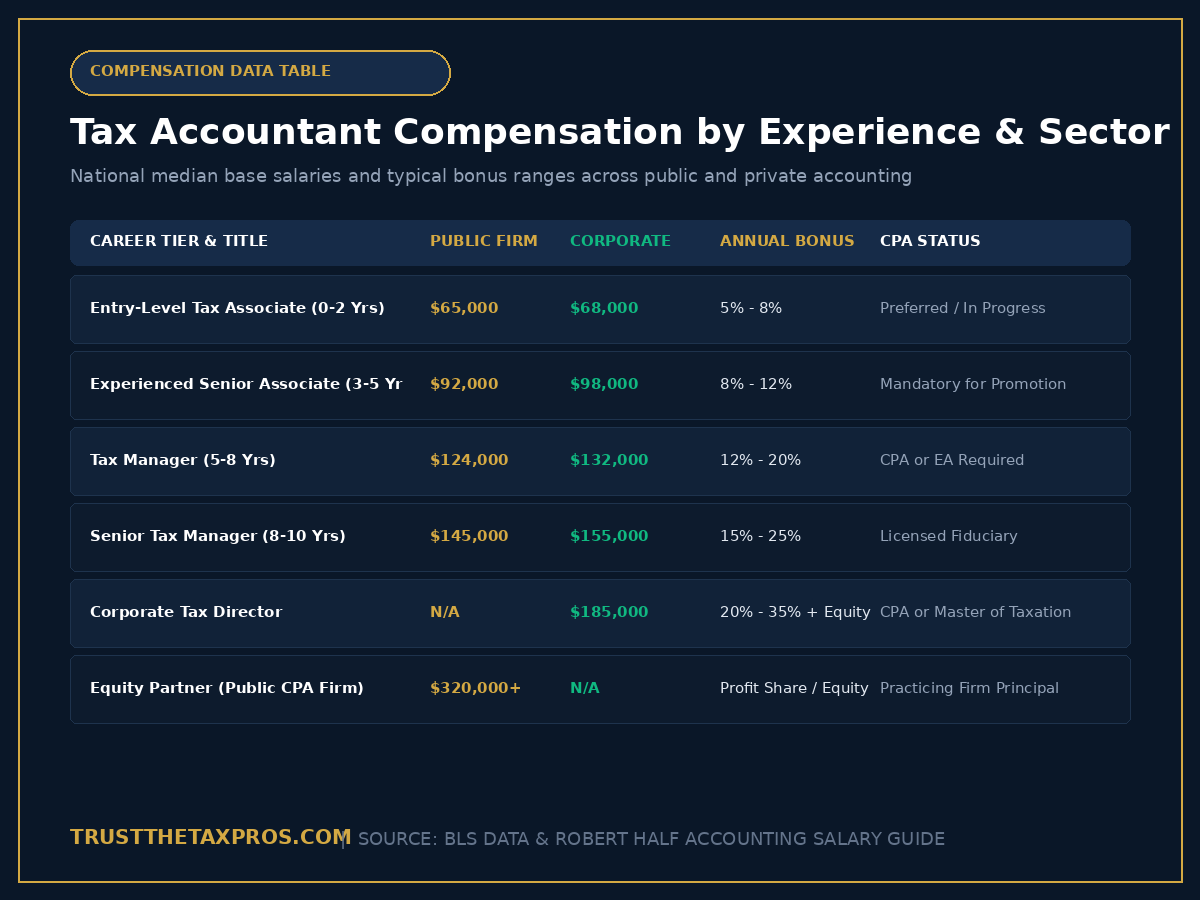
One of the most consequential decisions in a tax professional’s career is choosing between public accounting firms and in-house corporate tax departments. Each path offers distinct trade-offs in compensation structure, work hours, and advancement pace.
| Career Attribute | Public Accounting (Big 4 & Regional) | Corporate Tax Department |
|---|---|---|
| Entry Starting Salary | $65,000 to $75,000 | $68,000 to $80,000 (Slightly Higher) |
| Promotion Velocity | Structured promotions every 2 to 3 years | Slower; depends on departmental turnover |
| Tax Season Work Hours | 55 to 75 hours per week (Jan – April) | 40 to 50 hours per week (Predictable) |
| Incentive Compensation | Performance bonuses + Partner equity | Cash bonuses + Stock grants (RSUs) |
| Long-Term Earning Ceiling | Virtually uncapped for equity partners | Capped at VP / Tax Director tiers ($250k – $350k) |
Many ambitious professionals spend their first three to five years in public accounting to secure rigorous training, pass the CPA exam, and build resume prestige before transitioning into corporate tax roles for a 15% to 25% pay bump and predictable 40-hour workweeks.
To see how firm billing structures translate into professional salaries, explore our detailed breakdown on average tax preparation fees and accountant pricing models.
The Credential Premium: How Much Does a CPA License Add?
According to the National Association of State Boards of Accountancy (NASBA), completing the 150-semester-hour education requirement and passing the Uniform CPA Examination is the single most valuable investment an accountant can make.
The Measurable Value of Professional Credentials
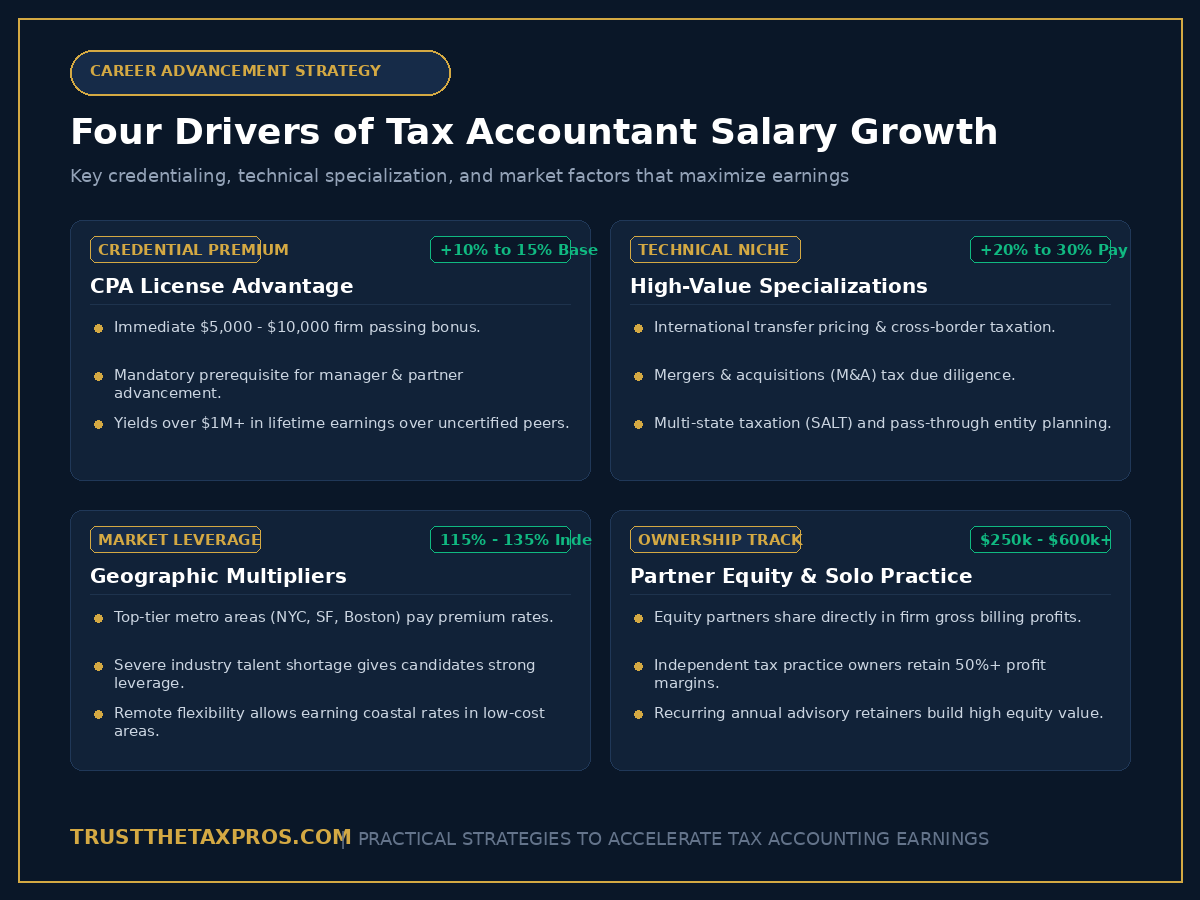
- 10% to 15% Base Salary Premium: Credentialed CPAs earn an immediate base salary premium over uncertified colleagues in identical job titles.
- $1 Million+ Lifetime Earning Gap: Over a thirty-year career, the compounding effect of faster promotions, higher bonuses, and executive eligibility produces over seven figures in extra earnings.
- Promotion Gatekeeper: Most accounting practices enforce a strict policy: you cannot advance to Tax Manager or Partner without an active state CPA license.
- Enrolled Agent (EA) Parity in Representation: For professionals specializing purely in tax dispute resolution, meeting IRS Enrolled Agent credential standards provides full representation rights before the IRS, commanding salaries of $75,000 to $125,000+ without requiring 150 college credit hours.
For an in-depth review of licensing distinctions and practice rights, read our guide on CPA credentials versus general tax preparers.
The Four Highest-Paying Tax Specializations
General compliance for basic individual tax returns is vulnerable to automated tax software and offshore processing. In contrast, specialized consulting niches command premium hourly billing rates ($300 to $600+ per hour), translating directly into lucrative staff compensation:
1. International Tax & Cross-Border Structuring
Multinational corporations and high-net-worth global citizens face complex reporting rules under FATCA, GILTI, and foreign tax credits. Tax accountants specializing in international transfer pricing and cross-border structuring earn 20% to 30% above generalists, with experienced managers routinely earning $145,000 to $180,000.
2. Mergers & Acquisitions (M&A) Tax Due Diligence
Private equity firms and corporate acquirers rely on M&A tax accountants to uncover historical tax exposures, model Section 338(h)(10) elections, and preserve net operating losses during corporate acquisitions. Senior managers in M&A tax advisory earn between $160,000 and $220,000, accompanied by substantial deal-completion bonuses.
3. State and Local Taxation (SALT)
Following the Supreme Court’s Wayfair ruling, businesses that sell products online face economic nexus laws across all fifty states. SALT specialists help companies manage sales tax compliance, state apportionment, and voluntary disclosure agreements. SALT managers command salaries between $125,000 and $160,000.
4. High-Net-Worth Estate & Wealth Planning
Family offices and private wealth boutiques pay substantial salaries to tax accountants who specialize in generational wealth transfer, irrevocable trusts, and charitable foundation tax planning. Senior advisors in this niche average $130,000 to $175,000.
Accounting firm partners seeking to understand how specialized labor is integrated into practice models can explore our guide on tax preparation outsourcing strategies.
Geographic Salary Multipliers: Where Do Tax Accountants Earn the Most?
Geographic location remains one of the largest determiners of tax accountant pay. Major commercial hubs offer significant salary premiums to offset local housing and living costs:
- New York City / Northern New Jersey: 125% to 135% of national average ($85,000 starting; $155,000+ manager).
- San Francisco / Silicon Valley: 130% to 140% of national average ($88,000 starting; $165,000+ manager).
- Boston / Washington D.C. Metro: 115% to 125% of national average ($78,000 starting; $140,000+ manager).
- Chicago / Los Angeles / Dallas: 110% to 118% of national average ($74,000 starting; $135,000+ manager).
- Midwest / Southeast (Non-Metro): 90% to 98% of national average ($60,000 starting; $112,000+ manager).
The rise of remote work has created significant geographic arbitrage. Many skilled CPAs live in affordable secondary markets while working remotely for coastal firms, capturing near-metro compensation levels with low local expenses.
Actionable Strategies to Maximize Your Tax Accounting Salary
Given the severe accounting talent shortage, employers are eager to reward proactive professionals. Implement these four proven career moves to accelerate your earnings:
- Pass the CPA Exam Early: Complete your exam sections before your second year of practice. Firms view early CPA passage as proof of technical rigor and prioritize you for complex engagements.
- Develop Tech & Automation Proficiency: Master modern workflow tools, data analytics (Alteryx, Power BI), and cloud tax engines. Accountants who eliminate manual bottleneck processes are promoted rapidly.
- Cultivate Direct Client Communication Skills: Technical competence gets you hired, but business development and client retention get you promoted to director and partner. Learn to speak clearly with business owners without relying on tax jargon.
- Negotiate With Market Data: During annual reviews, come prepared with documented realization rates, billable hour achievements, and published compensation benchmarks from BLS and Robert Half surveys.
Frequently Asked Questions
What is the average entry-level tax accountant salary in the United States?
According to national compensation surveys and BLS data, entry-level tax accountants (0 to 2 years of experience) earn between $62,000 and $78,000 in base salary. High-cost metropolitan markets like New York, San Francisco, and Boston frequently offer starting packages between $75,000 and $85,000.
How much does earning a CPA license increase a tax accountant’s salary?
Holding a CPA credential provides an immediate 10% to 15% salary premium over uncredentialed peers, alongside passing bonuses ranging from $5,000 to $10,000 at public accounting firms. Over a full career lifetime, a CPA license generates more than $1 million in additional earnings.
What is the salary difference between public accounting and corporate tax roles?
In the early career stages (years 1 to 5), corporate tax roles generally pay 5% to 12% higher base salaries with better work-life balance. However, at senior levels, public accounting equity partners significantly out-earn corporate directors through direct profit distributions, often exceeding $300,000 to $650,000+ per year.
Do Enrolled Agents earn comparable salaries to CPAs in tax practice?
Enrolled Agents (EAs) earn competitive salaries ranging from $75,000 to $125,000+ in tax controversy, representation, and specialized compliance. While CPAs command broader leadership and audit roles, EAs hold identical unlimited representation rights before the IRS.
Which tax specializations command the highest compensation?
The highest-earning tax niches include international transfer pricing, mergers and acquisitions (M&A) tax due diligence, state and local tax (SALT) consulting for large corporations, and high-net-worth family office estate planning.
How does the current accountant shortage affect tax professional compensation?
With more than 300,000 accountants leaving the workforce over the last decade, firms face intense talent competition. This supply shortage has accelerated starting pay, expanded annual retention bonuses, and increased remote work flexibility across regional and national firms.