Launching and running a commercial venture requires wearing countless hats, from sales and operations to customer service. However, handling federal and state tax filings alone often leads to costly errors. Hiring a qualified tax accountant for small business is one of the highest-return investments an entrepreneur can make to protect profits and ensure IRS compliance.
Many business owners struggle with knowing when to transition from basic software to a dedicated CPA, what professional fees to expect, and which strategic services provide true return on investment. Exploring fee benchmarks, entity planning advantages, and vetting criteria will help you choose the right tax partner for your growing enterprise.
- Compliance vs. Strategic Planning: A standard tax preparer merely inputs past historical numbers onto tax forms. A true small business tax accountant designs proactive year-round strategies to legally minimize self-employment taxes and income liability.
- Fee Benchmarks: Small business annual corporate returns (Form 1120-S or 1065) typically average $1,200 to $2,500, while bundled monthly advisory retainers range from $250 to $800 per month.
- 100% Tax Deductible: Under IRC Section 162, all professional fees paid for commercial tax preparation, bookkeeping review, and financial consulting are fully deductible business expenses.
When Does Your Company Need a Dedicated Tax Accountant?
When starting as an unincorporated sole proprietorship or single-member LLC, managing income and expenses with off-the-shelf software feels manageable. However, as business activity accelerates, self-filing quickly turns into a major operational risk.
You should retain a dedicated tax accountant when your business hits any of these critical milestones:
- Revenue Surpasses $50,000 to $100,000: At this gross revenue level, self-employment taxes (15.3% Social Security and Medicare tax) consume a massive portion of net profit, making entity restructuring advantageous.
- Hiring W-2 Employees or Independent Contractors: Payroll introduces strict trust fund tax liabilities under Form 941, Form 940, and state unemployment insurance. Filing errors here carry personal liability for company officers.
- Transitioning Entity Structure: Moving from a Schedule C sole proprietorship to a formal partnership (Form 1065) or corporate structure (Form 1120 or 1120-S) requires multi-tier tax accounting.
- Significant Capital Asset Purchases: Purchasing commercial vehicles, heavy machinery, or office equipment requires calculating Section 179 expensing and bonus depreciation under federal guidelines.
- Multi-State Sales and Economic Nexus: Selling products online across state lines exposes your company to multi-jurisdictional sales tax and income tax apportionment rules.
If you are filing an entity return for the first time, examine our foundational walkthrough on filing business taxes for an LLC to establish clean compliance habits early.

Core Responsibilities: What a Small Business Tax Accountant Delivers
Many entrepreneurs confuse bookkeepers with tax accountants. While bookkeepers record day-to-day invoices, bank feeds, and payments, a tax accountant operates at a higher strategic and regulatory level. According to official resources in IRS Publication 334 Tax Guide for Small Business, proper business recordkeeping must link directly to statutory tax reporting requirements.
Here are the primary services delivered by an experienced business tax accountant:
1. Entity Structure Selection and S-Corp Conversions
One of the single most valuable contributions an accountant provides is optimizing your business tax classification. Many profitable LLCs overpay thousands in self-employment taxes simply because they remain default “disregarded entities.”
An accountant models your revenues and expenses to determine the exact moment an S-Corporation election makes financial sense. They file IRS Form 2553 S-Corporation Election Instructions and establish a legally defensible “reasonable salary” under IRS guidelines. Calculate your potential savings using our S-Corp tax savings calculator.
2. Quarterly Estimated Tax Calculations
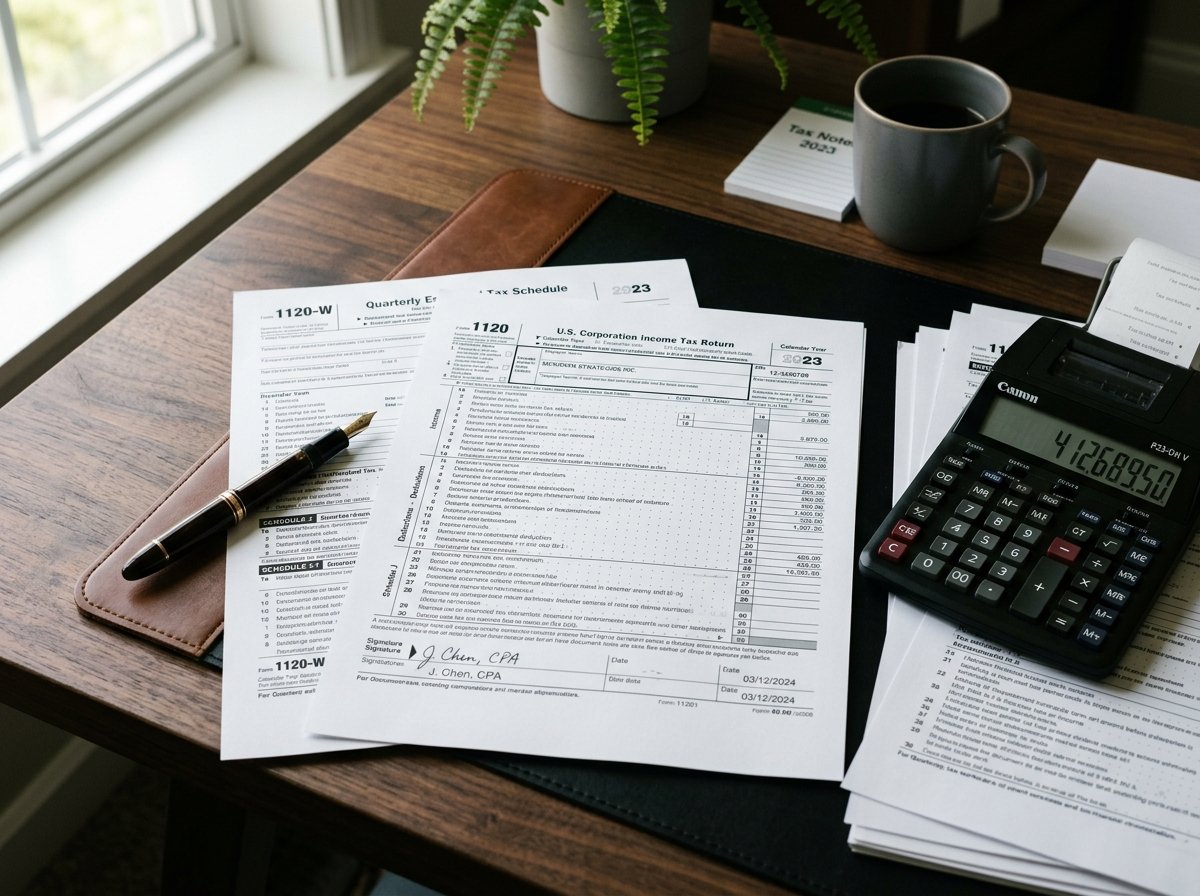
Unlike wage employees whose taxes are withheld automatically, business owners must pay income and self-employment taxes quarterly via Form 1040-ES or Form 1120-W. Failing to pay sufficient taxes by statutory deadlines triggers costly underpayment penalties under Internal Revenue Code Section 6654.
A specialized accountant recalculates your estimated obligations each quarter based on real-time year-to-date profit, preventing painful year-end tax surprises and preserving working capital.
3. Section 199A Qualified Business Income (QBI) Optimization
The Tax Cuts and Jobs Act introduced the Section 199A deduction, which allows eligible pass-through business owners to deduct up to 20 percent of their qualified business income. However, the calculation involves complex W-2 wage limitations, unadjusted basis of qualified property (UBIA), and Specified Service Trade or Business (SSTB) restrictions.
An accountant structures your profit distributions and wage payouts to ensure your business claims the maximum allowable QBI deduction without crossing statutory phase-out thresholds.
4. Deductions Maximization and Section 179 Planning
Small businesses miss thousands in write-offs simply because owners do not maintain compliant paper trails. An accountant audits your operating expenses to identify overlooked deductions, such as home office square-footage calculations, accountable reimbursement plans, vehicle mileage allocations, and commercial retirement contributions.
Under Internal Revenue Code Section 162, ordinary and necessary commercial expenses reduce net taxable earnings dollar for dollar. Review our downloadable small business tax deductions checklist for a complete category review.
How Much Does a Small Business Tax Accountant Cost?
Pricing for small business accounting varies based on entity type, transaction complexity, bookkeeping cleanliness, and whether you require year-round advisory or simple annual compliance. National accounting industry surveys provide clear market benchmarks:
| Service Model | Typical Price Range | Included Deliverables | Ideal Business Profile |
|---|---|---|---|
| Annual Entity Tax Return (Once a Year) | $1,200 – $2,500 | Form 1120-S, 1065, or Schedule C + state return and owner K-1s. | Clean books maintained by an internal bookkeeper with stable revenue. |
| Monthly Advisory & Tax Retainer | $350 – $950 / month | Quarterly tax estimates, monthly book review, annual tax filing, email advisory. | Growing companies wanting proactive cash flow guidance and zero tax surprises. |
| Hourly Strategic Tax Consulting | $200 – $450 / hour | Entity conversion analysis, M&A due diligence, IRS audit defense. | Businesses facing unique transactions or IRS examinations. |
| Full-Service Bookkeeping + Tax | $750 – $2,000 / month | Daily transaction entry, monthly reconciliations, payroll, sales tax, annual returns. | Established companies outsourcing their entire financial back-office. |
When comparing proposals, look beyond hourly rates. An accountant who charges $350 an hour but spots a $15,000 tax credit saves you significantly more than a discount preparer who charges $500 flat but misses basic industry write-offs. For detailed national pricing data, review our guide on tax preparation cost benchmarks.
- Hiring a Pure Retail Preparer: Storefront seasonal tax preparers specialize in simple W-2 family returns. They rarely understand corporate capitalization, partnership basis adjustments, or Section 179 recapture rules.
- Only Speaking Once a Year: Calling your accountant in March to prepare last year’s taxes leaves zero opportunity for tax planning. Once December 31 passes, most major tax reduction strategies are closed forever.
- Ignoring Industry Specialization: A CPA who primarily serves medical practices will not know the inventory accounting rules, sales tax nexus requirements, or merchant processing deductions needed for an e-commerce brand.
CPA vs. Enrolled Agent vs. General Accountant: Which Do You Need?
Not all financial professionals hold the same credentials or legal authority before the IRS:
- Certified Public Accountant (CPA): Licensed by state accountancy boards after rigorous testing and master-level education requirements. CPAs offer unlimited representation rights before the IRS, perform certified financial statement audits, and provide advanced corporate tax planning.
- Enrolled Agent (EA): Federally authorized tax practitioners licensed directly by the U.S. Department of the Treasury. EAs specialize exclusively in tax compliance and hold unlimited representation rights to defend clients in IRS audits and appeals nationwide.
- Uncredentialed Bookkeeper / Preparer: Individuals who hold an IRS Preparer Tax Identification Number (PTIN) but have no professional license. They cannot represent your company before the IRS during an audit.
For small business operations, hiring a licensed CPA or Enrolled Agent is essential. To understand how credential levels affect representation and audit security, read our complete CPA vs tax preparer comparison.

Key Questions to Ask Before Hiring a Tax Accountant
Before signing an engagement letter, conduct a structured interview to evaluate prospective accountants:
- “Do you specialize in my specific industry and entity type?” Ensure they understand the operational quirks, inventory rules, or service models unique to your sector.
- “Are you available for strategy check-ins throughout the year, or only during tax season?” Proactive tax planning requires mid-year and Q4 reviews before books close.
- “What accounting software platforms do you support?” Ensure their practice integrates smoothly with your cloud bookkeeping system, such as QuickBooks Online, Xero, or Gusto.
- “Will you represent my company if we receive an IRS audit notice?” Confirm whether audit defense is included in their retainer or billed under separate hourly representation agreements. For tips on audit notices, review our guide to IRS audit letter response.
- “How do you bill for ad-hoc advisory calls and tax questions?” Clarify whether quick 15-minute phone calls are covered under your agreement or billed in 6-minute increments.
For broader foundational strategies, review our complete guide on small business taxes guide to ensure you enter your accountant consultations fully prepared.
Frequently Asked Questions
How much does a tax accountant for small business cost?
Annual corporate tax preparation typically ranges from $1,200 to $2,500 for an S-Corporation (Form 1120-S) or Partnership (Form 1065). Ongoing monthly accounting and tax planning retainers generally range between $250 and $800 per month, depending on transaction volume and payroll integration.
What is the difference between a bookkeeper and a small business tax accountant?
A bookkeeper records daily operational transactions, categorizes expenses, and reconciles monthly bank accounts. A tax accountant analyzes financial statements, designs strategic tax reduction plans, ensures compliance with federal and state tax codes, and represents your company before the IRS.
When should a small business hire a CPA instead of DIY software?
You should transition to a professional tax accountant when annual gross revenue crosses $50,000 to $100,000, when hiring employees or contractors, when electing S-Corporation status, when acquiring capital equipment subject to Section 179 depreciation, or when selling across multiple states.
Are tax accountant fees tax deductible for small businesses?
Yes. Under Internal Revenue Code Section 162, professional accounting, tax preparation, and business consulting fees incurred in the ordinary course of business operations are 100 percent tax deductible as operating expenses.
Can a small business tax accountant help with payroll taxes?
Yes. Tax accountants configure payroll withholding schedules, prepare quarterly Form 941 reports, file annual Form 940 federal unemployment returns, calculate owner-operator reasonable compensation, and issue year-end Forms W-2 and 1099-NEC.
How do tax accountants save small businesses money?
Tax accountants uncover underutilized tax deductions, optimize the Section 199A Qualified Business Income deduction, structure S-Corporation distributions to minimize self-employment taxes, establish retirement plans like Solo 401(k)s or SEP-IRAs, and eliminate costly late-filing penalties.