Few events disrupt business operations more abruptly than applying for a commercial line of credit, selling an enterprise, or renewing a vendor contract, only to be informed that your company has lost its good standing. When corporate officers verify their records, they often encounter a troubling discovery: an adverse franchise tax account status. Whether your business status is listed as “Forfeited,” “Suspended,” or “Not in Good Standing,” understanding what this designation means is critical for protecting your enterprise.
State franchise tax compliance is not merely an accounting formality; it is the statutory foundation that grants your limited liability company (LLC) or corporation the legal privilege to conduct business. Allowing your account status to lapse exposes officers to personal liability, invalidates contract protections, and freezes commercial banking privileges. This guide explains how to check your franchise tax account status across major business states, the legal consequences of administrative forfeiture, and the exact step-by-step process to reinstate your company to full good standing.
What Is Franchise Tax Account Status?
A franchise tax is a privilege tax imposed by state governments for the right to establish, operate, or maintain an entity within that jurisdiction. Unlike federal income taxes (which are calculated purely on taxable profits), state franchise taxes and annual reporting requirements apply to registered entities regardless of whether they generated significant revenue.
Your official status reflects whether your business is fully compliant with state tax laws and informational filings. The three most active incorporation and business jurisdictions in the country (Texas, California, and Delaware) enforce strict compliance standards through public databases:
1. Texas Comptroller of Public Accounts
In Texas, the Comptroller manages franchise tax compliance under Chapter 171 of the Texas Tax Code. Using the official Texas Comptroller Franchise Tax Account Status Portal, anyone can check an entity’s standing using an 11-digit Texas Taxpayer Number, Secretary of State filing number, or Federal EIN.
2. California Franchise Tax Board (FTB) & Secretary of State
In California, business entity standing is monitored jointly by the Franchise Tax Board and the Secretary of State. Under California FTB Business Entity Status Guidelines, an entity must file annual tax returns, pay the mandatory $800 minimum franchise tax, and file biennial Statements of Information to remain active.
3. Delaware Division of Corporations
As the primary corporate capital of America, Delaware requires domestic and foreign entities to maintain current franchise tax accounts under the Delaware Division of Corporations Good Standing Rules. LLCs pay a flat annual fee, while corporations pay taxes based on authorized share counts or assumed par value.
If you are registering an entity for the first time this year, examine our walkthrough on filing business taxes for an LLC for the first time to establish clean compliance habits from day one.
Key Status Classifications and What They Mean
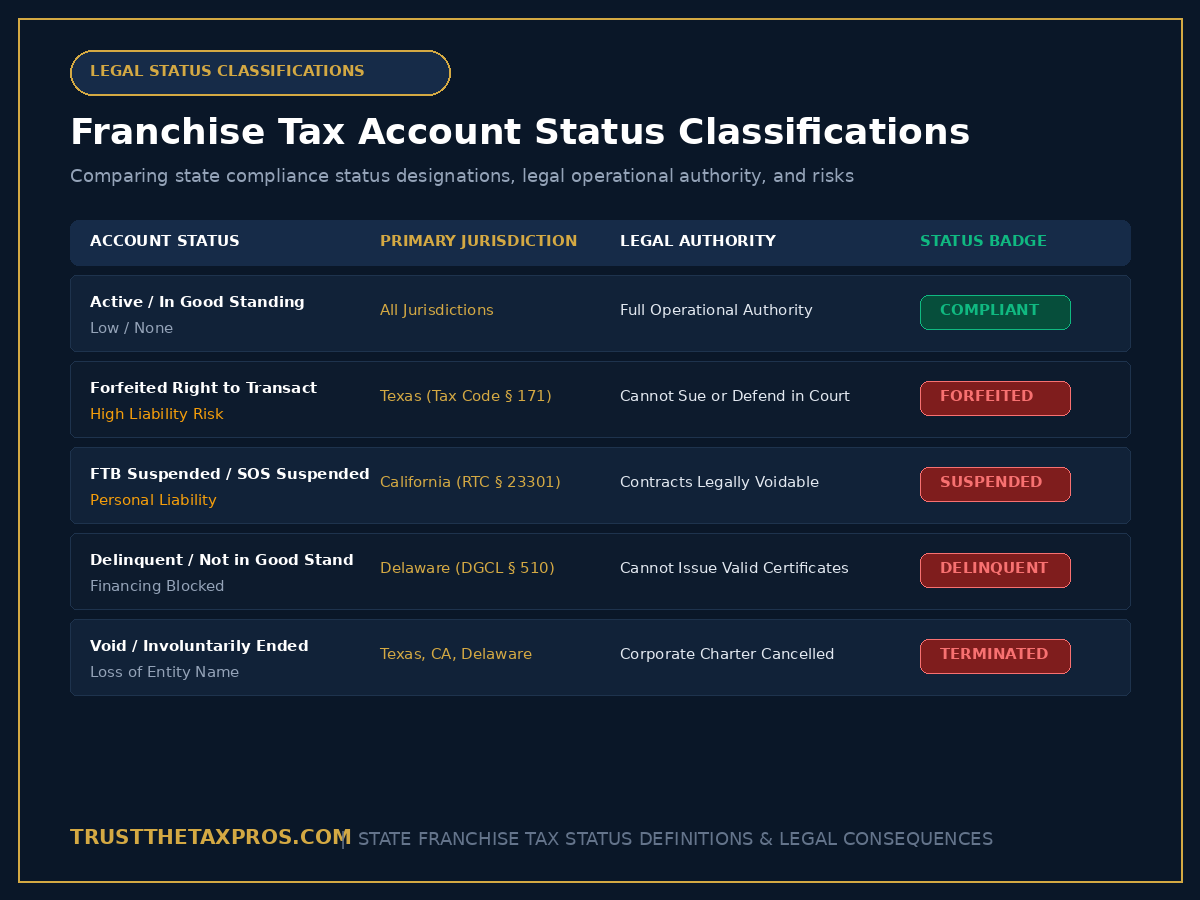
State search registries use specific terminology to describe an entity’s operational authority. Understanding the precise meaning of each status label helps you assess your legal exposure:
| Account Status Designation | Governing Jurisdiction | Legal Operational Impact | Compliance State |
|---|---|---|---|
| Active / In Good Standing | All States | Full legal authority to operate, enter contracts, and maintain bank financing. | Fully Compliant |
| Forfeited Right to Transact Business | Texas (Tax Code § 171) | Loss of state court access; entity cannot file lawsuits or defend claims; contract risk. | Tax Delinquent |
| FTB Suspended / SOS Suspended | California (RTC § 23301) | Corporate powers suspended; signed contracts become voidable; personal liability exposure. | Administrative Suspension |
| Delinquent / Not in Good Standing | Delaware (DGCL § 510) | State will not issue certificates of good standing; lender financings blocked. | Annual Fee Past Due |
| Forfeited Existence / Void / Dissolved | Texas, CA, Delaware | Legal entity charter terminated by Secretary of State; name becomes available to public. | Entity Charter Revoked |
To avoid tax compliance pitfalls that trigger state suspensions, consult our plain-English breakdown on small business tax compliance fundamentals.
The Severe Legal Consequences of an Adverse Status
Many business owners mistakenly assume that an adverse status is simply a bureaucratic notice that can be dealt with whenever convenient. In reality, operating under a forfeited or suspended status carries immediate, severe legal consequences:
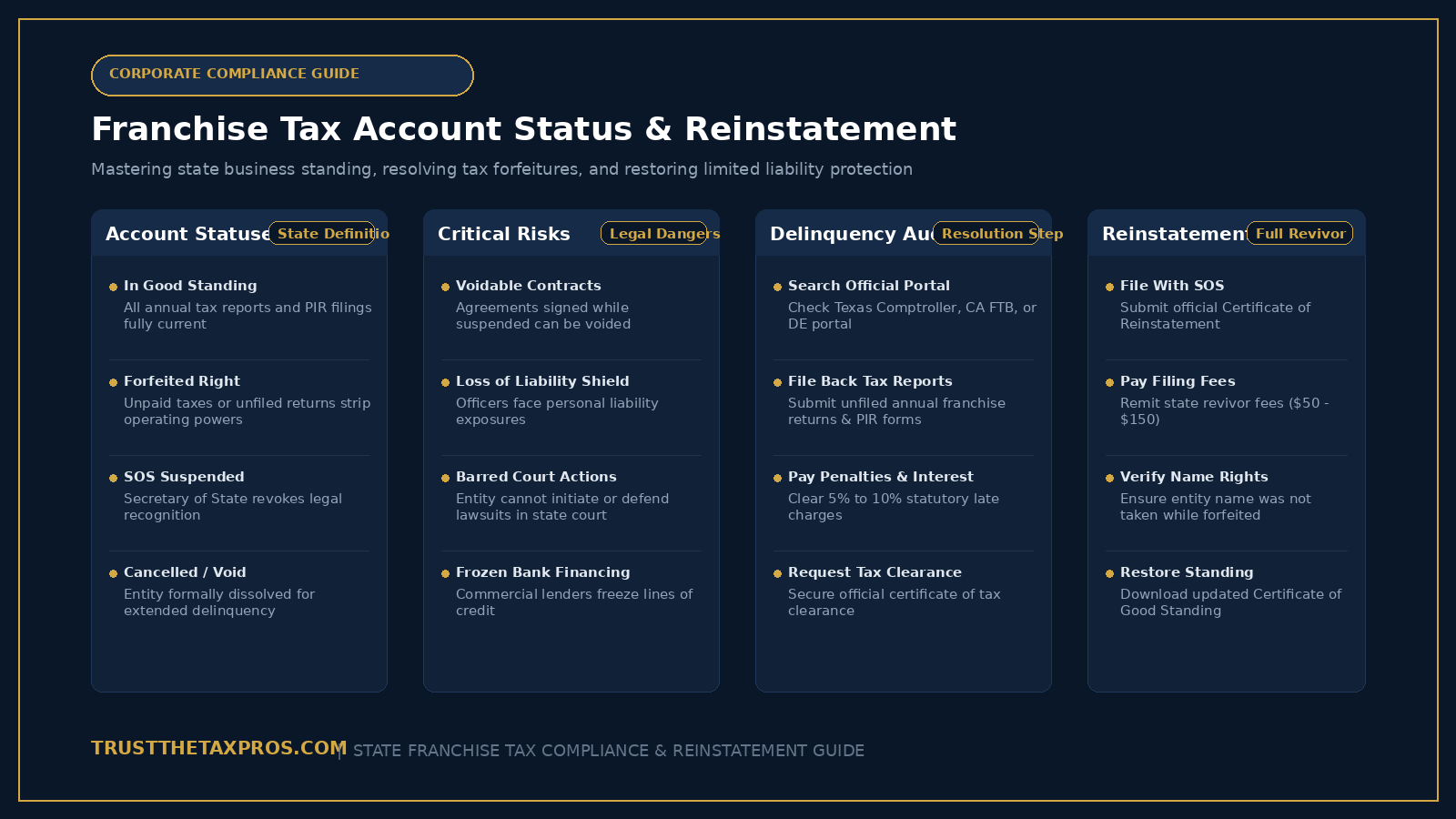
1. The Loss of Limited Liability Protection
The primary reason entrepreneurs form an LLC or corporation is to shield their personal assets from business liabilities. When an entity is suspended for failing to pay franchise taxes or file reports, state courts may treat the business as an unincorporated sole proprietorship or general partnership.
In Texas, under Section 171.255 of the Texas Tax Code, each director or officer of a corporation whose right to transact business is forfeited is personally liable for each debt created or incurred in Texas after the date the report or tax was due. If your business signs a commercial lease or incurs vendor debt while forfeited, you could be held personally responsible for the balance.
2. Inability to Sue or Defend in Court
A suspended or forfeited entity lacks the legal capacity to initiate a lawsuit or defend itself in state courts. If a customer refuses to pay an invoice or a vendor breaches a critical agreement, you cannot bring legal action to recover your funds until your entity is formally revived. Even worse, if someone sues your business while it is suspended, your legal counsel cannot enter a formal defense, often resulting in default judgments against your firm.
3. Voidable Contracts
In California, under Revenue and Taxation Code Section 23304.1, any contract entered into by an entity during a period of suspension or forfeiture is legally voidable at the option of the other party. If market conditions shift or the other party seeks to escape their obligations, they can petition the court to void the contract entirely, leaving your enterprise without legal recourse.
4. Loss of Business Name Protection
If an entity remains forfeited or suspended for an extended period, the Secretary of State will formally revoke its corporate charter. Once dissolved or voided, your company name enters the public registry and can be legally claimed by any competitor or third party. Reviving the company later may require adopting an entirely new business name.
For guidance on penalties and interest accumulation on unfiled returns, review our detailed guide on IRS and state late filing penalties and interest charges.
Step-by-Step Guide: How to Reinstate Your Business Entity
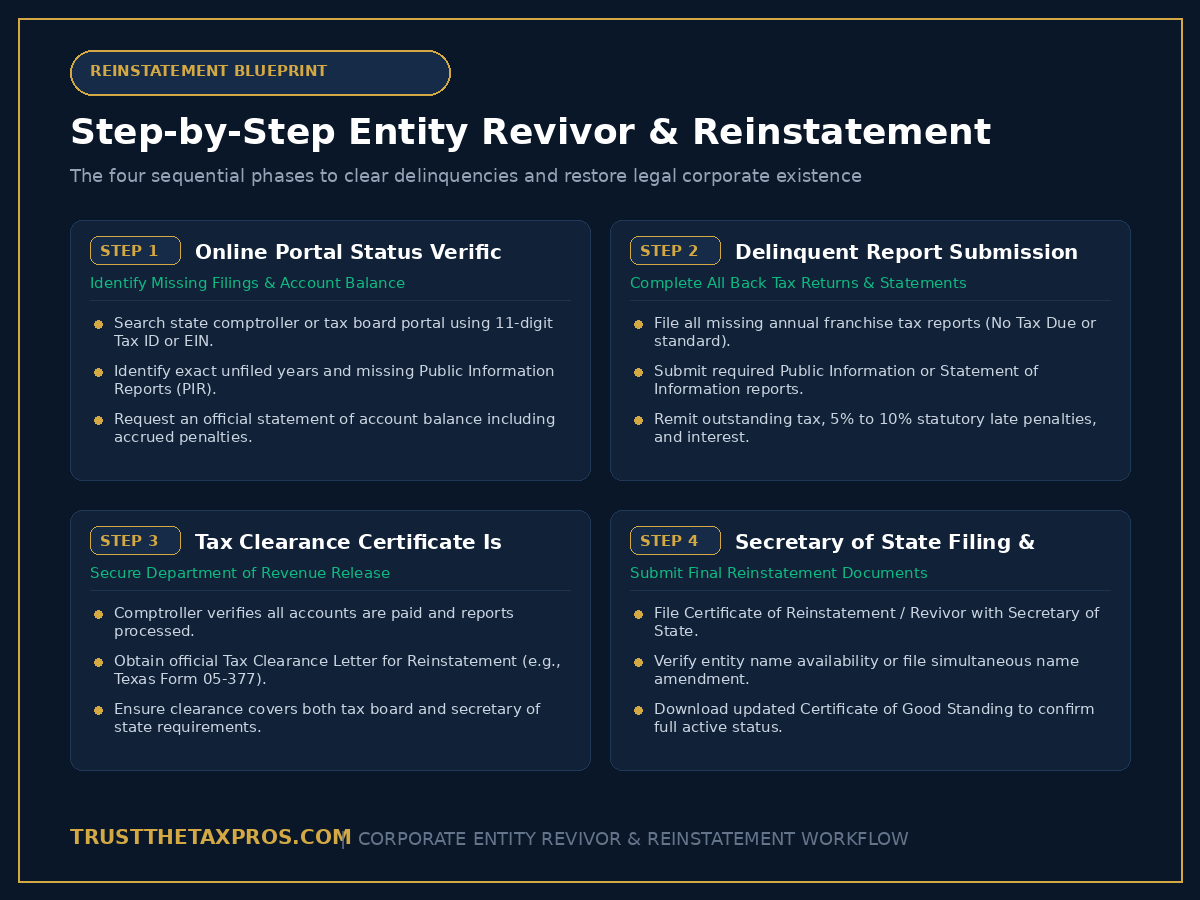
Restoring a forfeited or suspended business to active good standing requires completing a specific administrative process between your state department of revenue and the Secretary of State. Follow this four-step blueprint:
Phase 1: Conduct a Delinquency Audit
First, access your state online tax portal or contact the revenue department directly to obtain an official statement of account. You must identify:
- Every unfiled annual franchise tax return (including “No Tax Due” reports).
- Every missing informational filing (such as Texas Public Information Reports or California Statements of Information).
- The exact calculation of outstanding taxes, statutory late filing penalties (typically 5% to 10%), and accrued daily interest.
Phase 2: Prepare and Submit Delinquent Returns
Complete all delinquent tax reports for every missing tax year. In Texas, if your annualized total revenue falls below the statutory threshold (e.g., $2.47 million for recent years), you may only need to file Form 05-163 (No Tax Due Report) alongside Form 05-102 (Public Information Report). Even if zero tax is owed, the failure to submit the informational report is the most common reason Texas businesses forfeit their charters.
Submit all completed returns through the state online portal (such as Texas WebFile or California MyFTB) and remit full payment for back taxes, statutory penalties, and collection fees.
Phase 3: Secure a Tax Clearance Letter
Once the revenue department processes your back returns and confirms payment has cleared, you must request an official certificate of tax status (commonly referred to as a Tax Clearance Letter for Reinstatement). In Texas, this document is Form 05-377. This clearance certificate proves to the Secretary of State that the entity is fully compliant with state tax laws.
Phase 4: File for Reinstatement with the Secretary of State
Armed with your Tax Clearance Letter, submit a formal application for reinstatement or revivor with the Secretary of State:
- Texas: Submit Form 801 (Certificate of Reinstatement) along with the Comptroller’s Tax Clearance Letter and the statutory filing fee (typically $75 for corporations and LLCs).
- California: Submit FTB Form 3557 (Application for Certificate of Revivor) to the Franchise Tax Board, followed by filing any delinquent Statements of Information with the Secretary of State.
- Delaware: File a Certificate of Renewal and Revival of Charter with the Division of Corporations and pay accumulated annual franchise fees and late penalties.
Once approved, download a fresh Certificate of Good Standing to provide to your commercial lenders, vendors, and banking institutions.
Common Mistakes That Cause Unintentional Forfeiture
Over 80% of administrative forfeitures occur not because a company tried to evade taxes, but due to administrative oversights:
Four Compliance Traps Small Business Owners Overlook
- Assuming ‘Zero Revenue’ Means ‘Zero Filing’: Most states require annual franchise or informational returns even if your business generated zero dollars in gross receipts. Failing to file a “No Tax Due” return triggers automatic forfeiture.
- Ignoring the Public Information Report (PIR): In Texas, filing the tax numbers without the accompanying Public Information Report (which lists officers and directors) results in administrative forfeiture.
- Outdated Registered Agent Address: If you change office locations without updating your registered agent details with the Secretary of State, annual tax notices and delinquency warnings are returned as undeliverable, leading to surprise forfeitures.
- Missing the California $800 Annual Minimum Tax: Every LLC registered in California must pay an $800 annual franchise tax, due on the 15th day of the 4th month of the tax year, regardless of activity or profitability.
When to Work With a Licensed CPA for Reinstatement
While straightforward forfeitures involving a single missing report can sometimes be handled directly, multi-year delinquencies present substantial accounting and legal challenges. You should retain a licensed tax accountant when:
- Your entity has been forfeited for more than two years, requiring reconstructed bookkeeping and multiple prior-year tax returns.
- You need to negotiate penalty abatements or verify whether an S Corporation election was compromised during the suspension period.
- You face complex multi-state apportionment issues or potential personal liability assessments from state auditors.
To evaluate professional qualifications and representation standards, read our detailed comparison on choosing between a CPA and a general tax preparer.
Frequently Asked Questions
What does it mean if my franchise tax account status is forfeited?
A forfeited status indicates that your business entity failed to file required annual franchise tax returns, missed informational reports (such as a Public Information Report), or has outstanding state tax liabilities. Forfeiture strips your legal right to transact business, enter into enforceable contracts, or defend claims in state court.
How can I check my business franchise tax account status online?
You can verify your status through your state department of revenue portal. In Texas, use the Comptroller Franchise Tax Account Status search with your 11-digit taxpayer number or EIN. In California, check the Secretary of State bizfile portal, and in Delaware, verify through the Division of Corporations portal.
Can a business owner be held personally liable while an LLC is forfeited or suspended?
Yes. When an entity is forfeited or suspended, the corporate veil of limited liability protection can be pierced. In states like Texas (Tax Code Section 171.255) and California, officers, directors, and managing members can be held personally liable for debts and contractual obligations created during the suspension period.
Are commercial contracts valid if signed while an entity is suspended?
In states like California (Revenue and Taxation Code Section 23304.1), contracts executed while an entity is suspended are legally voidable at the sole discretion of the other contracting party. The suspended entity cannot enforce the contract in court.
How long does it take to reinstate a forfeited LLC?
Reinstatement typically takes two to four weeks. Processing requires submitting all delinquent annual reports, remitting back taxes, penalties, and interest, securing a formal Tax Clearance Letter, and filing a Certificate of Reinstatement with the Secretary of State. Expedited processing can shorten this to several business days.
What is a Certificate of Good Standing?
A Certificate of Good Standing (also known as a Certificate of Account Status or Certificate of Fact) is an official document issued by the state confirming that an entity is legally registered, authorized to do business, and current on all state franchise tax obligations.